Thursday, September 9, 2010

A Waste Of Air

Yesterday on NPRs Fresh Air, Terry Gross spoke to . . . a man. And the man was Michael Potter and the topic was bed bugs.

It was a total waste of time.

At my work, we're very concerned about the increase in bed bugs (Potter said it would be in urban areas and then spread out -- using the past as a predictor). But Terry offered us nothing.

Can you afford to give your house a heat treatment? Nope. Well youre out of luck because all Terry cares about is her frou-frou ass.

She has no idea, it was so obvious, that there are people who do not live like she does.

The important questions were never asked and Terry found the whole thing funny.


This is C.I.'s "Iraq snapshot:"

Thursday, September 9, 2010. Chaos and violence continue, the political stalemate continues, Nouri expresses concern . . . for inanimate objects, and more.

File it under "Now that the last crazy has spoken . . ." Caroline Alexander (Bloomberg News) reports that Iraq's should-be-former-prime-minister-because-his-term-expired-months-ago Nouri al-Maliki wants "the U.S. government to intervene to prevent the burning" of the Koran by a church in Florida. He wants the US government to intervene? As noted at length yesterday, political speech is protected speech, protected by the US Constitution. So crazy Nouri doesn't know what the hell he's talking about -- as usual. But grasp that the US puppet refused international calls to do a DAMN THING about the targeting of Iraq's LGBT community. Or about Iraq's Jewish community (which supposedly has 8 members currently). Or about Iraq's Christian community. Or about Iraqi women. Human life doesn't matter to Nouri but printed reproductions (that would be books) require a government ignoring its own laws and killing political speech? The puppet is insane. (At The New Republic, Isaac Chotiner tries to bring some reality to the topic.) Let's grab some more laughs before we address the serious topics of the day. If you do press criticism, it might be a good idea to have your facts right. Alex Pareene has always been trash as he demonstrated with his 2006 attack on Cindy Sheehan. Wait, we have to back this up. Columbia Journalism Review allegedly knows something about press criticism. Allegedly. Liz Cox Barrett, what the hell happened? It's so fashionable to kick Maureen Dowd around that facts no longer matter? Is that it? Liz recommends Alex "see Alex Pareene's solid critique of Dowd's column at Salon." Really? Here's Alex's opening (Salon): "Award-winning New York Times Op-Ed columnist Maureen Dowd wrote a political column about Barack Obama's speech last night! Of course the column had to be finished in time for this morning's paper, so it was obviously written in 10 minutes or so yesterday afternoon, before the speech was actually delivered." Really? Maureen Dowd did a column on Barack's speech? Maureen wrote a column on the remodeled Oval Office. "Not-So-Magic Carpet Ride" is not a column on Barack's speech. As sad as it is that Alex Pareene couldn't tell that, it's even sadder that Liz Cox Barrett and CJR couldn't tell the difference and actually hailed his little slam. Alex is really good, by the way, at slamming women. It's what he lives to do online and people should keep that in mind before promoting his sexism. If Maureen Dowd is as bad as Liz and CJR seem to think, why do they have to lie about what she actually wrote in order to prove her wrong? We won't attempt to explain deadlines to Alex (or Liz), the ship has obviously sailed on that for both of them. And, Liz and CJR, if you're so concerned about who's writing about Barack's Ira War speech, why haven't you highlighted any of the writing? For example, at IPS, Phyllis Bennis explores the realities of Iraq in "What We Didn't Hear from Obama on Iraq" (and link is to her text article but there are also two videos of Bennis analyzing -- on Fox News and the Real News Network -- the situation in Iraq):

But what he left out was more significant. Just on the cost of war, while acknowledging the overall cost, and speaking separately about job loss and the economic crisis in the U.S., he didn't make the crucial link between the two. He didn't say, for instance, that the cost of keeping 50,000 troops in Iraq another year and a half, more than $12 billion, could instead pay for 240,000 new green union jobs back home -- and still have funds left over to begin paying for real reconstruction and reparations in Iraq.
What else didn't we hear? We didn't hear that the 50,000 troops in Iraq now ARE still combat troops -- even if the Pentagon has "re-missioned" them for training and assistance. We heard about the 4th Stryker Brigade leaving Iraq, but not about the 3,000 new combat troops from Fort Hood in Texas, from the Third Armored Cavalry -- combat troops -- who just deployed TO Iraq 10 days ago.

CJR wants to ridicule Maureen Dowd for her "Iraq speech" column which she didn't write. And guess what? The Kicker, CJR's blog? It never covered the speech either. The hypocrites of CJR -- what would the wacky web be without them?

Today's big story? Liz Sly (Los Angeles Times) reports what "a close ally to Prime Minister Nouri Maliki" is saying -- Minster of Defense Abdul Qader Obeidi has stated that Iraq will require a US military presence (in "some form") "at least until 2016 to provide training, support and maintenance for the vast quantity of military equipment and weaponry that Iraq is buying from America" and that they will require assistance on "intelligence gather" after 2011 as well as help with their air force "at least until 2020." Already some try to pooh-pah the statements and insist they are in keeping with the SOFA -- no, they are not. Meanwhile Robert Dreyfuss (The Nation via NPR) questions US Vice President Joe Biden's "top aide for national security" Tony Blinken:

Since Iraq might, indeed, fall apart, I asked Blinken, are there any conceivable circumstances in which President Obama might renege on the plan to withdraw the remaining 49,000 US troops from Iraq by the end of 2011? What if Iraq falls back into violence and civil war? In response, Blinken called it a "hypothetical" question and he refused to comment. He added that the remaining US forces in Iraq -- two of whom were killed yesterday by a rogue Kurdish soldier -- are "fully prepared to deal with any contingencies that develop." Though both President Obama's own commitment and the terms of the US-Iraq treaty negotiated in 2008 by President Bush call for the removal of all US forces by the end of 2011, Blinken would not say definitively that the troops would leave no matter what. I don't know what Blinken's definition of hypothetical is, but it isn't hypothetical to say that there are no circumstances that could lead Obama to halt the withdrawal or, even worse, to reverse it and add more troops.

Yesterday Iraq's political stalemate hit the six month mark. March 7th, Iraq concluded Parliamentary elections. The Guardian's editorial board notes, "These elections were hailed prematurely by Mr Obama as a success, but everything that has happened since has surely doused that optimism in a cold shower of reality." 163 seats are needed to form the executive government (prime minister and council of ministers). When no single slate wins 163 seats (or possibly higher -- 163 is the number today but the Parliament added seats this election and, in four more years, they may add more which could increase the number of seats needed to form the executive government), power-sharing coalitions must be formed with other slates, parties and/or individual candidates. (Eight Parliament seats were awarded, for example, to minority candidates who represent various religious minorities in Iraq.) Ayad Allawi is the head of Iraqiya which won 91 seats in the Parliament making it the biggest seat holder. Second place went to State Of Law which Nouri al-Maliki, the current prime minister, heads. They won 89 seats. Nouri made a big show of lodging complaints and issuing allegations to distract and delay the certification of the initial results while he formed a power-sharing coalition with third place winner Iraqi National Alliance -- this coalition still does not give them 163 seats. They are claiming they have the right to form the government. In 2005, Iraq took four months and seven days to pick a prime minister. It's six months and one day and where's the government?

Alsumaria TV reports today, "Al Iraqiys List member Aliya Nassif warned of democracy collapse in Iraq if the Constitution and election results are not respected." Hayder Najm (niqash) writes of the latest rumors:

Reports of 'violent verbal arguments' between the Iraqiya bloc leader, Iyad Allawi, and Saleh al-Mutlaq, who heads the National Dialogue Front, have caused many in the Iraqi media to question the bloc's ability to maintain its unity and continuity.
Mutlaq's party is one of the key members of the Iraqiya bloc, holding 22 of the 91 parliamentary seats they won in the March elections. Mutlaq has recently become a target for Nouri al-Maliki, who is seeking to detach him and his party from Iraqiya by offering him a prominent position in a new government headed by the State of Law coalition.


When nothing takes place, when there's no movement or progress on an issue, rumors abound. Qassim Al-kaabi (Asharq Al-Awsat) notes, "Sources inside Al-Iraqiya List, which is led by former Prime Minister Iyad Allawi, have asserted that the media leaks claiming that US Vice President Joe Biden succeeded in persuading Arab and non-Arab countries to stop backing Al-Iraqiya are untrue and baseless and they also called baseless the reports attributed to a leading figure in the State of Law Coalition [SLC], which is led by outgoing Prime Minister Nuri al-Maliki, that the latter cited Biden for these remarks and that the countries responded positively apart from Saudi Arabia."

In news of violence, Reuters notes a Baquba home invasion in which the wife of a police officer was beheaded, a Muqdadiya home invasion in which Sunni Cleric Jabbar Saleh al-Jibouri, a Mosul grenade attack which injured five people and a Mosul raid on suspected insurgents in which 1 suspect and 1 police officer were killed. Dropping back to yesterday, Laith Hammoudi and Sahar Issa (McClatchy Newspapers) report a Lt Col was stabbed to death in Baquba while he was directing traffic and a Baquba home bombing which claimed the lives of 2 women.


Meanwhile Alsumaria TV reports that the former Camp Cropper (now Al Karkh Prison) has seen a prison break as "four non-convicted detainees" escaped and this "coincides with the disappearance of the prison manager Omar Khamis Al Dulaimi." Shashank Bengali (McClatchy Newspapers) explains that the prison was controlled by US forces: "The escape was the latest setback to U.S. forces as they hand over security operations to the Iraqis." Steven Lee Myers (New York Times) adds, "The prison break was the latest in a series of troubling developments here since President Obama declared the end of the American combat mission last week and celebrated the reduction of American troops to below 50,000 for the first time since the invasion in 2003. Attacks by insurgents, including one that drew Americans into a firefight on Sunday, the killing of two American soldiers by an Iraqi soldier at a base north of Baghdad and now the escape have bolstered a sense of unease here at a time when violence is spiking and the country's politics remains deadlocked."
Jake Hess is the reporter the Turkish government imprisoned. He's now been released and he speaks with his imprisonment to Margaree Little and Shaun Joseph (US Socialist Worker). From the interview we'll emphasize this section:

[Socialist Worker]: WHAT IS U.S. policy with regards to Turkey and the Kurds? Why does the U.S. seem to be hostile to Kurds in Turkey, yet allied with the Kurds in Iraq?


Jake Hess: WELL, THE U.S. doesn't really have a policy toward the Kurds as a people; they're viewed as a minority in the various countries they live in. The U.S. presumably looks at the Roma of Europe in the same way, for example. The U.S. record on Kurdish issues in disgraceful in both Iraq and Turkey. Currently, the U.S. is trying to maintain good relations with Iraqi Kurds, as the area under the control of the Kurdistan Regional Government is one of the few reasonably peaceful, stable and pro-American areas in Iraq. (As an example of how safe it is, I even hitchhiked when I was there.) For their part, Iraqi Kurds generally support the U.S. project in Iraq and want the U.S. to stay. They're afraid a U.S. withdrawal could result in the emergence of a new dictator, ethnic war spreading to the Kurdish areas and any number of other undesirable outcomes. The Iraqi Kurds are a traumatized people, and they want to prevent another disaster from occurring. It hasn't always been like this, of course. The U.S. has betrayed Iraqi Kurds several times. For example, in the 1970s, the Nixon administration encouraged Iraqi Kurds to revolt against the Baghdad government in order to help give the Shah of Iran leverage in a border dispute with Iraq. Nixon and Kissinger poured $16 million worth of secret aid into the conflict and armed the Kurds with Soviet weapons distributed by Israel. The U.S. abruptly cut off the funding after Iran and Iraq settled their dispute, leaving the Kurds vulnerable to an Iraqi crackdown that ended with thousands of deaths and some 200,000 refugees, according to the Pike Committee Report, which added that the Kurds might have reached an agreement with Baghdad, had the U.S. not encouraged them to hold out. As is well known, the U.S. went on to support Saddam Hussein's vicious repression of the Kurds in the 1980s and 1990s, leading to unbelievable slaughter and hardship, but the people who were responsible for these things during the Reagan and first Bush administrations remembered that they loved the Kurds of Iraq when it came time to invade again in 2003. Some people express their love in ways that the rest of us find difficult to understand. The U.S. supplied Turkey with the majority of the weaponry it used to depopulate Kurdish villages and commit other human rights violations in the 1990s, as the Arms Trade Resource Center and Human Rights Watch have documented in outstanding reports. Despite the fact that they have never attacked U.S. citizens of the U.S. itself, the Bush administration deemed the PKK a "common enemy" of Iraq, Turkey and the U.S. in 2007, and the U.S. has provided Turkey with actionable intelligence on PKK positions across the border. As the recently departed U.S. ambassador to Turkey, James Jeffrey, pointed out, Washington and Ankara are currently exploring ways to deepen their common war against the PKK, including through new arms sales. Jeffrey said, "We're trying to get as much as possible for Turkey as soon as possible."

There's much more of interest in the interview but we went with the section on Iraq. Of interest to the Kurds in Iraq is the disputed (and oil-rich) region of Kirkuk which both the KRG and the government or 'government' out of Baghdad claims. Long forgotten is that a census was supposed to take plaace and a referendum on the issue of Kirkuk. Allegedly the long delayed census will take place next month -- and Nouri and company insist that is the case whether or not a prime minister has been picked. Gilbert Gatehouse reported from the region on Tuesday's The World (PRI -- link has audio and text):

GATEHOUSE: And, whether the Iraqis here like it or not, that is exactly what the Americans are going to do, by the end of next year. For the moment it all seems to be working terribly well. We've got Arabs, Kurds and Turkmen patrolling these villages together and hanging out with the local kids. The question there is, what happens when the Americans take themselves out of this equation and leave the Arabs and the Kurds to keep the peace between themselves on their own. I meet Ibrahim Jibrail in the house of the village "mukhtar," or leader. Jibrail wears the traditional baggy Kurdish tunic and a turban.

SPEAKING ARABIC

GATEHOUSE: He lived through Saddam Hussein's attempt at ethnic cleansing and he says that if the American soldiers leave, that cooperation we've seen could easily falter, and the conflict between Arabs and Kurds could break out again. The rapid reduction in the number of American troops in Iraq has been accompanied by a show of almost unshakeable optimism, at least in public, on the part of the US military and the State Department. And yet, their outgoing overall military commander here, General Raymond Odierno, said recently that UN forces might be needed to keep the peace between the Arabs and the Kurds after the US fully withdraws at the end of next year. The commanding officer in charge of Kirkuk, Colonel Larry Swift, is more cautious.

LARRY SWIFT: Political problems, absolutely. We've got them right now. Plenty of them. The issue has been, and will continue to be, are Kirkuk's problems going to remain in the political realm. I think it's going to be an extraordinary challenge for those inside the provincial council in the government of Iraq and the [SOUNDS LIKE] Kurd Regional Government, and in the State Department to sort these things out. But I think everyone agrees that if it spills over to any other realm, everyone's going to lose.

GATEHOUSE: The trouble is, Kirkuk and its surrounding area sits on a sea of oil. And with so much historical baggage, without the Americans to keep the two sides apart, the fear is that the Arabs and the Kurds could decide that the only way to resolve those problems is through a return to conflict. For The World, I'm Gilbert Gatehouse, Kirkuk.


Because they always whore, the New York Times' Sarah Lyall declares Tony Blair a success despite the fact that his book isn't. She wants you to know that it's a 'hit!' because it will be number 3 on the paper's best seller list September 19th. But the paper's 'best seller' list is a bit like the Billboard chart in the pre-sound scan era and they forget to tell you that. In fact, everyone looks the other way on that and maybe it's time to take down the paper's chart once and for all? There's no real reason for their selective 'survey' to begin with in this day and time when scans as point of sale can give you an accurate accounting to begin with. Lyall finds it amusing that Tony Blair LIES in his book, grabbing a scene from a movie and passing it off as his own life. That's not amusing, that's indicative of the b.s. book he's written. P.S. She wants to insist Blair must be popular because he won three elections. Whores never worry about facts. Labour's own polling -- which I am highly familiar with, to put it mildly -- demonstrated how Tony has fallen. If she couldn't get ahold of those figures, she should have checked public polling which has repeatedly found the same unpopularity for Tony. But whores don't like facts so they ignore polls and instead find apologists who will say what they want them to say. Equally true, Israel is far from the paper's only twisted loyalties issues when it comes to their 'reporters.' What the New York Whores underplay, Samira Shackle (New Statesman) takes seriously and notes of Blair's claim to have never seen The Queen (maybe his ghost writer should be asked about viewing the film?), Shackle notes, "So what's the explanation, then? Telepathy? Insight? Bugging?" James Denselow (Huffing Post) argues:

Tony Blair's certainty of historical vindication in Iraq can only be challenged by a people's history of the war.
In interviews accompanying the release of his book Tony Blair has repeated that history will ultimately judge him on Iraq. Meanwhile on the same week that U.S. combat mission 'ended' for the second time in Iraq, U.S. Defence Secretary Robert Gates said that gauging success in the country will 'really require a historian's perspective'.
Yet there is a danger that an elite's history written by those responsible for the Iraq adventure can create its own reality.


At Antiwar.com, Justin Raimondo weighs in on the "antiwar lefties of yesteryear:"

However, it is precisely because of the long, heroic tradition of left-wing anti-imperialism that I tend to get a bit bitchy when it comes to the contemporary record, which hardly measures up. When I hear that United For Peace and Justice, the major antiwar coalition controlled by Communist party types, has basically dissolved itself – at a time when the US is fighting two and a half wars, with a third in the making – I tend to suspect they're just not that into it, as the saying goes. Perhaps this has something to do with the fact that their hero, President Obama, is the one fighting the wars now, and without George W. Bush to demonize anymore, the fight has gone out of them.
Be that as it may, the American radical movement has been in the front lines of the antiwar movement in this country ever since World War I, when radical and socialist newspapers were closed down by the tyrant Wilson, and Eugene Debs was jailed for speaking out against the slaughter. Back then, the Socialist party took the lead, staging antiwar demonstrations and denouncing the conflict as a capitalist scheme to divide up the world amongst the imperial powers. The war, they explained, was just an inter-imperialist feud over how to divide up the colonial spoils, and a competition for foreign markets that had turned violent. In this they were absolutely correct, but it was only after the war that the nation began to see their point.
Woodrow Wilson, whose prissy intellectualism and rhetorical devotion to "self-determination" and "democracy" won over the liberals over at The New Republic, was the first of the "humanitarian" interventionists, albeit unfortunately not the last. He dressed up his war aims in such highfalutin' phrases that one would have thought he and his armies were angels of mercy, or perhaps college professors intent on teaching the world how to live in peace: lots of liberals fell for it, and so did the American people -- but not for long.


iraq


niqash
hayder najm
asharq al-awsat
qassim al-kaabi
alsumaria tv
socialist worker
jake hess
margaret little
shaun joseph
pri
the world
gilbert gatehouse
the nation
robert dreyfuss

antiwar.com
justin raimondo

Wednesday, September 8, 2010

Brief

Yesterday on Fresh Air, Terry Gross spent all of her time with (yes, you know this is coming) a man. About a HBO documentary. It was not pretty radio.

Although it was better than today's which demonstrated both how stupid and useless Terry is. I'll blog about that tomorrow.


This is C.I.'s "Iraq snapshot:"

Wednesday, September 8, 2010. Chaos and violence continue, another journalist is killed in Iraq -- one of at least 14 people reported dead today in Iraq with at least 46 reported injured, antiquities are returned to Iraq (and some already returned are now missing), the political stalemate celebrates an anniversary, and more.

Today was a banner day for disgraces in puppet government. March 7th, Iraq concluded Parliamentary elections. The Guardian's editorial board notes, "These elections were hailed prematurely by Mr Obama as a success, but everything that has happened since has surely doused that optimism in a cold shower of reality." 163 seats are needed to form the executive government (prime minister and council of ministers). When no single slate wins 163 seats (or possibly higher -- 163 is the number today but the Parliament added seats this election and, in four more years, they may add more which could increase the number of seats needed to form the executive government), power-sharing coalitions must be formed with other slates, parties and/or individual candidates. (Eight Parliament seats were awarded, for example, to minority candidates who represent various religious minorities in Iraq.) Ayad Allawi is the head of Iraqiya which won 91 seats in the Parliament making it the biggest seat holder. Second place went to State Of Law which Nouri al-Maliki, the current prime minister, heads. They won 89 seats. Nouri made a big show of lodging complaints and issuing allegations to distract and delay the certification of the initial results while he formed a power-sharing coalition with third place winner Iraqi National Alliance -- this coalition still does not give them 163 seats. They are claiming they have the right to form the government. In 2005, Iraq took four months and seven days to pick a prime minister. It's now 5 months and 31 days. Phil Sands (National Newspaper) noted that if the stalemate continues through September 8th, it will then be a half a year since Iraqis voted. That's today, September 8th. Six months since Iraqis voted. No government.

As
Steven Hussain (UT's Shorthorn) points out, "Since the March elections, the Iraqi parliament has only met once for a total of 18 minutes. As of now, there seems no end in sight for this deadlock, and the furture of Iraq is still hanging in the balance." Duraid Al Baik (Gulf News) reports:

Many Iraqis say they have lost confidence in their country's ability to rise again. Many have left Iraq for neighbouring countries where they are awaiting the approval of western countries to accept them as refugees from what once was called "Liberated Iraq".
"Those, the majority of course, who had no option to leave the country are still struggling with power shortages and saline water and [a] lack of drainage system... the basics that they enjoyed under dictatorship," Baghdad University political science professor Dr Hassan Ali said.
"For them the fight over who is going to form the government is a sort of luxury they can not afford under the pressures of daily life."
He said that parliament, which is required by the constitution to elect the speaker of the House, the president of the country and the new prime minister to run the country for the next four years, had so far failed to perform its duty since it convened in June.

The
editorial board of the Khaleej Times calls the stalemate a "padlock on Iraq's politics" and opines, "It is thus imperative that Iraq's politicians get a grip on things and resolve this impasse at the earliest for the sake of the national interest. It may be prudent to rotate the office of the prime minister between the two or nominate a third candidate. Whatever needs to be done should be dealt with urgently lest others take the country over the brink."


Over the brink? As noted yesterday: "Alsumaria TV reports, 'Religious programs anchor on Al Iraqiya Satellite TV network and head of Al Sheala District Riyad Al Saray was killed by unknown gunmen in central Baghdad'." Today another journalist is killed. BBC News reports that al-Mosulliyah TV's Safah Abdul Hameed was assassinated "in front of his home." The Committee to Protect Journalism issued a statement today which included the following:

The Committee to Protect Journalists calls on Iraqi authorities to thoroughly investigate the murder of Safa al-Din Abdel Hamid, an Al-Mosuliya television presenter who was shot this morning in front of his Mosul home by gunmen firing from a speeding car, according to news accounts.

Abdel Hamid was the second Iraqi television anchor to be slain in as many days. Riad al-Saray, an anchor for Al-Iraqiya was gunned down in Baghdad on Tuesday.

"We extend our deep condolences to the family of Safa al-Din Abdel Hamid," said Mohamed Abdel Dayem, CPJ's Middle East and North Africa program coordinator. "That this is the second killing of a television presenter in two days sends a clear message to authorities that urgent action is needed."


On Riyad Al Saray, Reporters Without Borders explains:


Riyad Assariyeh, a 35-year-old journalist working for state-run Al Iraqiya TV, was shot dead by unidentified gunmen as he was leaving his home in Baghdad this morning. This clearly targeted murder brings to 15 the number of Al Iraqiya journalists who have been killed since Saddam Hussein's removal.
Reporters Without Borders calls for a proper investigation capable of identifying and arresting both the perpetrators and instigators of this murder and bringing them to justice. It would be deplorable it this killing were to go unpunished, which unfortunately has been the case in 99 per cent of the 230 murders of journalists and media workers since the US-led invasion in 2003.

The Committee to Protect Journalists offered the following on Riad al-Saray:

"We extend our deep condolences to the family and colleagues of Riad al-Saray," said Mohamed Abdel Dayem, CPJ's Middle East and North Africa program coordinator. "We call on the Iraqi authorities to end the culture of impunity by investigating this murder and bringing all those responsible to justice."
Al-Saray, who joined Al-Iraqiya in 2005, hosted programs that sought to reconcile Shiites and Sunnis, according to news reports and CPJ interviews. Amar Hassan, an Al-Iraqiya colleague, said that while al-Saray addressed political issues in his programs, he was not considered controversial. He said al-Saray was on his way to Karbala in southern Iraq when he was gunned down at about 6 a.m. Police said the gunmen used silencers in the attack.
Al-Iraqiya is part of the state-run Iraqi Media Network and has wide viewership across the nation. At least 14 other Iraqi Media Network staffers have been killed since the U.S.-led invasion of 2003, the highest death toll for any media organization in Iraq during that period.

Reporters Without Borders has just released [PDF format warning] "The Iraq War: A Heavy Death Toll For The Media." The report counts 230 journalists (here we classify all as journalists not "journalists" and "media workers" -- it's a war zone, we're not quibbling, the 230 were journalists) who have been killed in Iraq and finds that 12 were women but 93% of the deaths were men. 87% of those killed were Iraqis. 77 of the deaths took place in Baghdad.

In 2006, Nuri al-Maliki's government regularly threatened to shut down certain newspapers after accusing them of incitement to violence. Television networks were also pointed out as being responsible for stirring up ethnic and religious passions. They were prohibited from broadcasting segments that showed blood or murder scenes. On 5 November 2006, the Minister of the Interior decided to close down the Sunni television networks Al-Zawra and Salah-Eddin for having broadcast footage of demonstrators waving pictures of former dictator Saddam Hussein and protesting against his capital sentence. Both stations are still closed down.
In 2007, addition restrictions were imposed on the media. In May, the authorities banned journalists from filming bomb-stricken areas. In November of that year, they were also prohibited from going to the Kandil mountains on the Iraqi-Turkish border to meet with PKK rebels. Passage of the bill for the protection of journalists would make it possible to improve media professionals' working conditions. The Iraqi Parliament's delay in initiating a review of the bill -- which has been postponed since September 2009 -- appears to be one reason for the unrelenting attacks on the Iraqi press.

UPI notes that the report finds the Iraq War to be the deadliest war for journalists since WWII. Yesterday's snapshot noted Iraqis 'pranks' for television on one another (and called out US military participation in those pranks but has not and will not weigh in on what Iraqis do for TV in their own country). Kelly McEvers (All Things Considered, NPR) reports today that the segments filmed by Iraqis for TV (US soldiers were filming their 'pranks' and posting them on YouTube) and aired on Al-Baghdadiya TV's Khali en Buca is under threat from Nouri's government which states if the show is not pulled off Al-Baghdadiya, the network will be closed down. McEvers explains that the network aired a soap opera today in Khali en Buca's timeslot.

Yesterday, two US soldiers were shot dead in northern Iraq with nine more injured. Leila Fadel and Marwan Anie (Washington Post) report, "Details were murky Tuesday afternoon while the U.S. military investigated the incident. U.S. troops had escorted their commander to an afternoon meeting at an Iraqi army base in Tuz Khurmatu, 55 miles south of Kirkuk. During the meeting, a man in an Iraqi army uniform opened fire, the U.S. military said, adding that the assailant was shot dead at the scene. It was unclear Tuesday whether the young shooter, whom Iraqi security officials identified as Soran Rahman Taleh Wali, a Kurdish member of one of the Iraqi army's special forces units, had planned the attack or acted spontaneously." Some reports note that the shooter was engaged in a volleyball game with US troops. Jane Arraf (Christian Science Monitor) reports that the claim of the volleyball game made by a spokesperson for the Ministry of Defense has been withdrawn. Steven Lee Myers (New York Times) adds, "Niazi Uklo, a member of the provincial council in Salahuddin, said in a telephone interview that the soldier, a Kurd, opened fire after a dispute broke out during the meeting on the base." Arwa Damon and CNN report:

In a second attack in Salaheddin province, a U.S. soldier and a number of Iraqis were wounded when a convoy in central Tikrit was hit by grenades early Tuesday afternoon, a U.S. military spokesman said. Soldiers who were in the vehicle that was attacked killed the grenade thrower, he said.
An Iraqi Interior Ministry official and police in Tikrit said that the man threw two grenades at the convoy, damaging a vehicle, and that U.S. forces then opened fire "randomly," killing a civilian and wounding four others.

Reuters reports that today's violence included a Garma sticky bombing which claimed the life of 1 police officer and the police officer's son, a Baghdad suicide car bombing which claimed the life of the bomber and 3 other people, a Baquba home invasion in which 1 police officer was killed, a Mosul mortar attack which injured three people, a Mosul grenade attack which injured three people, two Al-Zab bombings which claimed the lives of 2 police officers and left nine more injured, a Baghdad car bombing and roadside bombing which claimed 3 lives and left at least twenty-four more people wounded, two Baghdad bombings which claimed 1 life and left five more people injured, and a Baghdda roadside bombing which injured two people.

The violence includes the destruction of Iraq's history. Writing for Museum News in 2007, Susan Breitkopf explained:

The only real comparison is to the surface of the moon. Craters as deep as 16 feet cover multi-acre sites that are remnants of what is widely considered the cradle of civilization. The craggy, arid earth, all but barren of vegetation, lies in mounds alongside the deep pits where thousands of Iraqi antiquities -- cuneiform tablets, ancient scrolls and kings commemorated in stone that might give clues to how civilization began -- have been ripped from their resting places and sold to nefarious (or unsuspecting) dealers and collectors. Some sites have been so ravaged that the top 10 feet of earth and all of the irreplaceable artifacts buried there for centuries are gone.

Amid the catastrophe of the war in Iraq -- the violence, bloodshed and loss of human life --is the loss of the world's cultural heritage in the form of hoards of antiquities. It is an ongoing, silent tragedy for which there seems to be no viable solution.


Sources say this is not the work of renegades with shovels. It is planned and executed by organized bands -- 200 to 300 per site -- with heavy machinery at many of the 12,000 sites. And the payout is big. The average Iraqi makes the equivalent of $1,000 per year, yet a cache of looted antiquities can sell for $20,000. And looters can sell two or three such caches every week.


The country was plundered and then-US Secretary of Defense Donald Rumsfeld thought it was funny to make jokes about it (in 2003, he mocked the looting as just being the same video of a vase being shown over and over). In defining "the other," it is important to rob them of any cultural history and that's what Rumsfeld with his sarcastic remarks did. On the issue of cultural history and who it belongs to, Kris Boyd interviewed Craig Childs (Finders Keepers: A Tale of Archaelogical Plunder and Obsession) on yesterday's Think (KERA) here for audio files. I haven't heard the broadcast yet -- and am noting it at the request of a friend -- but Joyce Wadler of the New York Times should make a point to listen since she's discussed but not named. Discussed? She's mocked. On the looting, David Gardner (Financial Times of London) notes, "The just announced return to Iraq of the headless statue of a Sumerian king – looted in the lawless aftermath of the US-led invasion in 2003 – seems an apposite footnote to the recent departure of US combat troops. Iraq remains lawless and headless. And combat has far from ceased." Farah Stockman (Boston Globe) reported yesterday on the efforts to find the stolen statue of King Entemena, "stolen from Iraq's national museum in 2003" and how Massachusetts College of Art and Design's John Russell worked with the US State Dept in a 2006 sting to recover the statue which is finally being transferred from the Iraq Embassy in DC to Iraq. For audio, Melissa Blockman (All Things Considered, NPR) interviewed Farah Stockman about the statue and other artifcats yesterday. Today Steven Lee Myers (New York Times) reports that "hundreds of looted antiquities" are being returned to Iraq where "632 pieces repatriated last year and turned over to the office of Prime Minister Nuri Kamal al-Maliki were now unaccounted for" and that this unknown "fate of those previously returned raised questions about the country's readiness to preserve and protect its own treasures." (I would argue this item listed as returned by SLM raises questions as well: ". . . and 362 cuneiform clay tablets smuggled out of Iraq that were seized by the American authorities in 2001 and were being stored in the World Trade Center when it was destroyed" -- how did the tablets survive?) On the issue of the now missing returned (to Nouri) artificats, Professor Larry Rothfield (The Punching Bag) hails it as, "Yet one more piece of evidence, if that were required, that the State Department dropped the ball completely by focusing its efforts on restoring the museum rather than on helping the Iraqis get their cultural policy infrastructure set up properly". Derek Fincham (Illicit Cultural Property) wonders, "Are Iraq's Antiquities in a Revolving Door?" Stephen Farrell (New York Times' At War Blog -- link has text and video) reports that the returned items include a "chrome-plated Kalashnikov Ak-47 assault rifle, with a peral hand grip and reciever, [which] was manufactured by an Iraqi weapons factory which produced personalized assault rifles for Saddam Hussein's family and friends."

From Melissa Block's interview with Farah Stockman:

Farah Stockman: He's rather short, he's about three feet tall. Dark. He's wearing a skirt. He has inscriptions on his arm and on his back. And he has no head.

Melissa Block: He's headless.

Farah Stockman: He's headless. Yes.

Melissa Block: And what happened to the head?

Farah Stockman: Archaeologists think it was actually lopped off 4,000 years ago when his city was conquered and they think it might be a symbol of the emancipation of the city of Ur which was where the statue was actually discovered.

Melissa Block: What about the real King Entemena? What do we know about his significance to Iraqi ancient civilization?

Farah Stockman: I think he's known as a powerful king. This was the cradle of civilization. This was one of the earliest known civilizations of ancient Mesopotamia, and I think the kings after him were much weaker than he was.


As the continued violence indicates, the Iraq War is not over. Appearing on the latest episode of CounterSpin (began broadcasting Friday), IPS' Phyllis Bennis spoke with FAIR's Steve Rendall about Iraq War realities: Excerpt:

Steve Rendall: As we survey news reports, we find that Obama's proclaimation that he is ended combat operations in Iraq have met with little skepticism from journalists. What's actually going to happen with US policy in Iraq?

Phyllis Bennis: The policy has not changed. It is true that the number of troops are significantly lower than they were at their heaight of 165,000. It's now down to about 50,000. That is a good thing. Reduction in troops is a good thing. But the notion that this troop reduction somehow means that all combat brigades, let alone combat troops are out of Iraq, is ust specious. The 50,000 troops that are in Iraq now are combat troops. The Pentagon has, in their own words, remissioned them -- they have given combat troops a new mission which is for training and assistance of the Iraqi military but they remain combat troops ready to re-engage in combat at any given moment. We heard from President Obama about the 4th Stryker Brigade which, as he described it, is the last combat brigade leaving Iraq. We didn't hear about the 3,000 new combat troops -- more combat troops -- from Fort Hood in Texas who were just deployed to Iraq ten days ago. We also didn't hear about the 4,500 special forces which have the job, one, of continuing its counter-terrorism opeartion -- meaning using its 'capture or kill' list to run around the country to capture or kill people. The other is to train their Iraqi counterparts, the Iraqi special operations force, which is shaping up to be something that looks suspiciously like an El Salvador death squad. This is not the end of comabt.

Steve Rendall: John Pilger reports in The New Statesman on September 2nd that US policy with regards to airstrikes and bombings will not be effected by the president's announcement. It looks like there's also -- and I think you've mentioned this -- going to be an increase in the number of contractors, military contractors in country.

Phyllis Bennis: Absolutely. The number of contractors is both disturbing in its own right and because its the beginning of a process under way of militarizing US diplomacy. There will be 7,000 new armed contractors coming into Iraq solely to work under the auspices of the State Dept, not the Pentagon, when the State Dept becomes the primary agency in Iraq. What we really didn't hear from President Obama is that the transition under way is not so much from US control to Iraqi control, as much as it is from Pentagon control to State Dept control. The agreement [SOFA] that was signed between the US and Iraq that requires -- if it doesn't get changed, which is, I think, a likely possibility -- requires all US troops and armed contractors under Pentagon control to be out of the country by the end of next year does not apply to contractors -- armed or not -- under the auspices of the State Dept. So with this giant new embassy that holds 5,000 diplomats -- it's the size of Vatican City -- there will be at least 7,000 armed contractors. The State Dept is bringing in armored cars, surveillance drones, planes and their own rapid response forces. So what we're seeing is the Pentagon leaving largely but the State Dept taking on military tasks.

Not really, Phyllis. The ones in charge are Samantha Power and other national security types from outside the State Dept. They will be working with the new US ambassador to Iraq James Jeffrey -- who was chosen because of his national security background and not his State Dept background. It's difficult to talk about this -- and I'm not slamming Phyllis for that -- because the public is being kept in the dark. If Congress wanted to, they could shine a light and demand to know who is in charge.

Who's in charge of the State Dept? The top person at the State Dept -- who then reports to Barack -- is Hillary Clinton who is Secretary of State. Where's Hillary been in the last month? Did she give an Iraq speech? No, she didn't. Did she speak to the press about Iraq? No, she hasn't. The State Dept is not leading this. A little shell games being played on the Congress and on the American people. The adminstration is attempting to continue the war and the hide the costs via the State Dept. Congress hasn't gone along so far. And did you see Hillary go down to the Hill and sell the money requested -- so far denied by Congress? No, you didn't.

What you've heard is Robert Gates, Barack, Joe Biden and assorted others make speeches for international audiences about Iraq. You haven't heard that from Hillary. She's not in charge of Iraq. And the idea that the administration wants to run this operation and wants to hide it behind the pretense that the State Dept's in charge? Sounds a lot like the dirty tricks Ronald Reagan (Barack's hero) pulled in Iran-Contra.,

It's a difficult subject to talk about because Americans are being intentionally left in the dark and deceived by the administration. Again, I'm not slamming Phyllis for her discussion, it's very difficult to discuss what's going on in the shadows. There are Democrats in the Senate who are outraged by what the administration is attempting and have stated that they will get to the bottom of it. Whether or not that is the case, there's also the fact that the mid-terms are coming up and if Republicans gain control of either house of Congress, investigations into any number of things could ensue. Considering the huge amount the administration is requesting for continued operations in Iraq, Republicans with control of one house might launch an investigation into what is really going on in Iraq and how such a plan was determined and devised without the knowledge of the American people or the consent and input of Congress.

Jonathan Tasini is running for the Democratic Party nomination against incumbent Charlie Rangel (disclosure, I know and like Charlie) and Tasini's campaign has sent a mailing which we'll note a portion of:

Enough is enough: The American people have been robbed -- by Wall Street buccaneers, greedy bankers, corporate CEOs and an elite that does not care whether the people can achieve the American Dream. They've bought our political leaders. They gambled away our jobs and retirement. They ravaged the planet. We must unite to sweep them from power so we can save our communities and our planet.

My opponent, Charles Rangel, has been in Congress for 40 years. He is part of the corrupt system. He is the #4 recipient of lobbyist money in the House. Bowing down to his corporate contributors, he has voted for half a dozen "free trade" agreements that have destroyed millions of good-paying jobs and forced wages down.

I am the only candidate in this race who has pledged not to vote for a single dime for the war in Afghanistan. Enough is enough.

I am the only candidate in this race to campaign for an INCREASE in Social Security, not cuts that even some Democrats are promoting. Enough is enough.

I am the only candidate in this race to campaign for a hike in the minimum wage to $10 an hour so the people can try to make a livable wage. Enough is Enough.

I need your help today.

We're being kind and including his fundraising link. I am not endorsing Tasini, I'm not endorsing anyone in any race that I cannot vote in. But it's really interesting that Tasini is promising not a dime to Afghanistan -- as if what? The Iraq War was over? The Iraq War is not over and currently Congress is refusing to grant the administration's request for Iraq War funds hidden behind 'the State Dept.' Would Tasini continue that refusal? It's a pertinent question.


Back to who's running things, if you're not getting the point that it's not the State Dept, Hillary gave a major speech today. Appearing before the Council on Foreign Relations today (link goes to State Dept and has text and a video option), she addressed Israel, Palestine, Russia, China, Egypt and others at length. Iraq? It was treated as an aside and received two casual mentions in the speech:

* In Iraq, where our combat mission has ended, we are transferring and transitioning to an unprecedented civilian-led partnership.


* When our troops come home, as they are from Iraq and eventually from Afghanistan, we'll still be involved in diplomatic and development efforts, trying to rid the world of nuclear dangers and turn back climate change, end poverty, quell the epidemic of HIV/AIDS, tackle hunger and disease.

During questions and answers, Hillary alluded to Iraq at one point:

Because what we know, especially from the threats that we have faced in Iraq and now in Afghanistan, is you have to be more integrated. So let's start thinking from a budget perspective about how to be more integrated.

Does it sound like Hillary's in charge of Iraq? She's not and, as we noted some time ago at Third, if she were, Barack's primary voters should be outraged since a number of them flocked to him due to the illusion that he was against the Iraq War. Long before Hillary was nominated as Secretary of State, Barack had already put Iraq under the "national security" control of Samantha Power who is currently meeting with Joe Biden's national security advisor regularly. Or are we not ever supposed to notice the man behind the curtain isn't the great and mighty Oz?


On the SOFA, Jason Ditz (Antiwar.com via World Can't Wait) notes the talk of the US military presence in Iraq being extended past 2011, "Not so, apparently, as a growing number of US officials are privately acknowledging that the US will 'almost certainly' keep a significant number of troops in Iraq past the deadline, which was negotiated in the Status of Forces Agreement. The subject hasn't so much been broached with the American public, where the official story that the war ended at some point in the past couple of weeks is still playing remarkably well, but it seems there is a growing resignation to this, at least privately." So much doesn't get broached with the American public.

In justice news, War Hawk Tony Blair has another cancellation. Saturday in Dublin, Blair had a book signing which resulted in his being pelted with shoes and eggs. As a result of that 'welcoming,' he canceled one London appearance on Monday. Now the BBC reports that he's canceled his remaining London book event. No real excuse is provided for this second cancellation; however, there are rumors that he's very upset by a Labour proposal the UK Parliament might take up which would require him and other foreign ministers to pay for their own security costs when participating in for-profit engagements. His London appearance would have reported cost the US equivalent of $250,000 to provide protection for Blair. UK's Stop The War notes:

Tony Blair's decision to cancel his party at Tate Modern gallery today, following him pulling out of a book-signing at Waterstone's, is another victory for the anti war movement and for the overwhelming majority in Britain who oppose his wars.

With Blair running scared of peaceful, democratic protests, Stop the War has cancelled the demonstration against Tate Modern being used to celebrate the publication of a war criminal's book.


The number of prominent artists who supported the Tate protest is yet another indication of how widespread is the determination that Blair will one day be held to account for his war crimes in Iraq.
The ignominy of war criminal Blair scuttling away from any contact with the general public is bound to be discussed at tonight's Stop the War public meeting in the House of Commons (see below).
Q: Who said: "You've got to put in prison those who deserve to be there"? A: Tony Blair, 6 September 2010

BBC quotes Stop The War's Lindsey German stating, "It shows he is running scared. The people who say we should not protest are denying us the right to persist in asking questions about the war and denying the rights of Iraqis who are still suffering because of Blair's policies." Kitty Donaldson (Bloomberg News) quotes Blair whining, "It's sad in a way because you should have the right to sign books or see your friends if you want to." Tell it to the Iraqi people, Tony. Instead of the bombs you ordered dropped, the house raids and so much more, don't you think they would have liked to have seen their friends or signed books? What an idiot and a criminal Tony Blair is. Carolyn Kellogg (Los Angeles Times) observes, "Antiwar protesters aren't the only ones questioning the contents of the book. On Wednesday, Peter Morgan, the screenwriter behind the movie The Queen, told the Telegraph that Blair's memoir includes a scene that he invented for the movie, complete with strikingly similar dialog. Will the attention hurt Blair's book sales? Will the protests continue? Will he ever be able to go on book tour, or will he have to content himself with other affairs of former world leaders -- encouraging youth, making statements about Africa and weighing in on the Mideast peace talks?"

This weekend there's an event in NYC which will feature many people including Media Channel's Danny Schechter and Peace Mom Cindy Sheehan. Mark Crispin Miller notes:

This weekend there will be a great symposium on 9/11, hosted by the International News Net here in Lower Manhattan. The line-up is staggering: Don Siegelman, Coleen Rowley, Ray McGovern, Hank Albarelli, Danny Schechter, Cynthia McKinney, Cindy Sheehan and many others-including, on a panel with yours truly, Peter Dale Scott and Michael Parenti.
The full schedule is accessible below, along with all the info that you'll need to get there, if you can.
MCM

How the World Changed After 9/11
Presented by the International News Net. A made for television event in lower Manhattan on September 11th and 12th, 2010
WHERE: Walker Stage – 56 Walker Street, New York, NY (1 block below Canal St., betw. Broadway & 6th Avenue – 6, R, or N train to Canal St. station)
WHEN: 12 noon on Sat. Sept. 11th through 6pm Sun. Sept. 12th
ADMISSION: $20 suggested donation per session, each session includes 2 panels, seating limited to 175
TICKETS: See Paypal links or call (206)-338-0319

NOTE: Can't come to New York? Stream all the events live including the Press Conference from NY City Hall and workshops Thursday the 9th, the rally at All Souls Church Friday night the 10th, street actions from Ground Zero Saturday morning the 11th , and the entire conference "How The World Changed after 9-11″ Saturday the 11th and Sunday the 12th. $10 for all of it. A portion of all proceeds goes to help 9/11 First Responders. You'll receive the web address and access code on Thursday the 9th.
More details: http://howtheworldchanged.org


For more on the symposium, you can listen to the Tuesday broadcast of the WBAI Evening News (click here for audio archives and you have 88 days to hear it before it vanishes from the archives) which opened with Lenny Charles discussing the event with WBAI's Jose Santiago.


iraq


the chrisitan science monitor
jane arraf
npr
all things considered
kelly mcevers


melissa block


phyllis bennis


jason ditz

Tuesday, September 7, 2010

11 men and only 1 woman

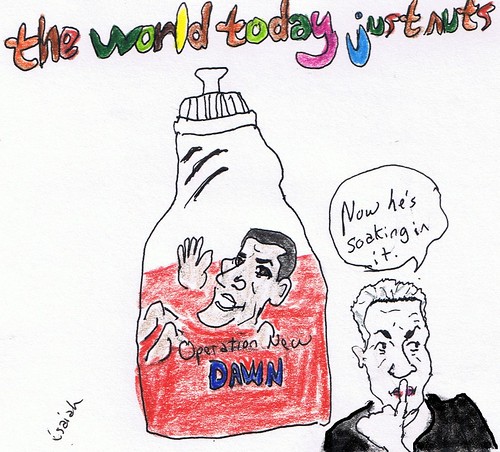
Now he's soaking in it


That's Isaiah's The World Today Just Nuts "Now He's Soaking In It" and be sure to read Kat's "Kat's Korner: Last Decade's Buried Treasure" and "Kat's Korner: The exclusion of Cher."

Barack's a War Hawk and he is soaking in the blood of the dead. Two more US soldiers died in Iraq today and that's on Barack.

Fresh Air? Friday, Terry Gross continued her salute to country music by interviewing another man and interviewing one group. So that was 11 interviews last week and she interviewed 10 men by themselves and 1 group. Monday she continued that salute and finally found a woman (Dolly Parton) worth speaking to 1 on 1 (these are all repeat interviews, she's doing repeats) and she also interviewed another man (Charlie Rich). She's now finished her salute to country music so she interviewed 1 group, she interviewed 11 men and she only interviewed 1 woman. Terry Gross hates women.

This is C.I.'s "Iraq snapshot:"

Tuesday, September 7, 2010. Chaos and violence continue, 2 US service members are shot dead in Iraq, another journalist is killed in Iraq, the "combat operations" are not over as a Sunday Baghdad attack demonstrated, the political stalemate continues, and more.
Liz Sly (Los Angeles Times) reports, "Two American soldiers were killed and nine injured Tuesday when a man wearing an Iraqi army uniform opened fire on them inside an Iraqi commando compound in the province of Salahuddin, highlighting the continued danger to U.S. troops in Iraq despite the formal end of combat operations announced by President Obamalas week." BBC News adds, "The US military says they were shot by a gunman dressed in Iraqi army uniform near the town of Tuz Khormato, 210km (130 miles) north of Baghdad." Barack declared "combat operations" over last Tuesday. Apparently not everyone got the memo . . . or else Barack was wrong. Sam Dagher (Wall St. Journal) observes: "But Tuesday's attack -- like a sophisticated assault on Iraqi facilities in central Baghdad on Sunday that American soldiers helped repel -- underscored what U.S. military commanders on the ground in Iraq have been saying for weeks: A change of mission doesn't mean the threats are over for the estimated 50,000 U.S. soldiers that remain in the country." Sunday attack in Baghdad?
Leila Fadel and Jinana Hussein (Washington Post) reported, "Just five days after the United States declared the end of its combat mission in Iraq, U.S. soldiers opened fire Sunday morning on suicide bombers who snuck into an Iraqi army base in Baghdad, a U.S. military spokesman said." Steven Lee Myers and Duraid Adnan (New York Times) observed, "Insurgents mounted a coordinated attack on one of the main military commands in Baghdad on Sunday, briefly drawing fire from American soldiers, an event that underscored the ambiguity of the American military's role in Iraq." NBC Nightly News with Brian Williams Sunday had Lester Holt anchoring and he noted, "Oversees now to Iraq and another suicide bombing. This one targeting one of the main Iraqi military commands in Baghdad. Twelve people were killed and thirty-six wounded when terrorists detonated a van filled with explosives, then stormed the base. American soldiers returned fire, helping to repel the attack." On The KPFA Evening News Sunday, David Landau explained:
In the Middle East today, American soldiers helped Iraqi troops battle insurgents in downtown Baghdad earlier today, repelling a major attack in the capital five days after President Obama had declared an end to US combat operations there. At least 18 people were killed and 39 injured when a group of suicide bombers and gunmen attempted to storm the army's east Baghdad headquarters located in a former ministry of defense building in a busy market district along the Tigris River. No Americans were among the casualties, according to a US military spokesman, but US soldiers did join in the fighting alongside Iraqis to repel the assailants, two of whom managed to enter the army compound. The US military also dispatched helicopters, bomb disposal experts, unmanned aerial drones and other unspecified intelligence, surveillance and reconassiance assistance to the scene of the downtown battle, the US military spokesman said. According to an Iraqi official, speaking anonymously, the Iraqi security forces had requested American help in the battle and US soldiers shot 2 snipers who had taken up position in nearby buildings. It was the first significant attack in Baghdad since President Obama's address to the nation on Tuesday in which he told Americans that US combat operations were over and said it was time to "turn the page" on Iraq.

John Hockenberry: It's safe to say it's a new dawn in Iraq but it's partly cloudly.

Celeste Headless: That's -- that's a pretty good weather forecast. Accurate but not pretty.

John Hockenberry: Exactly. The lack of clarity over what the "new dawn" and the end of combat operations in Iraq actually means for US forces was demonstrated over the weekend. And, you know, less than a week after combat operations ended, US forces were reportedly called in to repel a coordinated attack on an Iraqi military. No American casualties there -- or at least none killed. But in the bombing and the shooting that came after at least 12 Iraqis were killed and more than 20 were wounded. Iraqi forces were also involved in this firefight as well. Iraqi Defense Spokesperson Maj - Gen Mohammed al-Askari denied though that US troops had been involved.

Maj - Gen Mohammed al-Askari: [Translated by PRI] This is not true. We didn't call the American troops. The Iraqi troops did it, foiling the attackers. And we wouldn't use American troops in this kind of operation. I don't think only six attackers represents a threat to Iraqi national security. I'm in direct contact with the operation room and the Defense Minister and we never used the Americans in this incident.

John Hockenberry: But a US military spokesman, Lt Col Eric Bloom, said the Iraqi military had requested help from helicopters, drones and explosive experts. The details in this incident? Well we're going to go to two reporters with our partner the New York Times: Anthony Shadid, a foreign correspondent for the New York Times based in Baghdad -- we welcome him back -- he won the Pulitzer Prize for international reporting this year and in 2004 for his coverage of the Iraq War and he joins us from Baghdad and Michael Gordon, New York Times military correspondent and author of The Generals of War: The Inside Story of the Conflict in the Gulf and Cobra II. He joins us from northern Virginia. Anthony, since there's a delay on your line, let me just start with you. What are the details and the truth as we know it about this incident that took place over the weekend?

Anthony Shadid: You might be able to reconcile those two accounts, actually. I don't think the Americans were called in to the base, they were actually already in the base as part of what they consider these partnership programs. And American soldiers were there. Now what role they exactly played is still a little unclear. The way the American military portrays it, they did what they call suppressive fire. But the actual raid on where these two insurgents were holed up, that was done by Iraqi troops. Now when you look at this raid itself, the general, the Iraqi general may have been dismissive of six people posing a challenge, but we have to consider that this is one of the division commands in Baghdad and an operation of just six men managed to breach the security and actually enter the base -- only two of them managed to get inside. I think it is a blow in some ways to the perceived Iraqi security forces that the insurgents were able to pull off this attack. It lasted a few hours, it was a very loud scene, as-as you reported there were American helicopters involved along with drones. It's something that's going to be remembered here for a little while, I think.

John Hockenberry: Anthony Shadid, foreign correspondent for the New York Times reporting from Baghdad. Michael Gordon, in a situation where combat operations are said to have ended, what are we to -- How are we to characterize this incident? Is this purely defensive combat? There's going to be a lot of this over the next year or so, right?


Michael R. Gordon: Well I was just in Baghdad last week with Vice President [Joe] Biden and I've been at that particular base that was attacked. I was embedded there in '08. I think it's not the case that combat operations have truly ended. The way I put it is: The combat phase is over but the fighting goes on. When you read the fine print of what the administration is talking about, it's clear that offensive American combat operations in partnership with Iraqi forces will continue in the realm of Special Operations. It's called "partnered counter-terrorism" but what it means is Special Operation Forces will hunt for al Qaeda -- Iraqi and American. And also American conventional forces retain the right to defend themselves either with the Iraqis or without them.
Liz Sly and Riyadh Mohammed (Los Angeles Times) added, "An official with the Interior Ministry, speaking on condition of anonymity, said that the Iraqi security forces requested American help to defeat the insurgents, and that it was U.S. soldiers who shot two snipers who had taken up position in nearby buildings." As Hurriyet noted, Barack's claim of the end of combat operations "should be taken with a grain of salt". "American soldiers were rushing to the aid of the Iraqi army," In an intro to her slide show at wowOwow, Julie Dermansky observes, "On August 31, 2010, Obama declared it is "time to turn the page" on Iraq, yet he didn't declare the war is over. The page may be turned but the story is not over. A visit to Arlington West illustrates the open book as more casualties are added to the records, and more markers are added in the sand." The slide show is on the crosses put up for the fallen at Arlington West. Over the weekend, the Fort Worth Star-Telegram editorial board opined, "Claiming credit for the end of the combat mission means Obama will own whatever happens after the war he was so virulently against as a U.S. senator and a campaigner for the White House. He won't be able to point a finger at the war's architect, former President George W. Bush, any longer." Atul Aneja (The Hindu) points out:

Under cover of darkness, hundreds of armoured vehicles rumbled across the Iraqi border into Kuwait, marking the much-touted withdrawal of American combat forces. Dominant sections of the international media interpreted the August 19 pullout as a political statement -- the fulfilment of a commitment by President Barack Obama to bring home troops entrapped by the Bush administration in the Iraqi military quagmire. In short, the American public was made to believe that the pullout by the fourth Stryker Brigade was leading to the end of the U.S. occupation. On August 31, Mr. Obama formally declared in a televised address that all American combat operations in Iraq had ceased. The spin-doctors in the American establishment and their willing accomplices in the media have indeed done a marvellous job. An extraordinary task -- of dressing up a new phase of Iraqi occupation as the beginning of its end -- has been accomplished.
However, many questions arise in the wake of the withdrawal. How should the pullout be interpreted, if not as the occupation entering its terminal phase? What are the facts on the ground, and what prospects do they hold for the future of Iraqis?
There are three significant markers that the Iraqi occupation is not ending and is being merely repackaged. First, the suggestion that the U.S. combat operations are ending is just not true. The nomenclature, however, has changed significantly. Instead of being called "combat operations," the act of chasing militants, joint raids by U.S. Special Forces and their Iraqi counterparts on militant strongholds, and other offensive military tasks will henceforth be called "stability operations."
On the most recent broadcast of Inside Iraq (Al Jazeera, began airing Friday), guest host Teymoor Nabili spoke with Professor Sami Ramadani (London Metropolitan University), Mustafa al-Hiti (Iraqi National Alliance) and Saad al-Muttalibi (State of Law).
Teymoor Nabili: If I may begin in London with Sami Ramadani, I suppose you are the most distant from the process in a number of ways. So let me try and get just a broad baseline from you on what's going on. President Obama said that we have met our responsiblities in Iraq. Is he right in doing that? But particularly in saying that, particularly given that there is no government and that the process of democracy that Americans spent so much time trying to build appears to have yielded nothing.
Sami Ramadani: Absolutely and one could also add to your list the fact that Iraq is in such a mess. The population's daily lives have been reduced to a -- to a level which is equal to the worst in the world -- including Somolia and the like. The daily lives of the people who are there -- whether it is to do with health, with electricity, the essential services, unemployment, the condition of women, the -- not to mention the security situation, the death of over a million Iraqis.
Teymoor Nabili: Alright.
Sami Ramadani: The situation in terms of the -- I mean, the country is in ruins so I don't know what Mr. Obama or President Obama was talking about when he said 'fulfilling our responsibilities.'
Teymoor Nabili: Saad al-Muttalibi in Baghdad was laughing when you said that. This is not a country you recognize from those terms, apparently?
Saad al-Muttalibi: Well I thought this was a serious political program, not a comedian stand up program. Because, really what I'm hearing, has nothing to relate to. What he's saying -- Probably he's representing a political view that has gone with the past. I mean the Ba'ath Party is trying to show that Iraq is in dire straights and in a desperate position but that is the Ba'ath Party speaking and I suspect that the kind gentleman in London probably is somehow related to the Ba'ath Party.
If you don't grasp why Iraq's in gridlock, it's right ther with the ass Saad al-Muttalibi. Not only is he in Nouri's political slate (also in Nouri's political party) he is an adviser to Iraq's Ministry of Dialogue and Reconciliation. He damn well knows that the Ba'ath Party is illegal in Iraq (since the start of the Iraq War) and he damn well knows that you sideline opponents with that charge/smear. Brought on to discuss Iraq, he can't do it.
He immediately trashes the man he disagrees with as a stand up comic before making the deadliest accusation an Iraqi can make: "Ba'ath Party member!" This is not the first time Saad al-Muttalibi has pulled that stunt or even the first time on Inside Iraq. He is a thug. For some reason, he's a thug that gets on TV. But he's crooked, he's a liar and he's part of the problem that will refuse to let Iraq move forward. And if you're not getting it, the ministry he advises? They were supposed to have met a benchmark in 2007 (never did) of bringing former Ba'ath Party members back into Iraqi society and government. That's the 'reconcilaition' and people like Saad al-Muttalibi are the reason that there has been no reconciliation.
Gabriel Gatehouse (BBC News) reports that Nouri al-Maliki's ally Hussein al-Shahristani is arguing that the political stalemate is encouraging the violence such as the attacks Sunday on the Iraqi military base while "a small group of activists and politicians gathered outside the Iraqi parliament" today to register their objection to the stalemate. March 7th, Iraq concluded Parliamentary elections. The Guardian's editorial board notes, "These elections were hailed prematurely by Mr Obama as a success, but everything that has happened since has surely doused that optimism in a cold shower of reality." 163 seats are needed to form the executive government (prime minister and council of ministers). When no single slate wins 163 seats (or possibly higher -- 163 is the number today but the Parliament added seats this election and, in four more years, they may add more which could increase the number of seats needed to form the executive government), power-sharing coalitions must be formed with other slates, parties and/or individual candidates. (Eight Parliament seats were awarded, for example, to minority candidates who represent various religious minorities in Iraq.) Ayad Allawi is the head of Iraqiya which won 91 seats in the Parliament making it the biggest seat holder. Second place went to State Of Law which Nouri al-Maliki, the current prime minister, heads. They won 89 seats. Nouri made a big show of lodging complaints and issuing allegations to distract and delay the certification of the initial results while he formed a power-sharing coalition with third place winner Iraqi National Alliance -- this coalition still does not give them 163 seats. They are claiming they have the right to form the government. In 2005, Iraq took four months and seven days to pick a prime minister. It's now 5 months and 30 days. Phil Sands (National Newspaper) notes that if the stalemate continues through September 8th, it will then be a half a year since Iraqis voted. Khalid al-Ansary, Serena Chaudhry, Michael Christie and Samia Nakhoul (Reuters) report that Allwi is stating that, "I hope in Ocotber some time, late October (things will be sorted out)." Allawi also states that he is fine with someone else from Iraqiya becoming prime minister.


Alsumaria TV reports, "Allawi pointed out to two main pending points in coalition talks namely the position of prime minister and the question of who had the right to form the next government. Allawi said it was important to divide power amongst all political blocs in Iraq's fledgling democracy." Today Caroline Alexander (Bloomberg News) reports that news from the Aswat al-Iraq outlet states that Nouri al-Maliki refuses to step aside as candidate for prime minister for State of Law and that the Iraqi National Alliance is standing behind (current Shi'ite vice president) Adel Abdel Mahdi but the two groups, allegedly, have agreed to take a vote and go with whichever candidate receives 65% of the vote. Not addressed is what happens if no one receives 65%. Going into the March elections, for those who've forgotten, Nouri insisted he would win by a huge margin. He did not win. By any margin. Despite having many in the press call the election for him before the votes were even counted (for example, Quil Lawrence of NPR). Meanwhile Alsumaria TV notes that some members of the Iraqi National Alliance was at the home of Ahmed Chalabi addressing the issue of the stalemate and that the meeting stressed the need "to preserve unity within the national alliance." Michael Christie (Reuters) adds, "Shi'ite Iran, which exerts considerable influence over many Iraqi Shi'ite leaders after housing them for years when they were exiled under Saddam, is also pushing for a united front." Assad Abboud (AFP) reports that Iraqi politicians are stating that Nouri has the backing of both the US and Iran and that various blocs are currently scurrying to get behind Nouri.
Reuters reports a Samarra home invasion in which 3 family members were murdered "execution style," and, dropping back to Monday night, 2 corpses discovered in Kirkuk and 2 police officers injured in a Baghdad shooting. Alsumaria TV reports, "Religious programs anchor on Al Iraqiya Satellite TV network and head of Al Sheala District Riyad Al Saray was killed by unknown gunmen in central Baghdad."
In other news, Phil Bronstein (San Francisco Chronicle) and Eliott C. McLaughlin (CNN) both report (with text and video) on pranks being played in Iraq on Iraqis by Iraqis in the style of the MTV show Punk'd. And while that might make you grin, roll your eyes, groan or any variety of response, Oliver Pickup (Daily Mail) reports another aspect that should not be happening. Pickup reports on a group interjecting themselves into these antics: US soldiers. Pickup emphasizes a 'prank' a US soldier played on Iraqi by planting "a live grenade in an Iraqi's car". The scroll across the US video: "This is my partner and I working at a Traffic control point in Iraq. We decided to scare one of the locals a bit by placing a grenade in his trunk while he wasn't looking. This was all in fun and never in any intent to harm anyone." The US soldiers taking part in that need to be disciplined. There's no excuse for it and it shouldn't be happening.

There is the obvious fact that a live grenade could explode and, if and when that happens during a prank, it will not be, "Oh, those funny Americans!" That's just one problem. Equally true is that this is how rumors get started. US soldiers today having 'fun' by planting grenades and other weapons are encouraging a belief in Iraq that US soldiers planted and planned the violence. How so? Iraqis are outraged by the violence that has plagued and continues to plauge their country -- rightly so. They are outraged and have blamed everyone possible for the violence -- including their own governmental leaders, including US service members, everyone. When videos exist showing Americans doing these 'stunts' for 'fun' it's only a matter of time before a few people start saying, "See, it was the Americans." That belief then spreads and it becomes, at best, an urban legend that never goes away and, at worst, a reason to attack US service members. It's not cute, it's not funny and it needs to stop immediately. Maybe the US military brass needs to worry less what civilians in the US do and start focusing on the problems taking place under their command? (That's in reference to Petraeus' hectoring of some church in the US and their plan to burn the Koran -- which they can do as American citizens. I don't support book burnings of any type but they are a legal form of protest and they really aren't the US military's business. In fact, the US military needs to be told to butt the hell out of civilian life in the United States. Civilian groups in the US have and are weighing in and that's what happens in a democracy -- though the fear card shouldn't be played -- but military brass has no say in what US citizens do or do not do as they exercise their Constitutional rights to free speech. Fear card shouldn't be played? Though both the Republican and Democratic parties love to play the fear card -- and pretend they don't -- it has no place in this debate. It had no place in 2003 when it was used to attack the Dixie Chicks and how their 'remarks' would effect the world. This is a democracy, people will do what they want. If the burning isn't wise -- again, I support no book burnings -- then there should be valid arguments for it not taking place. Fear of what might happen OH NO WHAT MIGHT HAPPEN is bulls**t. You better find a better reason and stop trying to scare America. Shame on anyone who does that and shame on anyone who silently goes along with that.)
This is Workers World's editorial "Iraq's resistance stands up:"

From the point of view of the U.S. government and the Pentagon, the U.S. has begun to wind down its military occupation of Iraq, now in the middle of its eighth year. But Washington intends to keep control of Iraq's oil and foreign policy with a string of military bases, a supersized embassy complete with its own mercenary army, and a puppet government dependent on U.S. military, economic and diplomatic backing.

In the meantime these seven-plus years of occupation have destroyed much of Iraq, slaughtering its people and devastating its culture and its scientific and technical leadership. The occupation has divided Iraq along ethnic and sectarian fault lines as never before, and it left the city of Falluja poisoned with cancer-producing substances.

That the U.S. invasion has brought much pain and suffering to Iraq is indisputable. What is missing from the above picture, however, is one essential thing: the indomitable determination of the Iraqi people and nation to regain their sovereignty.

With U.S. troops leaving the country or staying safely within their well-protected bases, elements apparently from the Iraqi resistance launched 34 attacks in 16 cities on Aug. 25. Some 31 of the 55 people killed were members of the puppet police and security forces. It was clear that the Iraqi resistance that had prevented the U.S. from a clean takeover of Iraq is still around, still a force on the ground. More cities were hit at the same time than had ever been hit before, with police headquarters, checkpoints and government offices being the main targets.

Soon after the initial U.S.-British occupation in April 2003, George Bush claimed "mission accomplished." The fighting seemed over, but soon this illusion became a nightmare. Former army officers and many others grouped fighters around themselves who began to make life hell for the occupation army. The vast majority of Iraqis would simply not submit to imperialist rule.

President Barack Obama, who was elected partly based on his promise to leave Iraq, is on the verge of making a speech on Aug. 31 to the county explaining the withdrawal. The early word on Obama's speech is that the president will avoid the triumphant tone that got Bush into trouble. But no amount of intelligent words can cover up a policy of military aggression that has left the U.S. with only enemies and ineffective puppets in Iraq.


Articles copyright 1995-2010 Workers World. Verbatim copying and distribution of this entire article is permitted in any medium without royalty provided this notice is preserved.

Workers World, 55 W. 17 St., NY, NY 10011
Email: ww@workers.org
Subscribe wwnews-subscribe@workersworld.net
Support independent news DONATE
Friday Ashish Kumar Sen (Washington Times) reported, "The United Nations' refugee agency is expressing concern that Western European countries are forcibly deporting Iraqi citizens back to Iraq. Sixty-one people, most of them Iraqis living in Sweden, Norway, Denmark and Britain, were flown back to Baghdad this week." The UN Refugee Agency (UNHCR) released the following:

GENEVA, September 3 (UNHCR) -- The UN refugee agency on Friday objected to the continuing forced returns of Iraqi citizens from Western European countries soon after 61 people were flown back to Baghdad.
Spokesman Adrian Edwards told journalists in Geneva that UNHCR was "very concerned' about the returns. The 61 on Wednesday's chartered flight were mainly Iraqis who had been residing in Sweden, Norway, Denmark and the United Kingdom. UNHCR has not been able to confirm reports that three Iranians were among those on board.
UNHCR's guidelines for Iraq ask governments not to forcibly return people originating from the governorates of Baghdad, Diyala, Kirkuk, Ninewa and Salah Al-din, in view of the serious human rights violations and continuing security incidents in these areas.
"Our position is that Iraqi asylum applicants originating from these five governorates should benefit from international protection in the form of refugee status under the 1951 Refugee Convention or an alternative form of protection," Edwards said in Geneva's Palais des Nations.
UNHCR considers that serious risks, including indiscriminate threats to life, physical integrity or freedom resulting from violence or events seriously disturbing public order, are valid reasons for international protection.
Some of the individuals among the group returned on Wednesday may be destined for safer areas such as the Kurdistan Region in the north, others may have elected to return voluntarily.
"Nonetheless, of the 11 individuals we were able to interview on arrival, some originated from Baghdad and at least one person was a Christian from Mosul, in the governorate of Ninewa," Edwards said, adding: "The security situation in that governorate remains extremely volatile."
Similarly in the Baghdad governorate, the security situation remains unstable with increased attacks and several recent major security incidents. On August 25, for example, a series of coordinated attacks throughout the country, including suicide bombs, left 62 people dead and 250 wounded. Car explosions, roadside bombs, mortar attacks and kidnapping remain daily threats for Iraqis.
"We strongly urge European governments to provide Iraqis with protection until the situation in their areas of origin in Iraq allows for safe and voluntary returns. In this critical time of transition, we also encourage all efforts to develop conditions in Iraq that are conducive to sustainable and voluntary return," Edwards said.
The continuing violence in Iraq has resulted in large-scale internal and external displacement of the Iraqi population. More than 1.5 million people remain displaced within the country while hundreds of thousands of others have found refuge in neighbouring countries, mainly in Syria and Jordan.
UNHCR is concerned about the signal that forced returns from Western Europe could give to Iraq's neighbours, which, despite a score of national priorities, are hosting large numbers of Iraqi refugees.

Saturday Rob Hastings (Independent of London) reported that Iraqis Ahmed Hussein Saeed and Mohammed Abdullah escaped the Oxfordshire detention center they were being held on Thursday night and were hunted down "by police using dogs and a helicopter" and adds, "Fifteen Iraqi refugees have been flown to Baghdad this month, of which several were Kurds. British officials tried to send their flight on to Kurdistan but were told by the KRG that this was not acceptable. A spokesman for the Coalition to Stop Deportations to Iraq told The Independent that British authorities now simply left Kurdish refugees in Baghdad with $100 and a hotel room for the night, and instructed them to make their own way back home to Kurdistan from there."
Saturday in Dublin, a War Hawk was held accountable. AP reports that Tony Blair showed up to sign his memoir I Helped Kill Millions But Found Love In Bush and was pelted with shoes and eggs. There were no reports of injuries so apparently all the eggs and shoes hit Blair in the head. The War Hawk is attemping to garner press -- revisionary press -- while on his book tour. CNN reported Monday that Tones Blair has canceled a book-signing in London out of fear of protests. In a statement, Blair attempts to spin the animosity the world feels towards him insisting that "I have decided not to go ahead with the signing as I don't want the public to be incovenienced by the inevitable hassle caused by protesters." AFP quotes the War Hawk whining to Sky News, "I think it's sad if you can't sign a book without people trying to physically prevent you, and as we saw in Dublin there were hundreds more who wanted to come and have their book signed than wanted to protest." Tony's also running from the revelations that his "I will give all royalties to wounded British soldiers" was another of his Iraq War lies because his huge advance means there will be few (if any) profits from the book and he's not handing over any of that six-figure advance to wounded soldiers. UK's Stop The War notes:

Tony Blair has cancelled his book-signing at Waterstone's bookshop. He knows he cannot appear in public without being confronted by protests over his war crimes. He is running scared but he cannot hide. Stop the War has called a protest at Tate Modern gallery at 5.30pm on Wednesday September when Blair is hosting a book launch party, which will no doubt also be attended by Alistair Campbell, Jack Straw, Peter Mandelson and other war criminals.
Protest when Blair hosts book launch party Wednesday 8 September 5.30pm
Tate Modern Gallery, Park Street, Bankside, London SE1 9TG Tube: Mansion House
Q. Who said: "You've got to put in prison those who deserve to be there"? A. Tony Blair, 6 September 2010