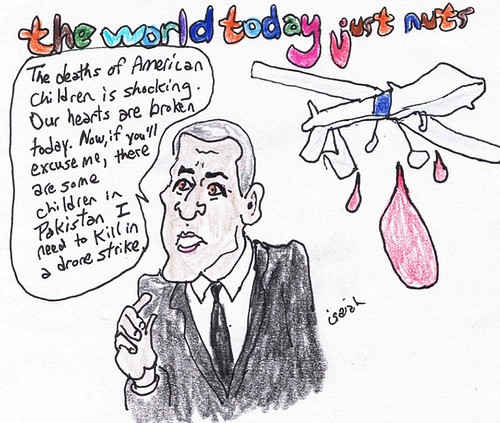
So Glenn, your fans are as ignorant as you.
And to Glenn's fans, if you honestly think I am scared or even troubled by your small minds, you should think again. It's 2013. You just look ignorant.
Glenn's a sexist. And I thought about that after last night. I thought about how he's attacking Kathryn Bigelow for a film he hasn't seen. And I thought about how, in that attack, he slips in a sentence where he notes he loves Homeland.
Homeland is pro-torture. And it's from a man. So Glenn shuts up. Being on TV -- even cable -- Homeland has the power to reach more viewers than a film can.
And Homeland is disgusting.
Ava and C.I. called it out last July, noting:
'We've got a new Hulu exclusive,' we were told more than once.
They're referring to Prisoners of War.
Prisoners of War is about what happens when imprisoned military members are released by the 'enemy.'
If it sounds familiar you may be thinking of Showtime's Homeland.
If it sounds familiar, it's because Homeland is based on Prisoners of War.
Prisoners of War was known as Hatufim when it aired in Israel in 2010. Before you think, "Oh, Hulu's gotten the rights to remake it," stop yourself.
Hulu's just re-airing a two-year-old foreign series. Sky TV is re-airing it in the UK. It's a syndication deal and it was never going to air over the air in the United States. In fact, Hulu demonstrated real stupidity in streaming this show.
Israel? Prisoners of war? For a number of Americans, Hulu just took sides in the never-ending Israeli-Palestinian conflict.
The reality is that Hulu was just too stupid and too starved for content to think clearly.
But reality will be lost by those who stream even a few moments of Prisoners of War.
That's because the series isn't entertainment, it's propaganda.
In the early sixties, when liberal artists felt shunned by the mainstream, they used films like Dr. Strangelove to convey messages. In this decade, it's conservatives who felt shunned and they've resorted to shows like 24 and Homeland. While the earlier group used humor to show what could go on, the newer group has only fear to offer.
So Homeland tells American audiences that the US Marine who is finally back home, he may actually be a sleeper for Muslim terrorists. The X-Files warned you to "Trust no one," but really meant, "Don't trust the government." Howard Gordon worked on The X-Files and 24 and copied (though he prefers "created") Homeland. And with each new series, Gordon gets closer to the ugliness inside him that he wants to pretend is inside the United States.
In Israel, Prisoners of War was an immediate hit and is now considered an Israeli-TV classic. That's not at all surprising for a country whose people are encouraged to hate and/or fear neighbors. Gordon apparently wants to do something similar within the US. It's not really working. Americans with Showtime have looked at Homeland and found it wanting.
21 million people legally have Showtime and yet the average Homeland episode couldn't even break 1.5 million in viewers -- despite repeat showings. And despite the usual idiots of the Water Cooler Set praising Claire Danes' bad performance which is all eye make up and grunts -- it's like sitting through The Mod Squad yet again. And that's good. It's good that the Howard Gordons haven't yet figured out how to sell hate and fear to a mass market.
Prisoners of War has figured it out. And watching it, you have to wonder if Triumph of the Will were only two or three years old, would Hulu be eager to grab it for summer viewing and promote their 'exclusive' showing of it as well?
But Glenn Glenn won't call it out. He'll attack women gladly.
He's a hypocrite. And we already noted he's an idiot because he's 'evaluating' a film he hasn't seen. If his fans write again, I'll do more on Glenn Glenn tomorrow night.
This is C.I.'s "Iraq snapshot:"
Tuesday,
December 18, 2012. Chaos and violence continue, Nouri ups his attacks
on the press and resorts to the military to carry it out (again), the
Peshmerga fires on an Iraqi aircraft, Jalal Talabani is rushed to the
hospital with rumors and confusion ensuing, Amnesty International
decries the executions in Iraq, and more.
APA reports Turkey's
"Prime Minister Recept Tayyip Erdogan has said Turkey is prepared to
bring Iraqi President Jalal Talabani to a hospital in Turkey after he
suffered a heart attack". A heart attack? A stroke? A coma? Details
shift depending upon the outlet.
What is known is that Jalal Talabani was taken to the hospital last night. All Iraq News noted
a statement from his office stated that it was a health emergency and
that the President of Iraq was fatigued due to the recent political
crisis and from his efforts to mediate the crisis between Baghdad and
Erbil. Alsumaria also noted the statement that it states he was exhausted. Aaad Abedine (CNN) was among the first to note it was a stroke and in the most recent update
quotes Kurdistan Alliance MP Mahmoud Othman stating, "His health
condition is not very good." However, Talabani's office throughout the
day did not say "stroke."
By 3:00 pm Baghdad time, Suadad al-Salhy, Isabel Coles, Patrick Markey and Michael Roddy (Reuters) were citing
unnamed "government sources" declaring Talabani in "critical but stable
condition." They weren't the only one citing government sources at
that time. For example, Alsumaria reports Talabani's health is deteriorating and that he is now in a coma according to "government sources." Kitabat went with an unnamed medical source who stated that Talabani was "clinically dead.". All Iraq News was noting that he has not regained conscious and that brain damage is feared. They also noted
that Talabani's office has issued a new statement declaring the
emergency health condition -- again, Talabani's office avoided
specifics -- was a result of the hardening of his arteries and repeat
the statement that his condition is stable.
Again, that
was what was in the news cycle earlier today (it was morning in the
US). It's already Wednesday in Iraq, early morning hours, and details
are not any clearer nor any more concrete. In their headline, the
Independent of London states "Stroke leaves President in a coma" (the text of the report doesn't mention a coma). Adam Schreck and Qaasim Abdul-Zahara (AP) call it a stroke and note that some reports "say Talabani may be in a coma." BBC News reports, "Well-placed Kurdish sources say he remains in a coma." As American Enterprise Institute's Michael Rubin points out at CNN's Global Public Square,
"The president's health has long been shaky; Talabani has made a half
dozen trips to Minnesota's Mayo clinic in recent years for various
ailments exacerbated by obesity and diabetes, compounded by years of
excessive smoking and drinking. Talabani's extended absences have become
commonplace. Just this past summer, Talabani was absent from Iraq for
almost two months after suffering complications from knee surgery."
With
the lack of clarity as to Talabani's condition, focus turns to what
happens if he passes away or is unable to continue as president? All Iraq News cites
the Constitution and explains that should the office of president
become vacant, the vice president would preside for no more than 30
days. There would be an election (elected by the Parliament) within 30
days to determine who would be the next president. We'll come back to
that in a minute. Kitabat notes
politicians are discussing succession issues and, should Talabani step
down, pass away or be unable to continue in office, most are stating
that Talabani's deputy in the PUK, Barham Salih, would be the next
elected president of Iraq. Conservative Michael Rubin offers
his belief that there will also be a push for Hoshyar Zebari. Hoshyar
Zebari is a Kurd (like Talabani and Salih) and he is in his second term
as Foreign Minister of Iraq. In that role he has traveled regularly to
meet with various foreign officials (such as Euopean Union High
Commissioner Catherine Ashton, US Secretary of State Hillary Clinton,
United Nations Secretary-General Ban Ki-moon, etc.). Lack of clarity
also prompted Osama al-Nujaifi to return home. All Iraq News reports
the Speaker of Parliament was in the midst of his scheduled trip to
India when he learned of Talabani's hospitalization and he ended his
official visit to return to Iraq. Though al-Nujaifi returned on his
own, it is also true that as one the "three presidencies" noted in the
Constitution (the others are the prime minister and the president), the
Speaker of Parliament does need to be present in Iraq during a time of
national uncertainty.
And if "national uncertainty" seems a bit much to some, please note that Alsumaria reports
the Islamic Union of Kurdistan (a minor political party in the KRG)
used today to launch a verbal attack on both Talabani and KRG President
Massoud Barzani.
Jalal is in his second term
as president of the constitutional republic of Iraq, his first term
began in April of 2006. Per the Iraqi Constitution, he cannot seek a
third term. (Jalal was also president in 2005 prior to the writing and
ratification of the Constitution.) He is a leader not only of the
Patriotic Union of Kurdistan (one of the KRG's two major political
parties) but also of the Talabani tribe. While his official power
derives from the Constitution, his prominence on the world stage results
from his personal biography as well as that of his wife Hero Ibrahim
Ahmed, First Lady of Iraq. Dropping back to the December 5th snapshot:
Like many notable Iraqis, her family has a long history of involvement in Iraqi politics and in being persecuted. Novelist Ibrahim Ahmad was her father. He was also a judge and one of the first chairs of the Kurdistan Democratic Party (the first after it changed its name). Moving up the political chain in Iraq has always meant creating enemies. He would end up in Abu Ghraib prison for two years. He would go on to become an editor of a newspaper and, more importantly to the political situation, the voice of the KDP following it's split into two parties -- the other, the Patriotic Union of Kurdistan, would be headed by Mustafa Barzani. Today the PUK is headed by Massoud Barzani who is also the President of the Kurdistan Regional Government. He is the son of the late Mustafa Barzani. Mustafa's grandson is KRG Prime Minister Nechirvan Barzani.
Like many notable Iraqis, her family has a long history of involvement in Iraqi politics and in being persecuted. Novelist Ibrahim Ahmad was her father. He was also a judge and one of the first chairs of the Kurdistan Democratic Party (the first after it changed its name). Moving up the political chain in Iraq has always meant creating enemies. He would end up in Abu Ghraib prison for two years. He would go on to become an editor of a newspaper and, more importantly to the political situation, the voice of the KDP following it's split into two parties -- the other, the Patriotic Union of Kurdistan, would be headed by Mustafa Barzani. Today the PUK is headed by Massoud Barzani who is also the President of the Kurdistan Regional Government. He is the son of the late Mustafa Barzani. Mustafa's grandson is KRG Prime Minister Nechirvan Barzani.
Jalal and Hero have been
married for over thirty years -- by all accounts a happy marriage -- and
their own personal histories and experiences go to why Jalal has been
an international presence. When Parliament votes in a new president,
which may not be until 2014 when Talabani's term expires, it is very
doubtful that anyone with the same national or international stature
will be the president. (Although Hero Ibrahim Ahmed would obviously
have a similar stature and the Talabani tribe has long supported women
politicians. It was nieces of Jalal's that were most vocal in decrying
Nouri's Cabinet in January 2011 for it's lack of women.) The editorial board of Lebanon's Daily Star observes,
"Replacing Talabani with someone as charismatic and experienced, with
the same skills of mediation, and with as few blemishes on his
nationalism, will be no easy task, especially for a government's whose
reputation has thus far been far from clean."
Jalal Talabani's name came up today at the US State Dept's press briefing when NPR's Jonathan Blakley asked State Dept spokesperson Victoria Nuland for a comment:
Jonathan Blakley: Can we move to Iraq?
Victoria Nuland: We can move to Iraq.
Jonathan
Blakley: Okay. President Talabani, he's sidelined. I'm wondering what
you know about his health because there's been a lot of kind of wild
speculation on how badly he is right now. Apparently, it's a stroke.
And also, do you -- are you fearful that with him sidelined, could there
be some instability up there in northern Iraq and Kurdistan?
Victoria
Nuland: Well let me start by saying that our thoughts are with
President of Iraq, Jalal Talabani, his family, and the people of Iraq.
We wish him a full recovery. I frankly don't have any information
beyond what his office has put out with regard to his health. I think
you know that we have been urging calm, we've been urging dialogue. We
were pleased with the initial agreement between Peshmerga and Iraqi
forces. We want that kind of calm to continue. We want stability to be
observed, obviously, up there. But we'll just have to see how he is
going forward.
Some will see -- I know I will -- more genuince concern in the US Embassy in Baghdad's Tweet than in all of Nuland's blathering.
 U.S. Embassy Baghdad
The U.S. Embassy in Baghdad wishes President Talabani a quick and full recovery.
As Jalal's fate remains uncertain, Nouri al-Maliki, chief thug and prime minister of Iraq, continues targeting journalists. We noted twice last week that Fakhri Karim is being targeted by Nouri -- Nouri's office issued a statement this week attacking the Al Mada editor -- because Karim believes Iraq can be and should be everything outlined in the country's Constitution. For that, for faith in Iraq's future, Karim is being publicly attacked by Nouri al-Maliki. Al Mada reports today that Fakhri Karim has received orders to evacuate his home immediately -- military orders. And to try to enforce them, Nouri sent a convoy of troops to Fakhri's home. Kitabat points out that Fakhri was calling on Iraqi President Jalal Talabani to intervene and get the order rescinded. That's not happening now because Jalal's in the hospital from an apparent stroke. This should scare many. In fact, people should be shuddering over the not-so-distant memory it recalls.
Let's drop back to December 17, 2011 because clearly some need their memories jogged of when Nouri last turned the military on enemies in Baghdad:
Ines Tariq (Al Mada) reports
on the controversy over whether or not the country's Supreme Court has
issued an arrest warrant for Iraq's Sunni Vice President Tareq
al-Hashemi. Reportedly, Nouri al-Maliki wants al-Hashemi arrested.
Nouri's political slate is State of Law. They came in second in the
parliamentary elections. Iraqiya came in first. al-Hashemi is a member
of Iraqiya. Iraqiya made clear Friday that things were changing and
today they walked out of the Parliament.
Meanwhile Al Rafidayn reports Nouri al-Malikis asking Parliament for a vote to withdraw confidence in Deputy Prime Minister Saleh al-Mutlaq. Nouri states he al-Mutlaq is no longer able to hold office as a result of an interview he gave to CNN. Tuesday, Arwa Damon and Mohammed Tawfeeq (CNN) reported:
Iraqi Prime Minister Nuri al-Maliki is amassing dictatorial power as U.S. troops leave the country, risking a new civil war and the breakup of the nation, his deputy warned
Meanwhile Al Rafidayn reports Nouri al-Malikis asking Parliament for a vote to withdraw confidence in Deputy Prime Minister Saleh al-Mutlaq. Nouri states he al-Mutlaq is no longer able to hold office as a result of an interview he gave to CNN. Tuesday, Arwa Damon and Mohammed Tawfeeq (CNN) reported:
Iraqi Prime Minister Nuri al-Maliki is amassing dictatorial power as U.S. troops leave the country, risking a new civil war and the breakup of the nation, his deputy warned
Tuesday.
Deputy Prime Minister Saleh al-Mutlaq told CNN that he was "shocked" to hear U.S. President Barack Obama greet al-Maliki at the White House on Monday as "the elected leader of a sovereign, self-reliant and democratic Iraq." He said Washington is leaving Iraq "with a dictator" who has ignored a power-sharing agreement, kept control of the
Deputy Prime Minister Saleh al-Mutlaq told CNN that he was "shocked" to hear U.S. President Barack Obama greet al-Maliki at the White House on Monday as "the elected leader of a sovereign, self-reliant and democratic Iraq." He said Washington is leaving Iraq "with a dictator" who has ignored a power-sharing agreement, kept control of the
country's security forces and rounded up hundreds of people in recent weeks.
[. . .]
"America left Iraq with almost no infrastructure. The political process is going in a very wrong direction, going toward a dictatorship," he said. "People are not going to accept that, and most likely they are going to ask for the division of the country. And this is going to be a disaster. Dividing the country isn't going to be smooth, because dividing the country is going to be a war before that and a war after that."
Like Tareq al-Hashemi, Saleh al-Mutlaq is a member of the Iraqiya political slate. Dar Addustour is reporting that the homes of al-Hashemi and al-Mutlaq as well as the home of Rafi Hiyad al-Issawi have been surrounded by "tanks and special forces." Dr. Rafi Hiyad al-Issawi was the previous Deputy prime minister (2007 through 2010). He was the head of Falluja General Hospital prior to that and he is currently the Minister of Finance. Like the other two, al-Issawi is a member of Iraqiya.
[. . .]
"America left Iraq with almost no infrastructure. The political process is going in a very wrong direction, going toward a dictatorship," he said. "People are not going to accept that, and most likely they are going to ask for the division of the country. And this is going to be a disaster. Dividing the country isn't going to be smooth, because dividing the country is going to be a war before that and a war after that."
Like Tareq al-Hashemi, Saleh al-Mutlaq is a member of the Iraqiya political slate. Dar Addustour is reporting that the homes of al-Hashemi and al-Mutlaq as well as the home of Rafi Hiyad al-Issawi have been surrounded by "tanks and special forces." Dr. Rafi Hiyad al-Issawi was the previous Deputy prime minister (2007 through 2010). He was the head of Falluja General Hospital prior to that and he is currently the Minister of Finance. Like the other two, al-Issawi is a member of Iraqiya.
[. . .]
[. . .] Liz Sly (Washington Post) notes
that the 'government' is "unraveling faster than had been anticipated
Saturday." She also notes, "In recent days, the homes of top Sunni
politicians in the fortified Green Zone have been ringed by tanks and
armored personnel carriers, and rumors are flying that arrest warrants
will be issued for other Sunni leaders." For days? Plural. "In recent
days."
He's again using the military to surround and intimidate someone he has labeled an enemy, the editor of Al Mada
newspaper. That should alarm and bother everyone. That should bother
Iraqis because why the hell is the Iraqi military -- especially
considering the last days of violence -- being stationed at Fakhri
Karim's home? How is the editor of a newspaper a military target?
This is an attack on the press and it's appalling and it's disgusting. This morning I called out the Committee to Protect Journalists for refusing to stand up for Fakhri.
In doing so, I noted that they didn't have their Iraq count correct
(they list only 3 murdered journalists for 2012) and their new report
was wrong because it claims that there were no murdered journalists in
2012 and I went over a Saturday phone call I had with a CPJ friend
over their silence on Nouri using the military Friday to shut down
satellite channel Al-Baghdadi in Iraq. The friend called later in the
morning to angrily inform me that late yesterday afternoon CPJ did
issue a statement calling that out. So let me include the link
and now let me note that we argued on the phone (loudly) about this
Saturday, Sunday and Monday morning. I'm glad they finally decided to
issue a statement and let me say I was wrong this morning when I said they hadn't issued one.
Let me further note that they did a much better job than I did (not
very hard to do) by noting that the radio station was Radio Al-Mahaba
(the press accounts I read and linked to had the radio station being
part of Al-Baghdadia, it's not, it's an independent women's radio
station). So praise to you for that but, please CPJ, explain to me
exactly how many phone calls need to take place and how loudly I need to
scream into the phone for you to note Iraq because you still haven't
noted Fakhri?
Yeah, you finally noted al-Baghdadi. But it's closed. Fakhri is alive and Al Mada
is publishing. At what point are you going to defend them? And when
are you going to call out turning the military loose on the media? In
what non-failed state is that suddenly acceptable?
But
please do let me know exactly how long and how loud I need to yell over
the phone to get concern expressed for Fakhri. I don't know him, I've
never met him. I know the paper he's the editor of, Al Mada. I
know it does strong work and has consistently had strong reporting. If
it makes a mistake, it corrects it. It's a responsible paper and one
that does investigative reporting. It should be considered a national
treasure and a point of pride for the international journalism
community.
Like most papers covering Iraq, it has been repeatedly targeted. Back in July, we were noting how both it and Kitabat were hacked and "May 25th, Al Mada reported
on how their website was experiencing daily attacks causing the site to
crash. They were down for the entire month of June. When they came
back up last week (they came up on Thursday, June 28th, they were able
to add new content Friday, June 29th), they really hoped CloudFlare was
going to help. But it hasn't. They've been down since Wednesday."
So Al Mada's
on it's own? Fakhri is on his own? So much for some sort of 'family
of journalists' around the world. Apparently there's family and then
there's step-family and the step-children will be ignored and left on
their own as though this weren't the 21st century but instead some
Grimm's fairy tale.
We do realize that Fakhri and others at Al Mada
are real people, right? They're real people with hopes and dreams doing
a job that we're all supposed to place a value on: informing the
public. They're doing serious journalism and I truly do not think it is
too much to ask that when they are under attack from their government
that those of us fortunate enough not to have to worry about being
attacked by Nouri al-Maliki can use our voices and use our voices loudly
to call attention to what is going on and, hopefully, to assist the
people working at Al Mada in both continuing their work and in
preserving their freedom. It doesn't cost me a thing (except maybe a
CPJ friend) to defend Al Mada and Fakhri. I won't be tossed in
one of Nouri's secret prisons. And that's why it's important that
everyone else who is as fortunate as me calls out what Nouri is doing
and makes it clear, "Nouri al-Maliki, the world is watching you."
That's the only thing might stop him.
After Al-Baghdadi is closed, CPJ shows up decrying it. But where were they when it mattered? From the November 27th snapshot:
Sunday the Iraq Times noted that Nouri's Dawa Party was targeting Al Baghdadi and the paper noted they stood in solidarity with the cable outlet. Iraqi Times notes that the cable outlet was prevented by security forces working for Nouri's office from entering Kadhimiya and filming. (This is the city that the US set up the base Camp Justice and where Saddam Hussein was executed.)
CPJ's online
posting about Al-Baghdadi neglects to inform readers that prominent
Iraqi politicians have called out the closing -- that includes cleric
and movement leader Moqtada al-Sadr's bloc in Parliament as well as
Iraqiya (headed by Ayad Allawi). Allawi and Sadr have a certain level
of power that many Iraqis don't, true. But so did Tareq al-Hashemi and,
for political reasons, he's now received his fifth death sentence
(while remaining Vice President of Iraq to this day). Nouri can't
execute me. Nouri can't execute CPJ. Again, those of us who have the
comfort of being able to call out these attacks on the Iraqi press need
to be doing so.
Can you imagine the fear in the United States if President Barack Obama had the US military surround the home of New York Times
editor Jill Abramson? Nouri sent the military to Fakhri Karim's home.
There is no excuse for that. And considering the US government's role
in starting the Iraq War and the US press' role in selling the Iraq War,
calling out Nouri al-Maliki's attacks on the Iraqi press should be a US
obligation, not option.
Adam Schreck (AP) reflects
on the year since (most of) the US military pulled out of Iraq. He
neglects to note the 15,000 that were moved from Iraq to Kuwait (for
more on that and for how long some US senators feel they should remain
in Kuwait seethe Senate Foreign Relations Committee released [PDF format
warning] "The Gulf Security Architecture: Partnership With The Gulf Co-Operation Council"), Ted Koppel's December 12, report on Rock Center with Brian Williams (NBC)
about what was really taking place in Iraq -- what 'reporters' insisted
on calling a 'withdrawal' but what the Pentagon had termed a "drawdown"
-- where the CIA, JSOC, DEA and FBI would remain behind, Tim Arango (New York Times) reporting three months ago that the US had sent another Special-Ops division into Iraq in September, the reports (Press TV, Voice of Russia) that 3,000 US troops had gone back into Iraq from Kuwait, the Defense Dept's December 12th announcement of the new agreement with Iraq [PDF format warning] the Memorandum
of Understanding For Defense Cooperation Between the Ministry of
Defense of the Republic of Iraq and the Department of Defense of the
United States of America. AFP covers the last year here and Kitabat covers it here.
Turning to today's violence, Alsumaria reports
the Ministry of the Peshmerga (elite Kurdish force) announced today
that they had fired on an Iraqi military aircraft (this would most
likely be a helicopter or drone) over Kirkuk Province which forced it to
withdraw. The Peshmerga states they fired to send a message and that
their next response will be stronger. Alsumaria notes
that MP Qutaiba Jubouri and Salahuddin Province Governor Ahmed Abdullah
were targeted with a car bombing outside of Tikrit -- both survived,
apparently without any injuries. All Iraq News notes 1 police officer was shot dead during an attack in Mosul today and they note 1 member of Jabour tribal clan was shot dead in Mosul as well. Alsumaria also notes a Mosul roadside bombing which injured three people. All Iraq News is reporting that a car bomb has gone off in Karbala. (They're also reporting that Jalal Talabani's office denies issuing a statement stating President Talabani has passed away and that Jalal's office has issued a statement maintaining that Talabani's health is improving.) In addition, Alsumaria notes the Anbar police found a car bomb in Falluja and detonated it.
Kitabat reports that, according to Nineveh Province Governor Ethel Nujaifi, a young girl was raped by a lieutenant in the Iraqi military. A judge ordered the officer's arrest but the Iraqi military has refused to turn him over. The Ministry of Defense is the one refusing. (The Ministry of Defense is headed by Nouri al-Maliki since he refused to nominate someone for the post and allow Parliament to confirm the nomineee.) Still on the topic of rape, Kitabat reports that Iraqiya MP Hamid al-Mutlaq revealed today that federal prosecutors have presented pre-liminary evidence to the Supreme Judicial Council that, prosecutors argue, prove that women are being raped and tortured in Iraqi prisons. As we noted when this scandal was breaking, Nouri has been very lucky and able to walk away from many scandals unscathed but Iraqis will not let this one pass by. Instead of attacking those who brought it up publicly, Nouri should have been announcing that he was addressing it and fixing it.
From prisons to executions, Peter Bouckaert (Foreign Policy) points out,
"After becoming president of a post-Saddam Iraq in 2005, Talabani often
tried to serve as a moral compass for a country mired in bloodshed. He
refused to sign off on executions -- even that of his arch-enemy Saddam
Hussein -- citing his personal opposition to capital punishment.
Ultimately, a compromise was reached where his deputies signed the
execution orders, resolving the deadlock. Today, Iraq sadly is one of
the world's leaders in executions, which are often imposed on people who
were convicted in unfair trials."
Dropping back to the November 12th snapshot:
Staying with violence, as noted in the October 15th snapshot, Iraq had already executed 119 people in 2012. Time to add more to that total. Mohammed Tawfeeq (CNN) reported
last night that 10 more people were executed on Sunday ("nine Iraqis
and one Egyptian"). Tawfeeq notes the Ministry of Justice's statement
on the executions includes, "The Iraqi Justice Ministry carried out the
executions by hanging 10 inmates after it was approved by the
presidential council." And, not noted in the report, that number's only
going to climb. A number of Saudi prisoners have been moved into
Baghdad over the last weeks in anticipation of the prisoners being
executed. Hou Qiang (Xinhua) observes, "Increasing
executions in Iraq sparked calls by the UN mission in the country, the
European Union and human rights groups on Baghdad to abolish the capital
punishment, criticizing the lack of transparency in the proceedings of
the country's courts."
So that makes at least 129 executions in Iraq this year alone. Amnesty International UK issued the following today:
Iraq has already executed at least 129 people this year
Amnesty
International is calling on the Iraqi authorities to halt the execution
of 28 prisoners whose death sentences were reportedly ratified
yesterday.
Death sentences for 28 people
accused of terrorism-related offences were reportedly ratified by one of
Iraq's vice-presidents, the last step in the judicial process. They are
at risk of imminent execution. Earlier this month it was reported that
around 40 death row prisoners were transferred to al-Kadhemiya Prison in
Baghdad where executions are carried out.
Meanwhile,
last week Amnesty urged the Iraqi authorities to quash death sentences
against four men sentenced on 3 December in Anbar province, western
Iraq, following the broadcast of "confessions" given while reportedly
being tortured in pre-trial detention.
Iraq
has already executed at least 129 people in 2012, the highest number
since 2005. As in previous years, it's estimated that hundreds have
been sentenced to death or had death sentences upheld by the courts.
Amnesty is calling on the Iraqi authorities to impose an immediate moratorium on executions as a first step towards abolition.
Amnesty International Middle East and North Africa Deputy Director Hassiba Hadj Sahraoui said:
"Death sentences are being flung out after grossly unfair trials relying on 'confessions' obtained under torture.
"Instead of carrying out executions, the Iraqi authorities should prioritise fixing its deeply flawed criminal justice system."
.
Since the death penalty was reintroduced in Iraq in 2004, the death sentence and executions has been imposed and carried out extensively, following procedures that violate human rights standards. Many trials of those sentenced to death have failed to meet international standards for fair trials, including by using "confessions" obtained under torture or other ill-treatment as evidence against the defendants. Some Iraqi television stations continue to broadcast self-incriminating testimonies of detainees even before the opening of a trial, undermining the fundamental right of defendants to be considered innocent until proven guilty.
.
Since the death penalty was reintroduced in Iraq in 2004, the death sentence and executions has been imposed and carried out extensively, following procedures that violate human rights standards. Many trials of those sentenced to death have failed to meet international standards for fair trials, including by using "confessions" obtained under torture or other ill-treatment as evidence against the defendants. Some Iraqi television stations continue to broadcast self-incriminating testimonies of detainees even before the opening of a trial, undermining the fundamental right of defendants to be considered innocent until proven guilty.
Amnesty opposes the death penalty
in all cases without exception, as a violation of the right to life and
the ultimate cruel, inhuman and degrading punishment. More than
two-thirds of the countries in the world have abolished the death
penalty in law or practice.
From executions to War Crimes, US journalist Dave Lindorff spoke with Iran's Press TV, "Lindorff
went on to say that President Obama is practically a 'war criminal'
under the 'UN Charter and the Nuremberg principles, which declare that
covering up war crimes by government and military leaders, and failure
to prosecute such war crimes, are in themselves war crimes."
Saturday, community member Ginger called our attention to an Iraq War veteran has been left rotting in a Mexican prison for four months. Patricia Mazzei (Miami Herald via Lake Wylie Pilot) reports:
When the mother of a military veteran arrested and detained in a dangerous foreign jail called her congresswoman's office two weeks ago asking for help, Rep. Ileana Ros-Lehtinen said she had a hard time believing former Marine Lance Cpl. Jon Hammar was in prison for carrying a six-decade-old shotgun into Mexico.
"We said, 'Surely she must be exaggerating,'" recalled Ros-Lehtinen, a Miami Republican.
She wasn't. Olivia Hammar's son had been in a state prison in Matamoros, along the Mexican border, for nearly four months.
Jon Hammar and a friend traveled into Mexico in an RV. He had a sixty-year-old rifle. At the US checkpoint, he showed the rifle and Customs told him to fill out a form (which he did) and that that was all he needed to do. He drove on through the checkpoint and ended up at a Mexican checkpoint where the gun was supposedly illegal (an inch too short --- which may or may not be an accurate measurement of the gun). His friend was released since Hammar made clear he was the gun owner. That was August, since then he has remained in a Mexican prison.
This should be a nightmare for many people. For Mexico? Lynn Brezosky (San Antonio Express) explains, "A group representing more than 14,000 businessmen in northern Mexico is pleading for the release of Marine Corps veteran Jon Hammar, warning his "unfair" imprisonment for carrying an antique shotgun on his way to a surfing vacation will further devastate an already struggling tourism market." The US? Richard Boyden (Black Hills Today) argues the White House is ignoring the Iraq War veteran, "A real friend of America would admit to their wrongs and make things right. Not to do so is the deliberate and intentional act of an enemy and therefore they should be dealt with as such for the sake of this Marine. President Obama needs to decide who's side he is on."
When the mother of a military veteran arrested and detained in a dangerous foreign jail called her congresswoman's office two weeks ago asking for help, Rep. Ileana Ros-Lehtinen said she had a hard time believing former Marine Lance Cpl. Jon Hammar was in prison for carrying a six-decade-old shotgun into Mexico.
"We said, 'Surely she must be exaggerating,'" recalled Ros-Lehtinen, a Miami Republican.
She wasn't. Olivia Hammar's son had been in a state prison in Matamoros, along the Mexican border, for nearly four months.
Jon Hammar and a friend traveled into Mexico in an RV. He had a sixty-year-old rifle. At the US checkpoint, he showed the rifle and Customs told him to fill out a form (which he did) and that that was all he needed to do. He drove on through the checkpoint and ended up at a Mexican checkpoint where the gun was supposedly illegal (an inch too short --- which may or may not be an accurate measurement of the gun). His friend was released since Hammar made clear he was the gun owner. That was August, since then he has remained in a Mexican prison.
This should be a nightmare for many people. For Mexico? Lynn Brezosky (San Antonio Express) explains, "A group representing more than 14,000 businessmen in northern Mexico is pleading for the release of Marine Corps veteran Jon Hammar, warning his "unfair" imprisonment for carrying an antique shotgun on his way to a surfing vacation will further devastate an already struggling tourism market." The US? Richard Boyden (Black Hills Today) argues the White House is ignoring the Iraq War veteran, "A real friend of America would admit to their wrongs and make things right. Not to do so is the deliberate and intentional act of an enemy and therefore they should be dealt with as such for the sake of this Marine. President Obama needs to decide who's side he is on."
The conservative website Red State noted last night:
An
Iraq War veteran is being held in a Mexican jail, chained to his bed,
his life continuously threatened, while his family is extorted for
money…and our nation's leaders appear impotent (or negligent) by their
failure to help him.
After you've read the story below, please go to the White House petition and sign it to press the Obama Administration to start working to bring Jon Hammar home.
Excerpt.
offline.
CPJ's posting includes a quote from CPJ's Middle East and North Africa program coordina