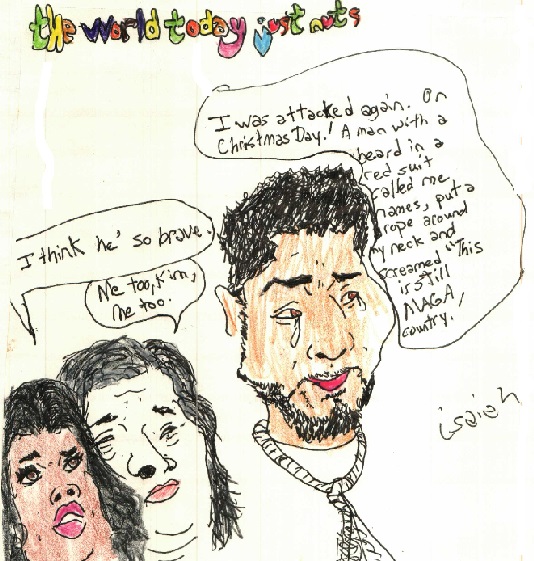
That's Isaiah's THE WORLD TODAY JUST NUTS "Do You Believe Jussie Now?" from Sunday.
I was really expecting that Monday would deliver a verdict on Ghislaine Jizzy Pants Maxwell but that did not happen. The New York Post notes:
The jury deliberating in the Ghislaine Maxwell trial failed to reach a verdict Monday — the third full day of their discussions — as they weighed legal nuances and pored over witness testimony from the trial.
The 12-person panel sent Judge Alison Nathan several notes Monday,
asking for clarification on what evidence they could take into account
for one of the charges. They also requested additional transcripts from
the trial.
The jury also asked for a number of office supplies to aid in their
deliberations, including Post-it notes, highlighters and white board
paper.
As the jury entered its 23rd hour of deliberations, they sent a note
to Nathan asking about flights they could take into account while
mulling if they can convict Maxwell of transporting a minor with the
intent to engage in criminal sexual activity.
CNN reminds:
Maxwell, the former girlfriend and longtime associate of the late sex offender Jeffrey Epstein,
has pleaded not guilty to six federal counts: sex trafficking of a
minor, enticing a minor to travel to engage in illegal sex acts,
transporting a minor with the intent to engage in criminal sexual
activity and three related counts of conspiracy. If convicted on all six counts, Maxwell faces up to 70 years in prison.
This is C.I.'s "Iraq snapshot:"
Monday, December 27, 2021. Are US troops in Iraq still getting combat pay and we remember Joan Didion.
Liteary
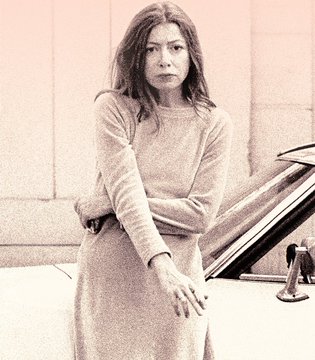
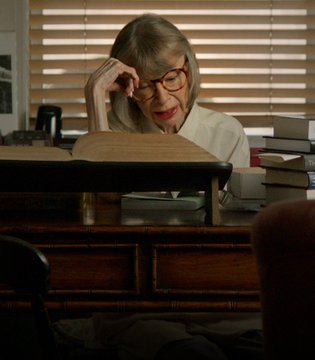
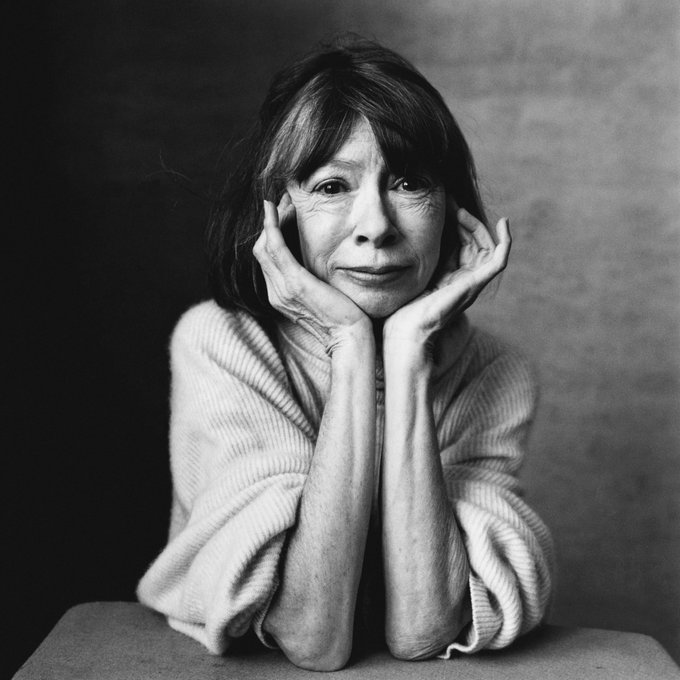
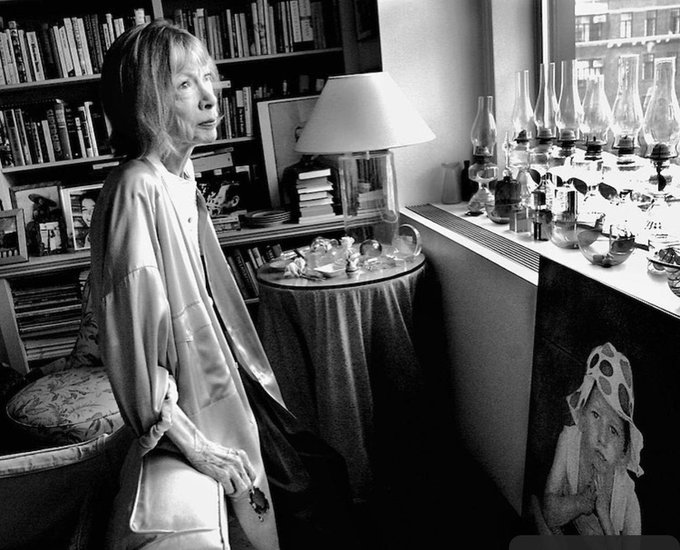
giant Joan Didion passed away December 23rd. She was preceeded by her
husband John Gregory Dunne and their daughter Quintana Roo Dunne. A
writer of the New Journalism school, Joan left behind many literary
landmarks including THE WHITE ALBUM, THE YEAR OF MAGICAL THINKING,
POLITICAL FICTIONS, BLUE NIGHTS, SLOUCHING TOWARDS BETHLEHEM, FIXED
IDEAS: AMERICAN SINCE 9/11, SALVADOR, PLAY IT AS IT LAYS and MIAMI.
Joan
had true talent and a great gift for writing. She was also the Queen
of Common Sense. That's why she was repeatedly able to catch things
others did not.
She was a one-of-a-kind writer and a
one-of-a-kind person. When I did the Friday snapshot, I tried to
include her in it but couldn't. It was too soon. And it probably still
is. I've paused dictation for about 25 or so minutes because I really
don't want to cover this. I said a long time ago I was not going to
write here about everybody I know if they passed away. I don't feel
like putting myself through that. Joan's one of the people I have to
write about. Brian De Palma is someone I'd have to write about.
Hopefully, he'll outlive this site by many years but when I was informed
of Joan's passing, he was the first person that came to mind. I love
Brian.
I have little love left for Barbra Streisand and
she's the one whose name came up when others called to discuss Joan's
death. They'd note my remarks about her in the October 21st snapshot:
Before we move on to Colin, let me note Barbra. I know her. I like
her. I applaud the art she produced with YENTL. We promoted RELESE ME 2
here. I've praised her performance in THE GUILT TRIP. And I try to
say nice things about her in real life. Which is why friends were
surprised when I recently slammed her here. Industry friends couldn't
stop calling as that was circulated. Basically saying, "You do get it
then?" Yes, and I always have. But I'm not a director and I never had
to put up with that crap on a set and I'm smart enough never to be in a
film with her. Her image is well earned. It has nothing to do with my
interaction with her.
But when ego mania and a her need
to be the center of attention at all times caused her to trash Bradley
Cooper? I know Bradley and he did not deserve her crap. So I would
have objected for that reason alone. But I have known Joan Didion for
decades now. And to watch, while Joan's in such poor health, as Barbra
stole the credit that Joan and her late husband John Gregory Dunne
deserve?
No.
As I wrote, this is why
she doesn't get awards. It's why she's never won a second Academy Award
for acting and never will. It's why she's hated by so many who have
worked with her and others who refuse to work with her. Joan and John
were ending their vacation in Hawaii when Joan turned to John and
exclaimed something like, "A STAR IS BORN with Carly Simon and James
Taylor!" That idea popped into her head and that's how you got the 70s A
STAR IS BORN.
The script was a hot property and the
studio was willing to do it with Carly and James -- but they ended up
not wanting to do the film. (Too close to home at the time as James'
career was muddling.) Various other women expressed interest and it was
a go project. It was happening. As it was coming down to the wire, it
was Cher's film. She would be starring in it. And the Sue and Barbra
swoop in.
That film is garbage, pure garbage. Kris
isn't bad in it but he's undercut by all the focus on Barbra --
especially when he's emoting but the camera's instated trained on
Barbra. Did the crew really mix s**t in with mud for a scene where
Barbra was in the mud? I don't know. Frank Pierson, the director of
the film, told me they did. It's not surprising if they did. She's a
terror on a set. I'd never go on a set with her. And you can go to
YOUTUBE and see her screeching homophobia when she visits Harrison Ford
on one of his film sets. That's Barbra.
She
destroyed the script for the film. She destroyed the balance that was
needed. And the biggest complain, which no one makes but I think
everyone viewing gets, is that the film should end on Kris. You do one
wrap up scene. Instead, Kris dies and it's Babs Babs Babs. Oh, she's
walking through the lonely mansion, oh she hears his voice on a tape
recorder, oh this and oh that and then that never ending two song medley
where her nose is frightening. She who screeches about unflattering
photography has allowed some of the worst video of her ever captured --
worst in terms of appearance -- and for what? To hog the movie? To
sing bad songs.
And she's going to slam Bradley's film? His film works, her film does not.
She's
going to slam Brad and she's going to steal Joan and John's credit?
Slamming Brad because she made the film about singer-songwriters and
blah blah blah.
She didn't do s**t with that. She
added the Orioles (which I always found racist) and she demanded that a
type of feminist sensibility be put into the film -- her sense of a
feminist sensibility which has always been a rather strange one.
She
made a bad film that's an endurance contest to get through and she
wants to slam Bradley and she wants to steal Joan and John's credit?
As
I said when I wrote about it here, this is exactly why she doesn't get
awards from her peers. It's that ego that claims credit for
everything. It's that ego that has to put others down to build herself
up. I can indulge in that in casual interactions with her but I'm smart
enough never to work with her. Carole King wasn't. Carole's
basically a nice person. So she won't publicly slam Barbra. But Carole
was a much bigger musical act in 1972 than Barbra when they did a
George McGovern benefit and ask Carole how much rehearsal time she was
allowed. Ask Quincy Jones how much time he go tot rehearse. Ask them
who monopolized the venue with rehearsal after rehearsal for what were
poor and simplistic arrangements. She has no concern or care for other
artists.
So I posted that here and it gets circulated
around a number of friends and then the circle gets larger and larger.
And I'm getting all these phone calls because it's the truth but people
are surprised I'd say it. Normally, I wouldn't. But she went after
Bradley and Joan. She atacked one, she erased the other.
I
wasn't in the mood. And I don't give her a pass because her son Jason
is gay. She's homophobic so I'm honestly not surprised that 'gay
rights' Barbra would praise the homophobic Colin Powell.
And that was picking up from the August 18th snapshot.
We bring it up now because glory hog Barbra can't say a word about
Joan. I guess it's jealousy? She can Tweet since Joan died, for
example, she just can't note Joan's death. Maybe it's guilt? After she
tried to steal Joan's credit yet again this year, maybe it's guilt. I
hope it's guilt -- coz she's got plenty, coz she's got plenty to be guilty of.
Unlike her, Joan was generous with praise and compliments and support.
And unlike Barbra, Joan also had a brain and intellect, here she is speaking with Jon Wienr in 2013:
There's
no difference between the parties, is there? We don't have an actual
argument. We have two parties that calibrate everything they do to
attract a very small group called "the target voters." As for the rest
of us, I don't think it's too strong to say we have been disfranchised.
She
wasn't the partisan fool Barbra and so many are. You'd never catch her
presenting as left but rushing to reTweet an article from THE ATLANTIC
excusing Joe Biden for doing nothing for the people in 2021. What kind
of fool? Only a fool like Barbra.
Here's the voice of intelligence, Joan from FIXED IDEAS: AMERICA SINCE 9:11:
All
I can say about the rest of that evening, and about the two weeks that
followed, is that they turned out to be nothing I had expected, nothing I
had ever before experienced, an extraordinarily open kind of traveling
dialogue, an encounter with an America apparently immune to conventional
wisdom. The book I was making the trip to talk about was Political Fictions, a series of pieces I had written for The New York Review about
the American political process from the 1988 through the 2000
presidential elections. These people to whom I was listening—in San
Francisco and Los Angeles and Portland and Seattle—were making
connections I had not yet in my numbed condition thought to make:
connections between that political process and what had happened on
September 11, connections between our political life and the shape our
reaction would take and was in fact already taking.
These
people recognized that even then, within days after the planes hit,
there was a good deal of opportunistic ground being seized under cover
of the clearly urgent need for increased security. These people
recognized even then, with flames still visible in lower Manhattan, that
the words “bipartisanship” and “national unity” had come to mean
acquiescence to the administration’s preexisting agenda—for example the
imperative for further tax cuts, the necessity for Arctic drilling, the
systematic elimination of regulatory and union protections, even the
funding for the missile shield—as if we had somehow missed noticing the
recent demonstration of how limited, given a few box cutters and the
willingness to die, superior technology can be.
These
people understood that when Judy Woodruff, on the evening the President
first addressed the nation, started talking on CNN about what “a couple
of Democratic consultants” had told her about how the President would
be needing to position himself, Washington was still doing business as
usual. They understood that when the political analyst William Schneider
spoke the same night about how the President had “found his vision
thing,” about how “this won’t be the Bush economy any more, it’ll be the
Osama bin Laden economy,” Washington was still talking about the
protection and perpetuation of its own interests.
These people got it.
They didn’t like it.
They stood up in public and they talked about it.
Only
when I got back to New York did I find that people, if they got it, had
stopped talking about it. I came in from Kennedy to find American flags
flying all over the Upper East Side, at least as far north as 96th
Street, flags that had not been there in the first week after the fact. I
say “at least as far north as 96th Street” because a few days later,
driving down from Washington Heights past the big projects that would
provide at least some of the manpower for the “war on terror” that the
President had declared—as if terror were a state and not a technique—I
saw very few flags: at most, between 168th Street and 96th Street,
perhaps a half-dozen. There were that many flags on my building alone.
Three at each of the two entrances. I did not interpret this as an
absence of feeling for the country above 96th Street. I interpreted it
as an absence of trust in the efficacy of rhetorical gestures.
There
was much about this return to New York that I had not expected. I had
expected to find the annihilating economy of the event—the way in which
it had concentrated the complicated arrangements and misarrangements of
the last century into a single irreducible image—being explored, made
legible. On the contrary, I found that what had happened was being
processed, obscured, systematically leached of history and so of
meaning, finally rendered less readable than it had seemed on the
morning it happened. As if overnight, the irreconcilable event had been
made manageable, reduced to the sentimental, to protective talismans,
totems, garlands of garlic, repeated pieties that would come to seem in
some ways as destructive as the event itself. We now had “the loved
ones,” we had “the families,” we had “the heroes.”
In
fact it was in the reflexive repetition of the word “hero” that we
began to hear what would become in the year that followed an entrenched
preference for ignoring the meaning of the event in favor of an
impenetrably flattening celebration of its victims, and a troublingly
belligerent idealization of historical ignorance. “Taste” and
“sensitivity,” it was repeatedly suggested, demanded that we not examine
what happened. Images of the intact towers were already being removed
from advertising, as if we might conveniently forget they had been
there. The Roundabout Theatre had canceled a revival of Stephen
Sondheim’s Assassins, on the
grounds that it was “not an appropriate time” to ask audiences “to think
critically about various aspects of the American experience.” The
McCarter Theatre at Princeton had canceled a production of Richard
Nelson’s The Vienna Notes, which involves a terrorist act, saying that “it would be insensitive of us to present the play at this moment in our history.”
I
found in New York that “the death of irony” had already been declared,
repeatedly, and curiously, since irony had been declared dead at the
precise moment—given that the gravity of September 11 derived
specifically from its designed implosion of historical ironies—when we
might have seemed most in need of it. “One good thing could come from
this horror: it could spell the end of the age of irony,” Roger
Rosenblatt wrote within days of the event in Time,
a thought, or not a thought, destined to be frequently echoed but never
explicated. Similarly, I found that “the death of postmodernism” had
also been declared. (“It seemed bizarre that events so serious would be
linked causally with a rarified form of academic talk,” Stanley Fish
wrote after receiving a call from a reporter asking if September 11
meant the end of postmodernist relativism. “But in the days that
followed, a growing number of commentators played serious variations on
the same theme: that the ideas foisted upon us by postmodern
intellectuals have weakened the country’s resolve.”) “Postmodernism” was
henceforth to be replaced by “moral clarity,” and those who persisted
in the decadent insistence that the one did not necessarily cancel out
the other would be subjected to what William J. Bennett would call—in Why We Fight: Moral Clarity and the War on Terrorism—“a
vast relearning,” “the reinstatement of a thorough and honest study of
our history, undistorted by the lens of political correctness and
pseudosophisticated relativism.”
Ifound
in New York, in other words, that the entire event had been seized—even
as the less nimble among us were still trying to assimilate it—to stake
new ground in old domestic wars. There was the frequent deployment of
the phrase “the Blame America Firsters,” or “the Blame America First
crowd,” the wearying enthusiasm for excoriating anyone who suggested
that it could be useful to bring at least a minimal degree of historical
reference to bear on the event. There was the adroit introduction of
convenient straw men. There was Christopher Hitchens, engaging in a
dialogue with Noam Chomsky, giving himself the opportunity to generalize
whatever got said into “the liberal-left tendency to ‘rationalize’ the
aggression of September 11.” There was Donald Kagan at Yale, dismissing
his colleague Paul Kennedy as “a classic case of blaming the victim,”
because the latter had asked his students to try to imagine what
resentments they might harbor if America were small and the world
dominated by a unified Arab-Muslim state. There was Andrew Sullivan,
warning on his Web site that while the American heartland was ready for
war, the “decadent left in its enclaves on the coasts” could well mount
“what amounts to a fifth column.”
And you can read it in full at THE NEW YORK REVIEW OF BOOKS. Joan was a regular contributor and TNYROB has a folder up with some of her writing.
Let's drop back to April 26, 2010, when a peace 'leader' was justifying people not hold Barack Obama accountable for continuing the Iraq War:
Oh, how sad. Having ethics might interfere with the ability to hero
worship. Poor pathetics. Leave them their hero worship, it's all they
have left having whored every belief they previously held. This is a
good point to drop back to November 2008 when Joan Didion was speaking
on a panel which included Andrew Delbanco, Jeff Madrick, Darryl
Pinckney, Robert Silvers, Michael Tomasky and Garry Wills at New York
Public Library's Cullman Center for Scholars and Writers. The New York Review of Books podcast the event (scroll down to November 17, 2008, What Happens Now? A Conversation on the 2008 Election) and we did a transcription of Joan's remarks at Third, "Joan Didion on the Cult of the Christ-child:"
Close
to the heart of it was the way in which only the very young were
decreed of capable of truly appreciating the candidate. Again and again,
perfectly sentient adults cited the clinching of arguments made on the
candidate's behalf by their children -- by quite small children. Again
and again, we were told that this was a generational thing, we couldn't
understand. In a flash we were sent back to high school, and we couldn't
sit with the popular kids, we didn't get it. The "Style" section of The New York Times yesterday morning mentioned the Obama t-shirts that "makes irony look old."
Irony was now out.
Naivete translated into "hope" was now in.
Innocence, even when it looked like ignorance, was now prized.
Partisanship could now be appropriately expressed by consumerism.
I could not count the number of snapshots I got emailed showing people's babies in Obama gear.
Now
I couldn't count the number of terms I heard the terms
"transformational" or "inspirational." The whole of election night I
kind of kept dozing on and off and the same people were on always on
television and every time I woke up to them they were saying "transformational."
I
couldn't count the number of times I heard the sixties evoked by people
with no apparent memory that what drove the social revolution of the
sixties was not babies in cute t-shirts but the kind of resistance to
that decade's war that in the case of our current wars, unmotivated by a
draft, we have yet to see.
It became
increasingly clear that we were gearing up for another close encounter
with militant idealism by which I mean the convenient redefinition of
political or pragmatic questions as moral questions -- which makes those
questions seem easier to answer at a time when the nation is least
prepared to afford easy answers.
Binghampton, New
York was supposed to be installing a financial cost of war counter for
Iraq and Afghanistan last Wednesday. The day before, it was called off
under pressure and allegations that it was 'disrespectful' to the
military (In a Junta, we must all salute, apparently).
We noted Joan here many times, but never enough. [Elaine noted Joan in "JOAN: FORTY YEARS OF LIFE, LOSS, AND FRIENDSHIP WI..." -- which Ava and I spoke with her about here.]
She was someone who added to the worth of this world and she will be greatly missed.
Writer and teacher Matt Bell Tweeted:
The one Joan Didion passage I have memorized, from teaching it so often in a lecture on syntax and style: "Time passes. Memory fades, memory adjusts, memory conforms to what we think we remember."
What I taught here is how Didion’s sentence repeats & expands for rhetorical effect: memory three times, followed by a single-syllable verb, then a two-syllable verb, then a longer verb phrase. I always think of it as a “telescoping” sentence, each segment pulled out of the last.
Whistle-blower Ed Snowden Tweeted:
“I remember all of the day’s misinformation very clearly, and I also remember this, and I wish I did not: I remember that no one was surprised.”
Joan Didion
NETFLIX Tweeted:
“It's easy to see the beginning of things and harder to see the ends.”— Joan Didion in The Center Will Not Hold.
Rest in Power to a trailblazing literary icon
Director Ava DuVernay Tweeted:
“It’s hostile in that you’re trying to make somebody see something the way you see it, trying to impose your idea, your picture. Quite often you want to tell somebody your dream, your nightmare. The writer is always tricking the reader into listening to the dream.” - Joan Didion
The wonderful Paul Rudnick Tweeted:
RIP the superb writer Joan Didion. Her movie Up Close and Personal was a tragic love story between an anchorwoman and her mentor. I was nervous about meeting Ms. Didion as I'd called the film Lady Reads The News in print. But she laughed about this and was completely wonderful
And Iraqi novelist Shahad Al Rawi Tweeted:
A single person is missing for you, and the whole world is empty." – Joan Didion -
A legendary writer and inspiring woman, rest In peace.
#joandidion
In
Iraq, the pretense that a 'withdrawal' of US forces has left really
isn't playing and the weasel word of 'combat' troops isn't working
either. MEHR reports:
Sabereen News telegram channel has reported a new attack on the US Army logistics convoy in Iraq.
According to Sabereen, a US military logistics convoy was targeted in Anbar province in western Iraq on Sunday afternoon.
No group has claimed responsibility for the attack yet.
They're
under attack. Are you surprised? If you are, you haven't been paying
attention -- which might make you a member of the US Congress. IRAN FRONT PAGE notes:
Hadi al-Ameri said the withdrawal of all US forces from Iraq is an
objective on which no compromise can be made as national sovereignty and
independence are Baghdad’s red lines.
He said he was opposed to US troops remaining in Iraq under the
pretext of training and consultations, and that the presence of even a
single American soldier in the country cannot be tolerated.
If the US chooses to stay in Iraq, he said, it will have to accept the consequences of this mistake.
He said if Iraq needs military trainers and consultants, an agreement
must be concluded to specify the place where they would be present as
well as their number and mission.
PRESS TV reports:
Back in July, Washington and Baghdad reached an agreement on the
American military’s withdrawal, under which the US would keep its troops
on Iraqi soil under the guise of providing advisory assistance to the
Iraqi military.
On Monday, the spokesman for the Iraqi Joint Operations Command said
American combat forces had completely pulled out of the Ain al-Assad air
base in al-Anbar Province and only the so-called advisory forces had
remained there.
[. . .]
However, Kate’ al-Rikabi, a former member of the Iraqi Parliament’s
Security and Defense Committee, said that the US occupation forces were
still present at Ain al-Assad.
Combat didn't end.
Probably combat pay did for US troops. That's a Joe Biden cick move and
he's full of dick moves. He needs to be asked, the Pentagon needs to
be asked, are US troops in Iraq being paid combat pay or not -- combat
pay is higher.
Common sense dictates that the question be asked. Our DC press isn't known for possessing common sense. Isaiah's THE WORLD TODAY JUST NUTS "Do You Believe Jussie Now?" went up Sunday and the following sites updated: