Tuesday, September 27, 2011

2 men, 0 women

Today on the first hour of The Diane Rehm Show (NPR), the guest was Jeremy Rifkin. Patrick Donahoe was the second hour guest.

Do they not notice when they book no women at all?

How?

How do they not notice?

This is C.I.'s "Iraq snapshot:"

Tuesday, September 27, 2011. Chaos and violence continue, the International Crisis Group releases a report whose findings on Iraq are fairly damning, the school year resumes in Iraq today, Jalal Talabani's $2 billion visit, and more.
The International Crisis Group has released a new Middle East report which, in the section on Iraq, "examines the steady erosion of the credibility of Prime Minister Nouri al-Maliki's government resulting from the failure to safeaguard institutions against corruption and abuse." The Iraq section can be found here (that's not PDF, for anyone worried), "Failing Oversight: Iraq's Unchecked Government." Corruption is common place in Iraq, the report notes:
Prime Minister Nouri al-Maliki's government has exacerbated the problem by interfering in anti-corruption cases, manipulating investigations for political advantage and intimidating critics to prevent a replication of the type of popular movements that already have brought down three regimes in the region. The government's credibility in the fight against corruption has eroded as a result, and this, together with troubling authoritarian tendencies, is giving ammunition to the prime minister's critics. To bolster its faltering legitimacy, Maliki's government will have to launch a vigorous anti-corruption campaign, improve service delivery and create checks and balances in the state system.
What can end corruption and bring confidence in the government?
Not much according to the report. The Parliament is hampered by a number of issues including the "delicate politcal ballances" necessary to end Political Stalemate I (the period following the March 7, 2010 elections through November 10th). Iraq's judicial system isn't independent and has demonstrated that fact repeatedly. The report notes, "It decided a number of high-profile disputes in a way that gave the Maliki government a freer hand to govern as it pleases, unrestrained by institutional checks." All of this means that the people aren't served by their government, that millions and millions of dollars continue to disappear and that one of the richest countries in the region is also a country that can't provide its people with potable water, reliable electricity, etc.
The report concludes with steps the Iraqi government and the US government can take. For the Iraqi government, there are six listed. It's the sixth one that needs to come first: "Enact a law that would prevent the head of the Higher Judicial Council from occupying the position of chief justice, and protect the Supreme Court's independence by forbidding any political interference."
That needs to be number one. If that step's not taken, none of the other five matter. Why do I say that?
Per the Constitution, following parliamentary elections, the slate or party that has the most votes is allowed first-shot at forming a coalition. Per the Constitution, following the March 7, 2010 elections, Ayad Allawi should have been named prime minister-designate since his slate (Iraqiya) came in first.
How was the Constitution violated?
By a ruling of the Supreme Court.
Until the Court is independent, all the other steps can be taken and they don't mean a damn thing. Failure of independence has meant repeatedly that laws and the Constitution can be bypassed to meet the demands and whims of Nouri.
Moving over to the three suggestions for the US government ("and other members of the International Community"), the most important one?
Operating under the premise that admitting the truth is the first step, "Publicly express disapproval of the Iraqi government's and parliament's failures regarding long-overdue reform." The White House really, really wants US troops in Iraq beyond the end of this year. For this reason, they blocked calls -- during the eight months plus of political stalemate following the March 7th elections -- for the United Nations to create a temporary, caretaker government (as Nouri refused to budge or abide by the Constitution). Nouri's promised them troops on the ground and they've decided to remain in bed with Nouri.
While the White House was pretending to support the Arab Spring and the right to protest, they ignored Nouri's attacks on protesters and on reporters who covered the protests. They looked the other way despite a few alarming reports filed out of the US Embassy in Baghdad. Currently, they're expecting the Kurds and Iraqiya to give again so that Nouri can get his way (see Saturday's "Iraqiya and the Kurds on the verge of being screwed over again"). The US government criticize puppet Nouri?
I support the recommendation, just don't see it happening in the near future (which I'll translate as between now and the end of the year). We're going to spend some time sketching in some areas the report mentions but doesn't go into great detail about.
Violence continues throughout Iraq. Al Mada notes that Nouri al-Maliki is grandstanding and demanding answers from Parliament for the continued and increased violence. Answers, of course, might be embarrassing to Nouri as some State of Law MPs realize and voice concern over what political rival Ayad Allawi might do with any findings. In November 2010, Nouri was named prime minister-designate and was mandated by the Constitution to come up with a full Cabinet in 30 days. He never did that. Three security ministries lack permanent heads. Those are the sort of facts that would not reflect well on Nouri.

Other things that can cause violence? Shutting people out of the political process, making people feel that they have no voice. Aswat al-Iraq reports:

The Director of the UN Iraq Assistance Mission (UNAMI)'s office in Iraq has charged that the conditions of human rights activists in Iraq as "fragile and miserable," and that the activists are facing many challenges and difficulties.
"The human rights activists in Iraq are facing a lot of challenges and difficulties," Francesco Muta said in a speech at the Conference of Civil Activists, held in Arbil on Tuesday and attended by Aswat al-Iraq news agency, adding that "Iraqis are being affected by the economic deterioration."

Nouri has demonized protesters, had them arrested, okayed their torture and kidnapping. Reporters covering the protests have been targeted. Just Friday in Baghdad, security forces whisked at least one activist away in ambulance (kidnapping) and then went on to torture her. Basaer News (link goes to paper, no individual links for stories, read the article now and don't e-mail me a week or a month later asking where the article is) reports, the Association of Muslim Scholars states the government arrested 1,000 people in August unfailry -- including women and young people. The province with the most arrests was Diyala with 277. The Association of Muslim Scholars is calling out the arbitrary arrests. When not attacking activists, Nouri likes to go after MPs. From the September 22nd snapshot:
Hossam Acommok (Al Mada) reports on Moqtada al-Sadr's criticism of Nouri al-Maliki swearing out an arrest warrant for Sabah al-Saadi claiming that criticizing Nouri is a threat to national security (see yesterday's snapshot). al-Sadr has called out the move and compared it to a new dictatorship and issued a call for the government to work on inclusion and not exclusion. Another Al Mada report notes Sadr declaring that Nouri needs to drop this issue and focus on the needed political work. It's noted that the Sadr bloc waited until Moqtada issued a statement to weigh in and that the Kurdish Regional Government President Massoud Barazni declared that the Kurdish bloc would not support a vote to strip al-Saadi of his immunity. As a member of Parliament, Sabah al-Saadi should be immune to Nouri's arrest warrant for the 'crime' of speech. Currently, the warrant exists but cannot be executed due to the immunity members of Parliament have. So in addition to filing charges against al-Saadi, Nouri and State of Law (his political slate) are also attempting to strip a member of Parliament of his immunity.
But that's not all. Nouri has a back up plan. Should the Parliament not agree to strip al-Saadi of his immunity, the warrant will stand through 2014 when al-Saadi's term expires (al-Saadi's decided not to run again or Nouri's made that decision and intends to utilize the Justice and Accountability Commission to keep him from running?) at which point all-Saadi would be a citizen (without immunity) and then the warrant can and will be executed. In addition, Al Mada notes the claim that immunity can be stripped of a member of Parliament if half-plus-one of those in attendance vote in favor of the motion.
For those wondering how an insult, any insult, rises to the level of criminal, this AFP report (in French) explains that Nouri's complaint utilizes a law from the reign of General Ahmed Hassan al-Bakr, Article 226 of the 1969 Criminal Code which made it a crime for anyone to insult a member of Parliament, the government, the courts, armed forces, etc.
Over the weekend, Al-Badeal noted Nouri's efforts to have Sabah al-Saadi arrested led to a rebuke from the Popular de-Baathification Movement (established in August 2009) which stated it rejects Nouri's efforts and finds them unconstitutional. The Movement also warns that dictatorship isn't born in a day and that they must remain faithful to all of those who died defeating Iraq's previous dictatorship. This Movement is a group that would normally be alligned with Nouri. For example, they keep a blacklist of people that they allege are Ba'athists and publish it online. If he's alarmed this group, he's alarmed pretty much Iraq's entire political spectrum with his moves. Kholoud Ramzi (niqash) reports:
Outside of a press conference he called last Thursday, al-Saadi has mostly refused to give interviews on the subject. But in a statement to NIQASH, he intimated that he was not overly concerned about the arrest warrant. "I didn't become an MP through currying favour with al-Maliki so I won't be removed by him either," al-Saadi told NIQASH. He added that the arrest warrant doesn't bother him and that he would "continue to expose the corruption cases inside al-Maliki's government, no matter what it took".
The warrant for al-Saadi's arrest was issued by Iraq's Higher Judicial Council, the federal body that oversees the country's supreme court, and the Council also requested that Iraqi's parliament lift the immunity al-Saadi currently has from prosecution; like many Western democracies, Iraq practices a form of parliamentary privilege where MPs enjoy immunity from prosecution for certain actions or statements while they are in office.
"The judiciary is a politicized body and much affected by partisanship," al-Saadi told NIQASH. "If Iraq had a fair justice system, then the two trade ministers - Abdul Falah al-Sudani and his successor, Safauddin al-Safi - against whom arrest warrants were issued, and even al-Maliki himself, would all have been held accountable for covering up corruption".
Dictators don't generally endorse a free press. And under Nouri, life hasn't been pretty for journalists. Reporters Without Borders notes that already this year has seen the deaths of 7 journalists in Iraq. One of those is Hadi al-Mahdi. The journalist and activist who had previously been arrested for covering the Baghdad protests and tortured while in the custody of Nouri's security forces was assassinated in his home on September 8th. Majid al-Zubaidi (Kitabat) remembers Hadi and swears that his memory will be summoned by all writers, actors, artists and singers who dream of a free Iraq. Al Badeal calls the assassination a treacherous act, notes it was an effor to silence a voice of freedom and states it holds the government and its security agencies fully responsible for the cowardly crime. Kholoud Ramzi (niqash) observes that the assassination "raises fears that state repression is on the rise again." Ramzi quotes Hadi stating, one day prior to his death, "If my blood paves the way to freedom in the same way that the Mohammed Bouazizi's did in Tunisia, then I will not fear death or the threat of death." Nizar Latif (The National) ties together Hadi's assassination, Nouri's targeting of Sabah al-Saadi and Nouri forcing Judge Rahim al-Ugaeily to properly capture life in 'liberated' Iraq:
But the suggestion of official involvement in a campaign of violent intimidation has certainly found an audience with Iraqi journalists, who say the dangers of reporting truthfully on government actions are increasing.
Hakam Al Rubaie, a columnist whose writing appears in various Iraqi newspapers, said: "There is too much pressure on us now, and the murder of Hadi Al Mahdi was a clear attempt to stop free and independent voices from talking about what is really happening in this country.
"It was bad enough to be targeted by militia groups and Al Qaeda. Now we are seeing Iraqi politicians becoming more and more aggressive against journalists."
Mr Al Rubaie, and many of his colleagues, said they were now more frequently publishing under pseudonyms because it was too dangerous to write under their real names.
"If you want to talk about subjects like corruption, or even terrorism and militias, you are taking your life in your hands in Iraq today," he said.
The International Crisis Group's report notes, "Although the perpetrators have yet to be found, the killing on 9 September 2011 of a prominent journalist and leading organiser of weekly protests against government corruption has contributed to rising fears of the Maliki government's authoritarian streak." Again, the ICG feels that Parliament is ineffective as a result of the delicate alliance in place. That's the alliance which is falling apart as a result of Nouri al-Maliki's refusal to honor the Erbil Agreement. Dar Addustour reports that the divide between Kurds and Nouri continue and that a group of Kurdish delegates are in Baghdad today. There continue to be calls for the Erbil Agreement to be published. The agreement is what allowed Iraq to leave Political Stalemate I with all political blocs making concessions (all but State of Law). Once the Erbil Agreement was finalized and used to make Nouri prime minister, he tossed it aside creating Political Stalemate II which has now lasted over nine months. How bad are things? Dar Addustour reports Ahmed Chalabi is calling for the issues to be dealt with.
Let's stay on the topic of corruption but move to the abuse of US tax dollars. State Dept employee Peter Van Buren is the author of the new book We Meant Well: How I Helped Lose the Battle for the Hearts and Minds of the Iraqi People (American Empire Project) which is in bookstores today. For telling the truth, he's targeted with retribution efforts by the government:
On the same day that more than 250,000 unredacted State Department cables hemorrhaged out onto the Internet, I was interrogated for the first time in my 23-year State Department career by State's Bureau of Diplomatic Security (DS) and told I was under investigation for allegedly disclosing classified information.
The evidence of my crime? A posting on my blog from the previous month that included a link to a WikiLeaks document already available elsewhere on the Web.
As we sat in a small, gray, windowless room, resplendent with a two-way mirror, multiple ceiling-mounted cameras, and iron rungs on the table to which handcuffs could be attached, the two DS agents stated that the inclusion of that link amounted to disclosing classified material. In other words, a link to a document posted by who-knows-who on a public website available at this moment to anyone in the world was the legal equivalent of me stealing a Top Secret report, hiding it under my coat, and passing it to a Chinese spy in a dark alley.
The agents demanded to know who might be helping me with my blog ("Name names!"), if I had donated any money from my upcoming book on my wacky year-long State Department assignment to a forward military base in Iraq, and if so to which charities, the details of my contract with my publisher, how much money (if any) I had been paid, and -- by the way -- whether I had otherwise "transferred" classified information.
Had I, they asked, looked at the WikiLeaks site at home on my own time on my own computer? Every blog post, every Facebook post, and every Tweet by every State Department employee, they told me, must be pre-cleared by the Department prior to "publication." Then they called me back for a second 90-minute interview, stating that my refusal to answer questions would lead to my being fired, never mind the Fifth (or the First) Amendments.
Van Buren, who has been featured here on Antiwar.com and on Antiwar Radio, has written an explosive book about his time on a provincial reconstruction team (PRT) in Iraq. It is at turns cringeworthy in its descriptions of how we patronized, condescended to, misunderstood and neglected ordinary Iraqis, and outrageous in the amount of money we threw at them and the Iraqi government over there, only to have the vast majority of those taxpayer dollars lost down a rabbit hole. Van Buren is funny, acerbic, truthful and very sensitive -- which is probably why he felt the need to risk everything to write this book in the first place.
The State Department is going after the messenger, but we need to keep a laser focus on the message: that our post-invasion efforts to "reconstruct" Iraq in the name of "counterinsurgency" has been a gigantic failure, the proportions of which we will still be measuring for years to come.
As noted in yesterday's snapshot, Peter Van Buren was a guest on yesterday's Fresh Air (NPR). The next day they post their transcript so we'll note this from the interview.
DAVIES: It sounds like this was a case where there was a big, important problem like sewage treatment and water purification, but that you didn't have nearly the kind of resources that you would need to do something on that scale. People needed to think bigger?
BUREN: We were never able to do thing on a large enough scale to make a difference because the thinking was never long-term. Everyone in Iraq was there on a series of one year tours, myself included. Everyone was told that they needed to create accomplishments, that we needed to document our success, that we had to produce a steady stream of photos of accomplishments and pictures of smiling Iraqis and metrics and charts. It was impossible under these circumstances to do anything as long-term as a water and sewer project, particularly with the need for our work to dovetail with work being done to the left and to the right of us. We rarely thought past next week's situation update. The embassy would rarely engage with us on a project that wasn't flashy enough to involve photographs or bringing a journalist out to shoot some video of something that looked good. The willingness to do long-term work, to do the very slow work that reconstruction and development takes place, the idea that development work is a pyramid, you build the base that creates the possibility of a top, never existed in our world.
DAVIES: Now, there were some efforts to do things on a smaller scale. They bought some of these Mobile Maxes, a trailer-mounted, what, a water filtration system. What happened there?
BUREN: One day, a soldier literally trolling through the Internet came across something called Mobile Max. Mobile Max seemed like the solution to our problems. It was a solar-powered, trailer-mounted water purification device. You put the hose into dirty water, the sun shone on Mobile Max, and clean water would pour out the other end. The soldier told his boss, who told his commanding officer, who told some other people, and believe it or not, in the time it takes me to write a letter home to my wife, we found that the Army was buying five million dollars worth of Mobile Maxes and paying to have them shipped all the way around the world to the middle of the desert at a place called Forward Operating Base Hammer. It took months and months for these things to arrive, and the day that they showed up, it was like a fair at the base. They came on trailers. They were bright blue. People came out of their workstations and sleeping quarters to see this arrive, as if the circus had come to town.
DAVIES: And what happened?
BUREN: We set the first Mobile Max up, put the hose into a hole that we had dug and found water in, waited for the sun to warm up the engine. There was a hush, and poured out of the other end of it - nothing. It turns out that the groundwater in Iraq is too salty for Mobile Max. Mobile Max can clean all sorts of naughty stuff out of water, but it can't turn salty water into drinking water, and so it was a complete failure.
DAVIES: And you had 25 of these things. What became of them?
BUREN: The five million dollars worth of Mobile Maxes were moved off to a corner of the base where they were parked in very neat rows and left to sit there for the course of the year that I was in Iraq. I'm told that soon after I left, and we closed the PRT down, the commanding general forces there, General Odierno, came out, asked what those blue things were, was told the story and ordered them to be gotten rid of.
Again the Fresh Air interview is now listen or read. Turning to some of today's reported violence, Mu Xuequan (Xinhua) reports a Sherqat bombing which claimed the lives of 2 police officers and left two more injured, 1 government official shot dead in Baghdad, and "the killing of five people, including two policemen, and the wounding of six people in separate gunfire and bomb attacks in Iraq's western province of Anbar." Aswat al-Iraq adds that a Mosul grenade attack left fifteen people "in a crowded market" injured.

Al-Kala'a Weekly reports the Minister of Communication, Mohammed Allawi, has declared several government buildings are radioactive as a result of their being shelled in 2003 by US forces. and it's noted that the US military has left "thousands of tons" of radioactive material and scraps outside al-Muthanna Province.
Today many Iraqi children went back to school. Al Sabaah notes over 8 million of them started the school year which would mean that approximately one-third of Iraq's population is school age. (Estimates of Iraq's population range from 25 to 28 million. In addition to the 8 million heading back to school, there is a large and uncounted number of Iraqi children who will not be returning to school today, orphaned by the war, they live on the streets. Streets that, Al Sabaah reports in Baghdad, are overlowing with sewage.) In the June 20th snapshot we were noting that the literacy rate the US was imposing in discussions on Iraq was incorrect and that is impossible for literacy rates to jump from 40% one year to over 70% the next in the midst of a war. Doesn't happen. Last week, Al Mada reported on a new crisis in Iraq: illiteracy. The Ministry of Planning says that illiteracy has increased by 40% among Iraqi children. That's more in line with reality. War provides no academic curve for school children caught up in it. And in the midst of a declared crisis, how much money is being spent on the education of Iraqi students? Not much. To process the students and supply them with books and schools, the paper says, will cost $51 billion dinars. That's US equivalent 4.3 million dollars. And, of course, yesterday the Iraqi government put down $1.5 billion dollars to purchase war planes. Yesterday, speculation was that the full cost for the order would be $3 billion. Today Viola Gienger (Bloomberg News) confirms that the planes will cost Iraq $3 billion. Yesterday, we noted that unless something had changed, the order would mean the US Air Force would be needed in Iraq beyond 2011. That has not changed. Geinger explains the first planes from the order will not begin arriving in Iraq until 2014.

War planes, Turkish war planes, continue to bomb northern Iraq. Supposedly, they are targeting the PKK (Kurdish rebels) but the Turkish government's well known opposition to a Kurdish homeland and northern Iraq being a semi-autonomous region for Kurds calls that claim into question. Al Mada reports today that there have been at least six suicides in the province of Erbil this month that can be traced to despair over the non-stop bombings which began August 17th. The government of Turkey has been stating for days now that the US government has agreed to provide them with predator drones (which they could then use to kill additional Kurds). Aswat al-Iraq reports that the Kurdish Parliament Sunday charged that the United States was providing Turkey with weapons to kill Kurds. Mahmoud Othman is quoted stating, "The Americans have taken a decision to supply the Turkish side with drones (planes without pilots) to kill the Kurds in Kurdistan [. . .] the American are playing a bad role in the Region." John Glaser (Antiwar.com) reminds readers of a piece he wrote last week in which he explained this "wouldn't be the first time and back when the Clinton administration 'donated' arms to Turkey for this same reason, it resulted in a signficant increase in violence and serious human rights violations."
Speaking before the United Nations on Friday, Iraqi President Jalal Talabani declared of withdrawal or 'withdrawal':
At the end of this year, the United States Forces will withdraw according to the agreement signed between the two countries in 2008. During this year our security forces proved great ability to combat terrorism and provide security. These forces are capable and efficient to fill the vacuum that the withdrawal of United States forces will create and that will promote the Iraqi national abilities to keep the gains achieved in the new Iraq. But the need will push the government of Iraq to keep numbers of American experts and others to benefit from their experiences in the fields of training and capacity building and according to the need of Iraq to these experiences. On this occasion, I would like to express on behalf of the Government and people of Iraq our thanks and appreciation for the assistance and support that were provided by the people and government of the United States, other friendly states and the United Nations to promote democracy in Iraq and its reconstruction. I avail the opportunity to be here in New York to express to the people of New York and all Americans the feelings of sympathy and solidarity on the tenth anniversary for the terrorist attacks in September 11.
Meanwhile, using the documents the Great Iraqi Revolution unearthered, Al Badeal points out that Jalal's visit was going to stick Iraq with a $2 billion bill ($2 billion in US dollars).

Monday, September 26, 2011

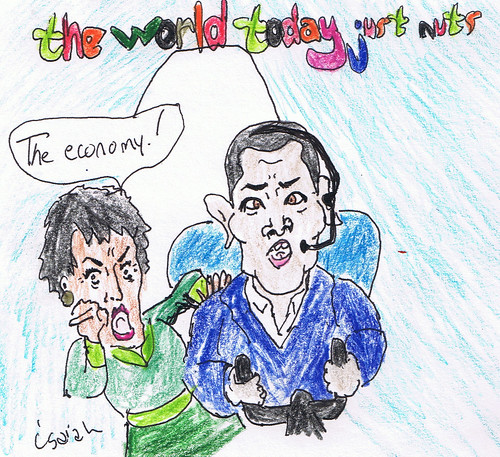
2 men, 0 women

the princess is piloting the plane


That's Isaiah's The World Today Just Nuts "The Princess Is Flying The Plane!" which went up Sunday along with Kat's "Kat's Korner: Tori's nocturnal prowl."


This is C.I.'s "Iraq snapshot:"


Monday, September 26, 2011. Chaos and violence continue, assassination attempts continue, the US military announces another death (that's 4 for the month, if someone says 2, they're not paying attention), Nouri continues his foot dragging (Political Stalemate II), a US government employee talks about fraud and waste with tax payer money, and more.
Last week, Linda J. Bilmes and Joseph E. Stiglitz had a column in the Los Angeles Times on the financial costs of the ongoing wars:

Many of these costs were unnecessary. We chose to fight in Iraq and Afghanistan with a small, all-volunteer force, and we supplemented the military presence with a heavy reliance on civilian contractors. These decisions not only placed enormous strain on the troops but dramatically pushed up costs. Recent congressional investigations have shown that roughly 1 of every 4 dollars spent on wartime contracting was wasted or misspent.
To date, the United States has spent more than $2.5 trillion on the wars in Iraq and Afghanistan, the Pentagon spending spree that accompanied it and a battery of new homeland security measures instituted after Sept. 11.
How have we paid for this? Entirely through borrowing.

The wars put the country into debt. And how was that money spent? Who benefitted. A very ugly answer -- not the Iraqi people -- emerges from a US government employee. Peter Van Buren is a US State Dept employee and he was part of a wave of diplomats sent to Iraq in 2009 in Barack's "surge." Julian Brookes (Rolling Stone) interviews him. In the excerpt I'm labeling the speakers to make it easier to follow and I've also put one remark in single quotes:
Brookes: And so then you went to Iraq and your job was to help get the local economy up and running?
Van Buren: Well, we didn't know what we were doing! When I arrived in Iraq my expectation was that I would step into the middle of this storm of busyness and somebody would tell me what to do, but it turned out everyone -- my State Department contractor teammates and the military unit I was embedded with -- was looking at me saying, "We though you knew what we were going to be doing here!"
[. . .]
Brookes: And where exactly was the money going?
Van Buren: The stupidest, most amazing thing -- I still see myself doing it -- was the micro-grant project. And this was decided on that we would kick-start small businesses by literally handing $5,000 in cash to Iraqis and encouraging them to use at the start of business. And we literally would drive into town and round up some people and hand them bundles of $5,000 in cash and say 'Please start a business.' No obligation, no follow-up. Nothing. They looked at us like we were completely insane.
Dave Davies: Now when you went to Iraq, this was in 2009. And this was far beyond the days when a lot of people would say American military policy was so misguided. By then, a lot of people think, we had figured this out. The military was much more committed to friendly engagement with the Iraqi population and reconstruction and winning hearts and minds. So you're there to do good things, to help rebuild the county. But, as you tell the story, you certainly weren't out among the people. Just tell us a little bit about your living kind of situation and how -- how that meshed with the mission that you had.
Peter Van Buren: What the PRT -- Provincial Reconstrution Team -- was supposed to do was to operate at a grass roots level, embedded with the US military to bring stability and economic success to all of Iraq -- particularly operating outside of the major cities. One of the key problems was the inability to reconstruct something while it was essentially still falling apart. The American presence in Iraq basically had three components. You had the military command which sat in a place called Victory Base. The army has no irony in its naming conventions. And they had a very limited view of things, they were very isolated. And then you had the American Embassy, the world's largest enemies surrounded by the world's largest walls that kept both bad guys and reality out. The joke was that the Embassy kept an eye on events in Iraq from the roof. And then you had the Provincial Reconstruction Teams -- me. We were small groups of people. We were embedded with military units. We would roll out in military convoys, typically riding in a military vehicles called MRAP which is like a giant monster truck. It has all sorts of armor and special electronics on it that make it less vulnerable to the IEDs that plague the campaign in Iraq for its entire life. It had machine guns at the top and full of soldiers with their game faces on. Guns, rifles, grenades -- the whole manner of stuff. Myself, I would wear body armor and a helmet, just like the soldiers wore. I wasn't armed. I didn't carry a weapon. We made quite an impression on people when we rolled through town. Sometimes when we rolled through the center of town we made quite an impression because our vehicles were tall enough that they tore down all the electrical and phone lines that were strung across the rodes. Sometimes we made quite an impression when we roared through fields and left ruts where there had been rice or wheat planeted. And often times we made quite an impression by attracting a lot of attention to people just by our presence. It was difficult to say that we ever could have normal interaction with anyone. The mere presence of us made us look like aliens descending from armored space ships in the middle of no where. Every interaction with every Iraqi took place with soldiers with weapons standing around. Often times I was told to leave my helmet and body armor on while I was speaking with the Iraqi people for my own safety. We rarely could stay in one place for too long without fear of attracting too much attention and an attack. Setting up appointments was difficult because it was dangerous to tell people too far in advance that we were arriving. We didn't want to give the bad guys too much time to get ready. And under those conditions, the ability to meet with people, to interact with them was a failure.
Dave Davies: And I believe that one of your first interactions with Iraqis involved this fellow -- I think he had the nickname McBlazer. And you had this issue you had to work out. Tell us that story.
Peter Van Buren: State Dept people love to wear blue blazers with brass buttons. It's almost kind of a uniform. And one of the Iraqis that we interacted with regularly had adopted this as his form of dress so he was nicknamed McBlazer among us. The Embassy constantly was tasking us to put on presentations, shows, lectures. We were going to tell Iraqis, "Here's how democracy works. Here's what women should be doing. Here's the way you should be running your businesses." These were hard to put on and it required a lot of logitstic arrangements, things that we couldn't possibly do on our own in a country where we couldn't travel freely, where telephone service was sporadic and where there was no infrastructure for us to work with. It became necessary for us to seek out these middle men, these operators, these carpet baggers. Slick guys, like McBlazer, who, for money, could make things happen. The very first day, as I arrived and met my team, the very first task I was handed was a -- was to commit fraud so that we could properly pay off McBlazer for the last thing. Now fraud is a nasty word to use --
Dave Davies: Let me just interrupt here. What do you mean fraud? What did you have to do?
Peter Van Buren: Well it turns out there were limits the State Department put on how much we could spend on refreshments. This was very important because without refreshments Iraqis wouldn't come to our meetings. We simply couldn't get a crowd unless we fed them. To feed them costs money and the cost of that food often times exceeded the maximum that we were allowed to spend. This doesn't stop a guy like McBlazer. He
simply created fake receipts for printing that covered the cost of the food. And my very first diplomatic action in Iraq was to be told by my colleagues to sign the fake receipts so that we could pay McBlazer for the food that we had to use to bribe the Iraqis to come to the meetings so that the Embassy would be satisfied that we were reconstructing Iraq.
That may seem like a great deal of tax payer money to waste; however, maybe the US government saw the war as a way to enrich the defense industry? Adam Entous and Nathan Hodge (Wall St. Journal) report that the US and Iraq have finalized a deal for Iraq to purchase eighteen F-16 planes with hopes of buying another 18. Thus far, they've put down $1.5 billion towards the purchase of the first 18. Suadad al-Salhy (Reuters) quotes an unnamed "senior U.S. military official" who estimates the cost for the 18 will be "roughtly $3 billion." Bob Cox (Fort Worth Star-Telegram) adds, "The sale, which has been widely expected for some time but not completed, would be the first in some time for Lockheed Martin which assembles the F-16 in Fort Worth." If you're thinking, "Well, maybe that 1.5 billion down -- on a 3 billion purchase -- saved some jobs," think again. Kevin James Shay (Maryland's Gazette) reports that Lockheed Martin announced they were laying off 540 workers in the state of Maryland. KERA (link is text and audio) notes that Lockheed Martin announced today that Fort Worth will see 370 layoffs -- this comes on top of "another 300 Fort Worth employees [. . . accepting] voluntary terminations, either through early retirements or resignations, and the company will not fill another 300 vacant jobs." David Markiewicz (Atlanta Journal-Constitution) reports Lockheed announced today they were "laying off 114 employees at its Marietta plant". Those may not be all the layoffs. (I'm surprised Palmdale doesn't have an announcement.) A few get rich. Most Americans suffer as a result of all the money wasted. And some Americans gave their lives in this war. 4 US service members have died in/from the Iraq War this month. DoD has tracked all four deaths in their official count (click here) but they have only issued announcements for two. Sunday a perfuncturary announcement was issued and, supposedly, only due to a US Senator stirring things up last week when his office called several people at the Pentagon demanding to know why deaths were not getting announcements and whether this was an accident or an order from the White House? Here's the Sunday announcement:

The Department of Defense announced today the death of a soldier who was supporting Operation New Dawn.

Sgt. Andy C. Morales, 32, of Longwood, Fla., died Sept. 22 in Baghdad, Iraq. He was assigned to the 143rd Sustainment Command (Expeditionary), Orlando, Fla.

For more information, media may contact the 143rd Sustainment Command (Expeditionary) public affairs office at 1-800-221-9401 ext. 1132 or e-mail Maj. John Adams at john.adams16@us.army.mil .

Over a million Iraqis -- well over a million -- have died in the Iraq War. And they continue to die because the war has not ended. As the war continues, violence continues to rock Iraq. Today Aswat al-Iraq reports a Kirkuk car bombing claimed 3 lives today and that two additional bombings did "material damage." In addition, they note, "An Iraqi soldier has been killed and another soldier was seriously injured in a joint US-Iraqi security operation in al-Fudheiliya township, 15 km to the east of Nassiriya city, the center of southern Iraq's Thi-Qar Province on Monday, a security source reported." Reuters adds that Mohammed Ali (Ministery of Health worker) was shot dead in Baghdad, an assault on a Baghdad police checkpoint left 1 police officer dead and two more injured, 1 Iraqi soldier was shot dead in Mosul and an attack on Mosul police checkpoint left one police officer injured. Hamid Ahmed (AP) notes the assassination of Mohammed Ali but gives his name as Mohammed Ali al-Safi and identifies him as a "senior Finance Ministry official" and Ahmed reports a Baghdad assassination attempt on Judge Munir Hadad that the judge survived; however, he was left wounded in the hand by a bullet.
Yesterday Karbala was slammed with four bombings. Aziz Alwan and Dan Zak (Washington Post) counted 15 people dead and one hundred and thirteen wounded. They also quoted Gamin al-Karbalie who is not smarter than a fourth grader. Though the bombings had just taken place, al-Karbalie just knew who was responsbile: al Qaeda in Mesopotamia. And he knew why: Because, he says, the group wants to demonstrate that Iraqi forces cannot handle security without the US.
Over 40,000 US troops are still on Iraqi soil and the bombings happened, that's A. B, how is it in al Qaeda's interest to keep US troops in the Middle East? Granted al Qaeda in Mesopotamia is a splinter group and one formed after the US invasion of Iraq; however, the goal of al Qaeda is US forces out of the Middle East. Why their motives would suddenly be to keep the US in Iraq, I don't know. But Ganim al-Karbalie apparently does. I have no idea who was responsible or why. But if you're going to point a finger and supply a motive, your little reenactment should make sense.
AP quoted provincial council member Hussein Shadhan al-Aboudi stating, "The aim of these explosions is to ignite the sectarian sedition after the killing of 22 Karbala residents in the Anbar desert two weeks ago. They also aim to destabilize the security situation in Karbala." Is he right? Who knows? But his hypothesis does add up. Tim Arango (New York Times) noted provincial council member Tariq al-Khaikani hypothesis, "Mr. Khaikani attributed the persistent violence in Iraq to the lack of ministers of interior and defense, two positions that have essentially been overseen by Prime Minister Nuri Kamal al-Maliki since the formation of a new government late last year. At the time, Mr. Maliki promised to name new heads of those ministries soon, but he has not yet done so."


The Telegraph of London (link has video and text) quoted
Mohammed Na'eim stating, "I was inside my house when I heard a big explosion. When I got outside I saw many people wounded and some bodies on the ground." Jamal Hashim (Xinhua) explained, "The attackers apparently followed old tactic which depends on creating an initial explosion to attract security forces and people, then they set off another blast to get heavier casualties, the source added." Raheem Salman (Los Angeles Times) observed, "Sunday's carnage, the latest in a series of deadly attacks across Iraq, harken back to the deadly days of civil warfare five years ago between Shiite and Sunni Muslims."
In other violence news, Today's Zaman notes Turkey continues bombing northern Iraq. AP notes that Turkish authority for these bombings expires October 17th; however, Parliament is expected to vote to extend the mandate at the beginning of next month.
And Thomas Friedman's Turkish twin, Abdullah Bozkurt (Today's Zaman), is gushing and giddy and, honestly, hostile: "The PKK made similar threats to US interests in the past, but they never materialized. The terrorist organization may act on their threats this time [. . .]" We'll check back in on Abdullah Bozkurt and his dream journal in a moment. Right now, what's got him so frisky? Dropping back to last week:
Meanwhile the government of Turkey is boasting of another round of carpet bombing today on northern Iraq. AP reports that in addition to carpet bombing the region, the government is using Heron drones to track movement (those drones supplied by the Israeli government) and intelligence passed on by the US government which the US government obtained via "U.S.-operated Predator drones". World Bulletin notes the Turkish boast of hitting "152 targets" since the bombings began on August 17th. The Times of Oman reports, "Turkish Prime Minister Recep Tayyip Erdogan has submitted a list of requests for help from the United States to counter Kurdish separatists, Anatolia news agency said Wednesday." And Erdogan's quoted stating his belief that it will be no problem for Turkey to get those predator drones from the US it requested last week.
Tom Mellen (Morning Star) puts it this way, "Turkish PM Recep Tayyip Erdogan revealed plans on Sunday to bolster joint military operations with the CIA and Iran against Kurdish guerillas based in occupied Iraq's semi-automous north." Marc Champion (Wall St. Journal) observes today, "Mr. Erdogan has begun his third term with a major aerial assault against militants from the Kurdish Workers' Party, or PKK, in their bases in the Kandil mountains of Northern Iraq. It is just the latest of many such Turkish assaults over the years, none of which have succeed in eliminating the PKK." But they're hopeful a new weapon will turn the tide, those predator drones. And that's what has Abullah Bozkurt giddy, gushing and hostile. Champion observes, "What Mr. Erdogan is offering the U.S. in exchange is less clear." Less clear? That's a nice way to put it.
AP reported Sunday that Turkish Prime Minister Recep Tayyip Erdogan has announced that, to fight Kurdish rebels in northern Iraq (PKK for Turkey, PJAK for Iran), the governments of Turkey and Iran have decided to work tother. Turkey and Iran, forming partnerships. That Iraq War sure was a success for the US government, wasn't it? And just think, the US will supply Turkey with predator drones and Turkey will share the intelligence gathered from the drones with the Iranian government. Fars News Agency reports, "Chairman of the Iranian parliament's National Security and Foreign Policy Commission Alaoddin Borougjerdi met Turkey's ambassador to Tehran on Sunday. At the meeting, the two sides discussed bilateral relations and exchanged views over other issues of mutual interest."
Over the weekend, Suha Sheikhly and Adam Youssef (Al Mada) reported on Iraq's unemployment problem noting that Diwanya Province has the highest unemployment rate and speaking to a worker who left there for Baghad only to encounter a lack of jobs there as well. Friday saw a demonstration in Baghad and unemployment has been one of the issues driving the protests but not to the degree, the reporters state, as elsewhere in the Arab region. They spoke with 24-year-old protester Jabbar who said that there were few opportunities for work. Another protester is 26-year-old Mutashar who left his wife and child in Nasiriyah to come to Baghad and find a job only to discover there were no jobs in the capitol either. Throughout the Iraq War, those selling alcohol have been regularly targeted with shootings and bombings. That doesn't deter anyone, they're so desparate for employment to feed their families. W.G. Dunlop (AFP) reports that, despite this, it remains a busy occupation with many willing to work in any of Baghdad's 96 alcohol stores. This includes Yazidi Shakir who left Mosul to make moeny for his family and now "only gets to see his family in Mosul every two months for 10 to 15 days". Unemployment was not addressed by Nouri al-Maliki despite his promising in February that it would be. He asked for 100 days and he did nothing. The 100 day deadline long ago passed. Dar Addustour noted the response of Najaf's religious authority: Refusing to receive Iraqi politicians. And it's noted that what politicians discussed months earlier with Grand Ayatollah Ali Sistani was not carried out.
Following the March 2010 elections, gridlock and paralysis set in in Baghdad. Nouri al-Maliki wasn't happy with the results (his State of Law came in second) and dug his heels in refusing to allow anything to move forward. In Novemeber 2010, the Erbil Agreement was reached with all the political blocs (except State of Law) giving up something. Nouri wanted to remain prime minister and was allowed to. The Kurds were supposed to get Article 140 of the Constitution implemented, Iraqiay was supposed to get a new commission on national security which would be independent and headed by Ayad Allawi. Those are the broad strokes. Nouri got re-appointed prime minister and promptly trashed the agreement creating Political Stalemate II. Yesterday Aswat al-Iraq reported, "The Chairman of al-Iraqiya Coalition, Iyad Allawi, has discussed the political developments in Iraq with Iraqi Kurdistan's Premier, Barham Saleh, in a meeting they held in Arbil, in which both sides have confirmed necessity to implement the Constitution and the Agreements, concluded among different Iraqi parties to form the government of national-partnership." Iraqiya has been clear on their position repeatedly. Saturday Alsumaria TV noted, "Iraqiya advisor Hani Ashour affirmed that Al Iraqiya List believes that there is no need for any meeting if Arbil agreements are not followed as a consensus political reference that would help put an end to the country's crisis and achieve effective national partnership." Each day, the rift appears to grow deeper between Nouri on one side and Iraqiya and the Kurds on the other. Dar Addustour notes Massoud Barzani, KRG President, met with Kurdish officials on Saturday to discuss their issues with Nouri al-Maliki's governance. Aswat al-Iraq notes that Barzani and Allawi met today and the following statement was issued: "Barzani and Allawi have discussed the implementation of agreements, concluded among Iraq's political parties and commitment to the Constitution, as well as finding practical means and solutions for the problems inside the political process, its development and progress." Al Sabaah adds that a Kurdish delegation may meet with Nouri al-Maliki this week to present their demands -- they're due to arrive Tuesday and the delegation is supposed to be led by KRG Prime Minister Barham Ahmed Saleh.

The Kurds and Iraqiya are among the most vocal about Nouri's refusal to follow the Erbil Agreement; however, they are not the only ones raising concerns. Ahmed Alaa (Al Mada) reports that members of the National Alliance (alligned with State of Law) are expressing doubts about Nouri's heavy-handed approach and refusal to consult with others or create a politcal dialogue. The largest objection within the National Alliance is said to come from Iraq's Supreme Islamic Council.

Among Nouri's heavy handed moves has been firing another Chair of the Integrity Commission. He did this during his first term as prime minister as well. This second go round, there was a much louder objection from Parliament and the political blocs. Aswat al-Iraq notes Nouri has appointed Judge Ala'a Jawad Hamid as the new Chair.

In an apparent effort to distract from Nouri's endless power grabs, State of Law is insisting that members of Iraq's security forces are joining or re-joining the Ba'athist Party (the Ba'athist Party was the dominant party in Iraq under Saddam Hussein and prior to his ruling the country, the Ba'ath Party, regionally, is part of a Pan-Arab movement).
The US remains in negotiations with Iraq on a continued US military presence beyond 2011. The F-16 purchase should mean the US Air Force remains ("should mean" due to past talk of this deal). In addition, some troops will be shoved under the State Dept umbrella regardless and remain in Iraq. What is known is that Yochi J. Dreazen is back in Iraq covering things for the National Journal and The Atlantic. He notes that the US military base in Basra has already seen many troops depart with more scheduled to:
The upcoming troop withdrawal won't mean the U.S. presence here disappears, however. Instead, the number of Americans in Basra will actually increase significantly in the months ahead as the State Department dramatically expands its consulate here.
U.S. officials say the consulate will eventually employ more than 1,200 people, making it larger than most embassies. The bulk of its employees will be security contractors and civilian officials from the State Department's Bureau of International Narcotics and Law Enforcement Affairs, but a small number of military personnel will be stationed within the consulate as part of State's Office of Security Cooperation, which oversees weapons sales to Baghdad and security training.

Saturday, September 24, 2011

4 men, 2 women

Friday the first hour of The Diane Rehm Show saw reporters Michael Hirsh and Karen Tumulty round out a reporters panel with sexist Ron Elving. (If you've forgotten Ron's sexist performance on cable in 2008, NPR is so happy. If you haven't, then, like me, you're wondering why White men expressing sexism openly don't warrant the firing Juan Williams received?)

The second hour, the guests were Moises Naim, Courtney Kube and Richard McGregor.

If you're a Tori Amos fan, be sure to catch her half-hour concert at Hulu. Songs are "Ruby Through The Looking Glass," "Bells For Her," "Girl" and "Concertina" -- I think that's all. If I missed one, add in a comment. In between songs performed for an audience, Tori speaks to the camera about performing. And remember, Kat's reviewing Tori's new album. It'll go up at The Common Ills sometime on Sunday. And my favorite Tori song? That's a tough one. Today I'll say "Pretty Good Year."

This is C.I.'s "Iraq snapshot:"

Friday, September 23, 2011. Chaos and violence continue, Nouri's on another power-grab, Jalal Talabani is in the US and making curious statements, a Republican debate demonstrates how DADT may not be over, and more.
We're going to start in the US because something big happened last night and you might think that with so many people writing online and unable to do any real work of any kind, you just might think they could get the point. But, yet again, they miss it completely. It's hard to believe how collectively stupid The New Yorker and all the rest can be. Last night was a GOP debate. The Republican Party is currently watching to see who they want to support for their party's presidential candidate. This is of grave interest to the stutned left as opposed to the real left. The stunted left can't find a real issue even if you taped it to their ass and let them use both hands.
One of the questions submitted via Google was from Stephen Hill, an Iraq War veteran. He was booed. And for homophobes like Amy Davidson, that's the story. And it's shocking and it's appalling and please vote Democrat!!!!!
Amy Davidson is nothing but a homophobe. If you doubt there are homophobes at The New Yorker, you haven't read very closely. A homophobe looks at a very complex threat to the gays and lesbians and instead reduces it to "mean Republicans booed! Vote Democrat!"
Amy has nothing to offer except, "Teacher! Teacher! They booed! They booed!" As a second grade tattle tale, she's almost gifted but as a grown woman she's an embarrassment. For starters, her little tattles were done yesterday and this morning by others. And I could have called them out then but I didn't take it as seriously until this afternoon when Amy Davidson suddenly 'discovered' the topic and aped everyone else already writing about it.
For those who tremble and sob right now, I suggest you grow the hell up. Anthony Mahchek is an Iraq War veteran, a wounded one. And he spoke at Columbia this year. And he was booed and heckled. It was not the end of the world or even of the end of society. We covered this in "On speaking and being booed in a democracy."
The United States is a democracy. I speak all the time, right after the election (2008) to antiwar audiences, I was booed for refusing to lie that the SOFA meant the war ended in 2011. I was booed, I was cursed. It wasn't the first time in my life and surely won't be the last time. Anyone who gets up to speak better be prepared for that. I have a right to speak, you have a right to boo me. You have a right to speak, I have a right to boo you. If the boos become a problem then something may be done. In most settings, including Columbia, booing after comments is not going to get the booer in trouble. An organized boo, a boo-in, if you will, might result in security doing something because a boo-in would prevent anyone from speaking.
But if you get before an audience -- and I have many, many times -- there's a chance you're going to get booed. If you don't want to be booed, don't put yourself out there.
The veteran took a highly unpopular stand. He was allowed to speak, people were allowed to register their objection.
[. . .]
The outrage, I do want to note, that is being churned is being churned by the Daily Mail and the New York Post. The veteran is not quoted boo-hooing that he got booed. He's been in combat, I don't think he's a cry baby. He's seen a lot worse than a negative reaction to his taking what (he must have known) was an unpopular position.
He obviously believes in his position or he wouldn't have taken it. Why did he face an angry crowd? Because he probably hopes that his remarks would lay the groundwork for them to reconsider. And it might. Or it might make it easier for the next person who speaks out in the same manner. The veteran doesn't seem stupid -- the press does -- I doubt he expected a standing ovation. I would guess his hopes were more along the lines of "I'll plant some seeds and maybe they'll sprout in a few weeks or months."
That's what we all do, regardless of the issue and our position, when we speak out on something that's unpopular. He had every right to speak and those that booed had every right to boo. That's what life is in America. Again, he doesn't seem scarred by it (he may be laughing about the whole thing) or surprised by it. There is no caste system in America. We are all equal. Your opinion is something you can share, but you're not able to pull rank on me and silence my dissent because you did this or that or whatever. That's not how free speech works.

That's fairly straightforward. I would assume most adults and teenagers could follow it. If someone disagrees with you, there's a chance that you will be booed if you speak in public. And someone almost always disagrees with you on something. No one is protectedfrom booing, not a president, not a nun, not a soldier, no one. It's part of the social contract.
Is it good that they booed Anthony Mahchek? Yeah, it is. It shows that they have the strength to disagree if nothing else. And maybe that's true of those who booed Stephen Hill as well? And like Mahcehck, I doubt Stephen Hill shed any tears over it or was surprised that some members of the audience wished he'd hide in a closet for all time. Good for him for getting his question out there.
But Amy Davidson doesn't want to tell you about that.
That seems to be a common element among the press since the 2008 election. Remember how the gas bags just couldn't understand the SOFA? Remember how confusing tht was for them? In November 2008, on Thanksgiving Day, when the White House finally released the SOFA, we were able to figure it out. But then our main concern was the Iraq War not how to spin things for partisan politics. Anyone with even a basic understanding of contract law who took the time to readover the SOFA would have quickly realized it was a three year contract replacing the one year one (the UN mandate). Yes, the SOFA said that all US troops would leave Iraq at the end of 2011. And for those completely stupid, that was the end of it. But there were kill clauses that would allow the SOFA to be killed and that provision about 2011? That was only if nothing replaced the SOFA and the SOFA wasn't extended.
The gas bags misled America on the SOFA. Now they're doing the same on LGBT rights. I'm not in the mood to play.
Don't Ask, Don't Tell wasn't repealed, it was vanished. An important decision on Don't Ask, Don't Tell came from Judge Virginia Phillips of the United States District Court for the Central District of California. She found it unconstitutional. That was her ruling. That ruling needs to stand. As Marcia noted earlier this week, the Justice Department is attempting to get the decision tossed. If the decision is vacated, Stephen Hill's question becomes even more important.
Here's what Stephen Hill asked:
In 2010, when I was deployed to Iraq, I had to lie about who I was, because I'm a gay soldier and I didn't want to lose my job. My question is, under one of your Presidencies, do you intend to circumvent the progress that's been made for gay and lesbian soldiers in the military?
There was booing. And that's all the Amy Davidson's care about. I believe Stephen Hill's concern, however, was about equality in the US military. I don't think his concern was hurt feelings over what Republicans might do. Had that been his concern, he probably wouldn't have asked his question.
Why did complain about the way Don't Ask, Don't Tell was handled? Because there's nothing on the books in terms of a law. As pointed out here repeatedly, Barack didn't sign a law guaranteeing equality. No law was passed on that. Don't Ask, Don't Tell was simply removed from the books. Therefore it could come back under a different president. If it does come back, one thing that would help gay soldiers would be Judge Phillips' ruling which is why the Justice Dept needs to stop trying to overturn the judge's decision. It hurts the Justice Dept not one bit for that decision to stand. It's a historic decision and one that needs to be cited in other cases. If the decision is vacated, stare decis doesn't apply, no precedent was set via the decision. That matters tremendously and for those who never got why, last night's debate pointed it out. From the official Fox News transcript, this is the response from Rick Santorum to Stephen Hill's question.

SANTORUM: Yeah, I -- I would say, any type of sexual activity has absolutely no place in the military. And the fact that they're making a point to include it as a provision within the military that we are going to recognize a group of people and give them a special privilege to -- to -- and removing "don't ask/don't tell" I think tries to inject social policy into the military. And the military's job is to do one thing, and that is to defend our country.

We need to give the military, which is all-volunteer, the ability to do so in a way that is most efficient at protecting our men and women in uniform.

(APPLAUSE)

And I believe this undermines that ability.

(APPLAUSE)

KELLY: So what -- what -- what would you do with soldiers like Stephen Hill? I mean, he's -- now he's out. He's -- you know, you saw his face on camera. When he first submitted this video to us, it was without his face on camera. Now he's out. So what would you do as president?

SANTORUM: I think it's -- it's -- it's -- look, what we're doing is playing social experimentation with -- with our military right now. And that's tragic.

I would -- I would just say that, going forward, we would -- we would reinstitute that policy, if Rick Santorum was president, period.

That policy would be reinstituted. And as far as people who are in -- in -- I would not throw them out, because that would be unfair to them because of the policy of this administration, but we would move forward in -- in conformity with what was happening in the past, which was, sex is not an issue. It is -- it should not be an issue. Leave it alone, keep it -- keep it to yourself, whether you're a heterosexual or a homosexual.

I don't want to debate Santorum on this issue. I cleary believe he's wrong and we could play Dumb Ass one step above Amy Davidson and go into all the ways in which Santorum's wrong. But if we're going to be adults and not homophobes, because we're going to pay attention to what he said in relation to what Stephen Hill asked.
Would President Rick Santorum "circumvent the progress that's been made for gays and lesbian soldiers in the military?" And Santorum's answer is: Yes, he would reinstate Don't Ask, Don't Tell. By his own words. (I actually would guess he'd do far worse. Were he president, I think he would go back to the 1982 directive from Reagan which barred gays from serving.)
How is that possible?
No, the answer isn't, "Because Rick Santorum's an idiot." Whether he's smart or not, he's intelligent enough to grasp what the next president can do: Refuse to allow gays and lesbians in the military.
That might make Rick Santorum a mad genius, that he sees what so many refuse to. This is exactly what we pointed out repeatedly on Don't Ask, Don't Tell. You don't vanish it, you overturn it. If you vanish it, if you just wipe it away, there's nothing to prevent it from coming back.
Congress should have gone with an equality law. The White House didn't want that. And currently the White House wants to destroy Judge Virginia Phillips' ruling -- even as we now know that at least one Republican wanting to get into the White House plans to ban gays and lesbians from serving if he becomes president.
Judge Phillips' ruling needs to stand. And it was a huge, huge mistake on the part of the Congress and the White House to act as if they did something amazing. They didn't. And if you're concern is equality and not scoring partisan points for one side or the other, that's what you address. You address the realities that Stephen Hill and so many others could be facing. But The New Yorker and Amy Davidson want to play you and waste your time. I'm sorry, I don't tolerate or embrace homophobia. I call it out. I did so when Barack Obama put homophobes on stage at campaign events. When an 'ex-gay' preached hate at an official campaign event, I didn't play dumb and stupid. Amy Davidson is a homophobe because she only cares about homophobia when she score points against a Republican. Furthermore, she'll deliberately confuse the issue and waste everyone's time while risking the hard earned rights of the LBGT community in order to avoid addressing the real issue, the real question Stephen Hill was asking which is that Don't Ask, Don't Tell got erased but nothing was put in to protect gays and lesbians in the military from future discrimination.

Until you'r ready to deal with that, you don't need to weigh in on the issue. You're just causing problems. The same way those who insisted the SOFA meant US forces all leave Iraq at the end of 2011. That end is approaching but the US is engaged in engaged in negotitations to extend the US military presence. Maybe had a lot of uninformed idiots not lied and whored, those of us who believed in "OUT OF IRAQ NOW!" would have stayed focused on the issue and troops would already be out of Iraq.
December 21, 2010 was an important day. Iraq is currently in Political Stalemate II which began December 21st when Nouri al-Maliki's inability to follow the Constitution and nominate a Cabinet which Parliament signed off on was overlooked and he was illegally moved from prime minister-designate to prime minister. In the nine months, two days and counting since, Nouri's been unable or unwilling to fill the security ministries. Acting ministers are not real ministers. They've never been voted on by Parliament so they have no real powers and can be dismissed by Nouri at any time without any oversight from Parliament. The puppet has puppets.

The Political Stalemate largely results from the failure of Nouri to abide by the Erbil Agreement -- the understanding which ended Political Stalemate I. Nouri got what he wanted out of the agreement (to remain prime minister) and then trashed the agreement. Ayad Allawi and his Iraqiya political slate have been highly critical of Nouri over this. More recently, the Kurdish voice calling for a return to the Erbil Agreement has grown stronger. Currently, Nouri and the Kurds are at logger heads. Earlier this week, Speaker of Parliament Osama al-Nujaifi traveled to the Kurdistan Regional Government to meet with Kurdish officials.

Al Sabaah reports that while al-Nujaifi did carry a few ideas or proposals with him, they were verbal and nothing in writing. Both sides were in agreement that the Constitution needed to be followed and, the paper reports, there are plans for a meet-up between the Kurds, Iraqiya and the National Alliance. New Sabah spoke with the National Alliance's Hassan al-Jubouri earlier this week and he stressed the need for a consensus to be reached.

Al Mada reports that al-Nujaifi will visit Iran and Turkey to raise the issues of their bombing northern Iraq. In addition, al-Nujaifi told the press that the Constitution must be followed and any oil and gas law must result from dialogue and discussions. One of the Kurds chief complaints is Nouri's proposed oil & gas bill. Kurds have strong reasons to complain, Nouri's staged yet another power grab and gone back on an agreement. Ahmed Rasheed (Reuters) reports that the 2007 agreement has been pushed aside, "The amended law would give the oil ministry authority to hold bidding rounds for most oil and gas fields, leaving currently producing fields and discovered but undeveloped fields close to them in the hands of a newly created Iraqi National Oil Company (INOC). The 2007 draft version restricted the ministry to auctions for discovered, undeveloped fields. The changes could result in the inclusion of Kurdish fields in future auctions, which the Kurds say they will not accept." Reuters also provides an overview of past oil laws and bills. As Nouri attempts this power grab, maybe it's worth noting how Shell Oil got a pending deal under his 'leadership'? Ben Lando and Ben Van Heuvelen (Iraq Oil Report) utilize WikiLeaks cables to demonstrate that Shell was laughing and mocking Iraqi officials, bragging about how they were so stupid Shell had to teach them basic economics. The reporters notes that "in contrast to the transparent and competitive bidding rounds that the Iraqi Oil Ministry held in 2009 and 2010 for oil and gas contracts, the Shell deal has been brokered behind closed doors. Critics have charged that the noncompetitive and secret process has put Shell's prerogatives -- particularly its desire to export gas -- ahead of Iraq's interests. And although the draft contract that now stands before the Cabinet is substantially different than the agreement that first drew widespread opposition, the deal remains haunted by its shadowy history."
So Nouri's hand-picked team was a laughing stock to Shell? At what point does this start to reflect on Nouri? He's not a newbie. He's been prime minister since 2006. That's five years. In that time he has repeatedly demonstrated little concern for the needs of the Iraqi people and he has refused to listen to other politicians.
Al Mada quotes Ayad Allawi stating that he urges dialogue and that Iraq has entered into a "crisis" period which must be resolved. But it's another Al Mada article today in which Allawi voices his thoughts at length including that the only thing the Erbil Agreement achieved was to inaugurate Nouri as prime minister. The article notes that Iraqiya met yesterday and quotes their spokesperson as she states that Iraqiya has repeatedly provided Nouri an opportunity to return to the Erbil Agreement and that this is the last time they will urge him to do so. Whether or not this means Iraqiya will move for a no-confidence vote is not addressed in the article. Since it's not addressed in the article, either it's not being planned or it's being kept a secret plan. And Al Mada notes the Kurdish bloc is denying that any secret deal has been made between political blocs, that the only deal is the Erbil Agreement.
Meanwhile Iraqi President Jalal Talabani is out of the country. He's in the US and today he spoke to the United Nations. Many things about his visit trouble some observers but maybe what should be most eye brow raising is this series of remarks from his speech to the UN:
Iraq is concerned about the tragic situation of the Palestinian People which is the result of Israeli Practicis which are incompatible with international laws and customs and international humanitarian law. Iraq is doing everything in its capacity to support the struggle of Palestinian People in getting all its inalienable rights, in particular establish its independent state on their homeland, with its capital Jerusalem, and inthis regard, Iraq endorses and supports the direction of the Palestinian Authority to go to to the United Nations to achieve full international recognition of a Palestinian state during the meeting of the current session of the General Assembly, and calls on the international community and all peace-loving forces to stand by the Palestinian people in their legitimate struggle to achieve its goals, and demanding the Israeli government to fully withdraw from all Arab territories occupied in 1967. This would contribute to the settlement of the Arab-Israeli conflict, and to bring comprehensive fair peace in this vital region of the world.
Those are laughable statements coming from Talabani. Not only because of Iraq's own problems with human rights, but also because, golly molly jolly gee who could it have been that had Palestinian refugees trapped on the border for almost seven years? Oh, that's right. Iraq. Yeah. It wasn't until February 2010, when Syria agreed to take them in, that these stranded persons were finally given something other than a desert prison posing as a 'refugee camp.' And, stay with me, it gets worse, which country was it that saw the Palestinian Human Rights worker kidnapped? Oh, right again, Iraq. Wednesday it was reported that "gunmen wearing the attire of the Iraqi Ministry of Interior" kidnapped Qusaia Abdul-Raouf. International Middle East Media Center reports:
The foundation said that, on Wednesday evening, Qusai Abdul-Raouf was on tour documenting the increasing attacks carried out by the Iraqi Forces against the Palestinian refugees in Al Baladiyyat neighborhood in Baghdad.
During his documentation tour, a black tented shevorleh parked near him, and three gunmen wearing the attire of the Iraqi Forces, operating under the Ministry of Interior, violently placed him in their vehicle and drove away. His whereabouts remain unknown until the time of this report.
Palestinian refugees are subject to kidnap and murder in Iraq as some groups accuse them of being supporters of the former Iraqi President, Saddam Hussein.
Dozens of attacks were carried out against the Palestinian refugees since the war on Iraq in 2003 leading to the death, injury, and abduction of hundreds of refugees.

And the president of Iraq wanted to get up before the UN today and claim concern about the plight of Palestinians?
Meanwhile Aswat al-Iraq reports that protesters gathered in Baghdad's Tahrir Square today to protest over the large amount of money being spent so Jalal Talabani can be in the US. Of the protest, the Great Iraqi Revolution reports, "Our correspondent in Tahrir Square:: A number of ambulances are seen near the Square. By every one of these ambulances stood four intelligence officers, curiously enough, the ambulances' engines were running and later it became apparent that they intended to abduct some of the activists and protestors." And ambulance 1038 was used in the abduction of Sanaa Aldulaimi overseen "by an intelligence officer called Abdullah Al Rikabi" -- Sanaa Aldulaimi was later released.
Turning to other reported violence, Reuters notes multiple bombs went off in a single Baghdad leaving 4 injured and nine wounded. Aswat al-Iraq notes a Baquba attack left 1 police officer dead and three more injured, and an armed attack in Mosul left 1 Iraqi soldier dead, a second armed assault left 1 woman dead. Alsumaria News notes 1 female corpse was discovered outside of Kut. Three Chrisians were kidnapped on a Kirkuk hunting trip (see yesterday's snapshot). Alusmaira News reports that the ransom for the three is set at 600,000 dollars. Aswat al-Iraq reports Ary Mohammed Ali was kidnapped in Kirkuk yesterday and the kidnappers have stated their ransom is $50,000.
Back to the US, Senator Patty Murray is the Chair of the Veterans Affairs Committee. Her office notes:

(Washington, D.C.) -- Today, Senate Veterans' Affairs Committee Chairman Patty Murray applauded the passage of H.R. 2646, the Veterans Health Care Facilities Capital Improvement Act of 2011. This bipartisan legislation will allow for new construction projects in five states and Puerto Rico and will allow VA programs to operate uninterrupted, including vital assistance to homeless veterans. The bill also includes approval for upgrades at the VA Medical Center in Seattle.

"VA has worked tirelessly to get veterans off the streets and into housing. Their efforts are commendable, but there is still work to be done," said Senator Murray. "H.R. 2646, as amended, contains critical extensions to many of VA's programs to end homelessness among veterans. Our nation's veterans have sacrificed much in their service to this country, we must make sure they receive the care and benefits they earned."

"I'm also delighted that this bill would allow VA to begin a $51.8 million project to seismically strengthen the nursing tower and community living center at the VA Puget Sound Healthcare System in Seattle, Washington. It is vital that this building be upgraded so that the VA Puget Sound Healthcare System can continue to deliver world-class healthcare to veterans in a safe environment."

Specifically, the Veterans Health Care Facilities Capital Improvement Act of 2011 will:

· Allow for seismic corrections for Building 100 at the VA Medical Center in Seattle, Washington, in an amount not to exceed $51.8 million;

· Authorize job-creating infrastructure improvements to VA's facilities;

· Authorize increased funding for the Supportive Services for Veteran Families program, which provides prevention and rapid rehousing assistance for homeless veterans;

· Authorize increased funding for the Grant and Per Diem program, which provides transitional housing assistance for homeless veterans;

· Reauthorize the special needs set aside in the Grant and Per Diem program which provides transitional housing for the frail, elderly, terminally ill, women, and those with children; and

· Reauthorize the Homeless Veterans' Reintegration Program, which provides employment assistance for homeless veterans.

###