Editorial: What's the cost, what's the exit strategy?
Last Thursday, the House Foreign Affairs Committee held a hearing on the Islamic State and Iraq (see "Iraq snapshot" and "Iraq snapshot" ) and heard testimony from the Special Presidential Envoy for the Global
Coalition to Counter ISIL John Allen as well as Brig Gen Michael Fantini
and Brig Gen Gregg Olson.
In the hearing, US House Rep. Alan Grayson (above) raised the issue of spending.
US House Rep Alan Grayson: Gen Olson, trying to piece together information from public sources, it appears to me that we're spending roughly a million dollars for every ISIS fighter that the US military kills. Does that sound right to you?
Brig Gen Gregg Olson: The figure that we understand for the operation cost per day is about 8.5 million dollars.
US House Rep Alan Grayson: But am I right to think that we're spending approximately a million dollars for every single ISIS fighter that US forces kill?
Brig Gen Gregg Olson: I-I haven't done the math, sir.
US House Rep Alan Grayson: Alright let's assume for the sake of the argument that that's correct. Does it make sense for us to be deploying the most powerful military force that the world has ever seen and spend one million dollars to kill some man standing in the desert, 6,000 miles from the closest American shore, holding a 40-year-old weapon? Does that make sense?
Brig Gen Gregg Olson: The military strategy as designed provides US support to a coalition that will degrade, dismantle and ultimately defeat ISIL.
US House Rep Alan Grayson: What about you, Gen Fantini? Can you think of ways that we could spend less than a million dollars and still keep America safe for every gentleman standing in a desert, 6,000 miles away, whom we kill?
Brig Gen Michael Fantini: Congressman, I-I can't address the math that you're presenting. I don't know whether that's accurate or not. Uh, from the perspective of continuing with the strategy of developing local forces, to enable those local forces with coalition support to degrade and defeat ISIL, I would submit that is a worthy expenditure of resources.
US House Rep Alan Grayson: Well let's talk about that. You of course are very, very familiar with what Gen Powell said about what makes for a good effective war and what doesn't. Gen Powell said that we need a vital national security interest that's pursued by a clear strategy, we need overwhelming force and we need an exit strategy. So let's start with you on that, Gen Allen, what is our exit strategy?
The National Priorites Project notes:
With that kind of a price tag, you'd think Americans would be asking for Barack to clearly define a plan and to explain its costs.
You'd also think they'd be asking what is the exit strategy for the latest wave of the never-ending Iraq War.
Grayson asked.
US House Rep Alan Grayson: Well let's talk about that. You of course are very, very familiar with what Gen Powell said about what makes for a good effective war and what doesn't. Gen Powell said that we need a vital national security interest that's pursued by a clear strategy, we need overwhelming force and we need an exit strategy. So let's start with you on that, Gen Allen, what is our exit strategy?
Envoy John Allen: The exit strategy is an Iraq that ultimately is territorial secure, sovereign, an ISIL that has been denied safe haven ultimately has been disrupted to the point where it has no capacity to threaten at an existential level the government of Iraq and the nation of the Iraqi people and ulitmatly ends up in a state that does not permit it to threaten the United States or our homeland.
US House Rep Alan Grayson: General Allen, that doesn't sound like a strategy to me. That sounds like a wish list.
Envoy John Allen: You know --
US House Rep Alan Grayson: You certainly understand the difference between a strategy and a wish list.
Envoy John Allen: And-and I do. And this strategy, in fact, has a whole series of lines of effort that converge on Da'ash to prevent it from doing the very things that I just mentioned.
US House Rep Alan Grayson: But what is our strategy?
Envoy John Allen: The strategy is to pursue a series of lines of effort from defense of the homeland to stabilization of the Iraqi government to the countering of the Da'ash message, to the disruption of its finances, to the -- uh -- impediment of the foreign fighters to the empowerment of our allies to the le-leadership of a coalition ultimately aimed to the defeat of Da'ash. That's a strategy.
US House Rep Alan Grayson: But none of those are exit strategies, right?
Envoy John Allen: There is no exit strategy for this. This is about dealing with Da'ash. This is about defeating Da'ash. The success of the strategy is not about exit. The secees -- success of the strategy is about empowering our partners so that they can ultimately restore the territorial integrity and the sovereignty of a country and deny Da'ash the ability ultimately to, uh, to do that.
Once upon a time there was an Out of Iraq Caucus in the House.
It's a shame that those who belonged to the caucus are largely silent on Iraq today.
This is C.I.'s "Iraq snapshot:"
Tuesday, March 31, 2015. Chaos and violence continue, Tikrit is liberated!, oops not so fast, Barack Obama spent a lot of time courting Iran but there appears to be no wedding announcement, and much more.
Today, Iraq's Prime Minister Haider al-Abadi Tweeted:
Others rushed to join in the chorus of hosannahs. Rahshan Saglam, (Press TV) declared, "Iraqi Federal police forces and the popular mobilization have liberated the presidential palaces and raised the Iraqi flag in the Tikrit Mosque, the central prison and the University of Tikrit." AFP added, "The operation to retake the hometown of former president Saddam Hussein began on March 2 and had looked bogged down before Iraqi forces made rapid advances in the past 48 hours." And Khalid Al-Ansary and Caroline Alexander (Bloomberg News) called it the country's "biggest military victory over Islamic State."
But . . .
ARR notes that after al-Abadi made his announcement, "local commander Abdul-Wahab al-Saadi said that soldiers were still about 300 yards from the city centre." And the New York Times' Rod Norland, Falih Hassan and Omar Al-Jowoshy (as well as an unnamed journalist in Tikrit) report:
In Tikrit, however, an Iraqi general, who asked not to be named so as to avoid openly contradicting the prime minister, said that reports of Tikrit’s fall were at best premature.
“God willing, it will fall,” he said.
Other military officers and a civilian official reached in Tikrit said it was true that Iraqi forces had advanced into the center of the city and had entered government buildings and parts of the Republican Palace. But they said that parts of the palace remained in Islamic State hands and that fighting was continuing.
And the Times team notes such claims of 'liberation' also took place last June and point to their June 29th article documenting that. Mitchell Prothero (McClatchy Newspapers) reports:
Iraqi Prime Minister Haidar al Abadi announced that the city’s western and southern portions had been liberated, but military commanders involved in the operation warned that at least three neighborhoods and a palace complex defended by hundreds of Islamic State fighters remained out of government hands.
It's not unlikely that the operation could wrap up soon.
Remember the small number of militia members who walked out after the US government ordered US air strikes last week? They rushed back in this week.
Why?
Because they felt the operation was about to wrap up and that the Americans would grab the credit for its accomplishments (however small or large the accomplishments might be).
Loveday Morris (Washington Post) notes, "Militia leaders refused to admit Tuesday that they were still working under American air cover. One coalition strike occurred overnight as the pro-government forces advanced, according to Col. Wayne Marotto, a spokesman for the coalition operation."
They weren't the only ones failing to note the air strikes.
In his public remarks, Haider al-Abadi thanked the Iraqi security forces as well as the militias.
He pointedly did not think the US pilots -- this despite his begging for this help and assistance.
Regardless of what happens next, the operation is a failure and will always remain one.
There are two main reasons why it is a failure.
1) It took way too long.
Tikrit was chosen to rally the spirit among the Iraqi forces.
It was felt that attacking in Saddam Hussein's hometown would goad the forces into stronger fighting and give them a target worth winning.
While it has led to many excesses -- which include War Crimes that people seem more comfortable calling "human rights abuses" -- it didn't lead to a quick and decisive victory.
Tikrit is still not completely controlled by Baghdad's fighters and it's been a month. (Some like to say it started March 2nd. It was still March first on the Pacific Coast.)
As it now stands, the takeaway is that the mission was going nowhere until US war planes got involved. Fair or not, that is the takeaway.
So the operation that was supposed to rally and provide hope ended up demonstrating the vast limitations of the forces.
2) Haider lied.
It's never a good idea for a leader to lie to the people.
We can dissect Plato's notions of the cave and the noble lie and blah blah blah.
But the reality is that Haider has now said Tikrit is liberated and it's not.
It may yet be.
But he said it before it happened.
He now looks rather foolish.
He can always point to Barack Obama who looks even more foolish.
"Without preconditions," then-US Senator Barack insisted of his planned talks with Iran should he be elected US president.
Apparently, he also meant to say "without time limitations."
He has wasted years on negotiations with Iran.
And, yes "wasted" is the term.
The deadline for his hoped for deal -- details to come, as always, after a deal had been negotiated -- came and went.
And still the US is engaged in negotiations.
This is stupidity beyond belief and why so many are so bothered by Barack.
As we noted March 22nd:
Democratic leadership in the Senate has made clear to Barack that, if there's a deal to make with Iran, he needs to make it already.
Not only has his dilly-dallying on a treaty harmed Iraq, it's also harming the image of the United States which is beginning to appear as indecisive as Barack himself. (That was the point Harry Reid was conveying to the White House last week.)
The United States looks very weak now.
Today was the deadline and the deadline passed but negotiations continued.
The power of no.
You have to be willing to walk away.
If you're not willing to walk away, they own you.
In the entertainment industry, we know our "no" is as powerful as our "yes."
And we know we need to be prepared to say "no."
Debra Winger's made a career out of saying "no" better than anyone. Bill Murray has a film career -- something none of his SNL peers can't claim -- because he has always understood the power of "no."
You have to be willing to walk away.
And that may mean you lose out on something but it also means, in the next negotiation, people know you're not going to cave.
There was never any reason to waste so much time on one deal (with anyone, leave Iran out of it for now).
There was no reason when issues still remained unresolved to bring Barack into publicly.
You keep the president out of the negotiations publicly until the deal is set and that's when he or she swoops in to look like the gifted and talented.
Instead it looks like yet another failure by Team Barack -- like the failed bid to get the Olympics in Chicago, remember that?
When the time ran out, the US should have walked away from the table.
That wouldn't mean an end to talks.
24 hours later, the talks could be restarted for whatever reason.
But you make the point that you will walk away.
And if you fail to make that point, no one takes you seriously.
Nor should they.
In addition, by staying in negotiations after the deadline passed, the US showed their hand. There's no more bluffing. Clearly the deal is more important to the US than it is to Ian. All future negotiations will be the US government speaking from a position of weakness.
Now in terms of Iran . . .
As Betty noted, the most likely outcome of a deal with Iran was a contract that would be used for war. That is what tends to happen in the last two decades when leaders of foreign countries make concessions to the US government -- see Saddam Hussein (letting the inspectors back in) and Muammar Gaddafi (agreeing to demands of Bully Boy Bush only to be targeted shortly after by Barack).
In terms of Iran and Iraq, the White House has failed.
It has failed to speak up for the Sunni population, to condemn attacks on them, etc.
It's done so to avoid angering the government in Iran.
Iran's led Barack around on all fours by a ring in his nose for the last year.
And the result is that the US remained silent on the abuses of Iraqi forces, the War Crimes.
We noted the horror of a Sunni man being set on fire by Iraqi forces. More recently there was the 11-year-old boy shot dead by Iraqi forces. Those were caught on video.
Iraqi Spring MC posted a video today.
Watch how the Iraqi forces treat a citizen they've detained.
Grasp that they do this knowing they are recording one another.
They stroke and play with the man's beard in a manner that is the behavior of a predator.
They slap him and hit him repeatedly.
This is a civilian. A Sunni civilian, so he doesn't matter to the forces, but the man is a civilian.
And for their amusement, they hit him. Repeatedly.
The same State Dept that condemns this and that action in other countries -- or when carried out by the Islamic State -- has been silent.
The consensus among members of Congress has been that the White House didn't (a) want to risk pushing Iraq closer to Iran and (b) didn't want to risk angering Iran (which supplies, trains and supports many of the thugs in Iraq) in the midst of (never-ending) negotiations.
Now maybe members of Congress are wrong.
Maybe even without the pursuit of an Iran deal, Barack would have remained silent about the abuses in Iraq?
He certainly stayed silent from 2010 through 2014 (Nouri's second term) until June. This was after the exposure of torture chambers and the Iraqi forces murdering peaceful protesters and so much more. Barack stayed silent throughout all of that.
That silence prompted this.

If you can't walk away from the table, then you just lost everything -- including your ability to bluff.
Where is the work on a political solution in Iraq?
Haider Al-Abadi also Tweeted the following:
That was today. Yesterday, he Tweeted:
Hopefully, in these visits, the need for a political solution is being conveyed.
And the need for it to come quickly.
The Iraqis suffered under Nouri al-Maliki's empty words and promises.
Haider should be getting results.
If he doesn't, then US support needs to diminish.
Margaret Griffis (Antiwar.com) counts 252 violent deaths today.
They didn't live to see a political solution in Iraq.
Will anyone?
iraq
reuters
the washington post
loveday morris
bloomberg news
caroline alexander
iraqi spring mc
mcclatchy newspapers
mitchell prothero
Today, Iraq's Prime Minister Haider al-Abadi Tweeted:

PM Al-Abadi announces the liberation of Tikrit and congratulates Iraqi security forces and popular volunteers on the historic milestone
Others rushed to join in the chorus of hosannahs. Rahshan Saglam, (Press TV) declared, "Iraqi Federal police forces and the popular mobilization have liberated the presidential palaces and raised the Iraqi flag in the Tikrit Mosque, the central prison and the University of Tikrit." AFP added, "The operation to retake the hometown of former president Saddam Hussein began on March 2 and had looked bogged down before Iraqi forces made rapid advances in the past 48 hours." And Khalid Al-Ansary and Caroline Alexander (Bloomberg News) called it the country's "biggest military victory over Islamic State."
But . . .
ARR notes that after al-Abadi made his announcement, "local commander Abdul-Wahab al-Saadi said that soldiers were still about 300 yards from the city centre." And the New York Times' Rod Norland, Falih Hassan and Omar Al-Jowoshy (as well as an unnamed journalist in Tikrit) report:
In Tikrit, however, an Iraqi general, who asked not to be named so as to avoid openly contradicting the prime minister, said that reports of Tikrit’s fall were at best premature.
“God willing, it will fall,” he said.
Other military officers and a civilian official reached in Tikrit said it was true that Iraqi forces had advanced into the center of the city and had entered government buildings and parts of the Republican Palace. But they said that parts of the palace remained in Islamic State hands and that fighting was continuing.
And the Times team notes such claims of 'liberation' also took place last June and point to their June 29th article documenting that. Mitchell Prothero (McClatchy Newspapers) reports:
Iraqi Prime Minister Haidar al Abadi announced that the city’s western and southern portions had been liberated, but military commanders involved in the operation warned that at least three neighborhoods and a palace complex defended by hundreds of Islamic State fighters remained out of government hands.
It's not unlikely that the operation could wrap up soon.
Remember the small number of militia members who walked out after the US government ordered US air strikes last week? They rushed back in this week.
Why?
Because they felt the operation was about to wrap up and that the Americans would grab the credit for its accomplishments (however small or large the accomplishments might be).
Loveday Morris (Washington Post) notes, "Militia leaders refused to admit Tuesday that they were still working under American air cover. One coalition strike occurred overnight as the pro-government forces advanced, according to Col. Wayne Marotto, a spokesman for the coalition operation."
They weren't the only ones failing to note the air strikes.
In his public remarks, Haider al-Abadi thanked the Iraqi security forces as well as the militias.
He pointedly did not think the US pilots -- this despite his begging for this help and assistance.
Regardless of what happens next, the operation is a failure and will always remain one.
There are two main reasons why it is a failure.
1) It took way too long.
Tikrit was chosen to rally the spirit among the Iraqi forces.
It was felt that attacking in Saddam Hussein's hometown would goad the forces into stronger fighting and give them a target worth winning.
While it has led to many excesses -- which include War Crimes that people seem more comfortable calling "human rights abuses" -- it didn't lead to a quick and decisive victory.
Tikrit is still not completely controlled by Baghdad's fighters and it's been a month. (Some like to say it started March 2nd. It was still March first on the Pacific Coast.)
As it now stands, the takeaway is that the mission was going nowhere until US war planes got involved. Fair or not, that is the takeaway.
So the operation that was supposed to rally and provide hope ended up demonstrating the vast limitations of the forces.
2) Haider lied.
It's never a good idea for a leader to lie to the people.
We can dissect Plato's notions of the cave and the noble lie and blah blah blah.
But the reality is that Haider has now said Tikrit is liberated and it's not.
It may yet be.
But he said it before it happened.
He now looks rather foolish.
He can always point to Barack Obama who looks even more foolish.
"Without preconditions," then-US Senator Barack insisted of his planned talks with Iran should he be elected US president.
Apparently, he also meant to say "without time limitations."
He has wasted years on negotiations with Iran.
And, yes "wasted" is the term.
The deadline for his hoped for deal -- details to come, as always, after a deal had been negotiated -- came and went.
And still the US is engaged in negotiations.
This is stupidity beyond belief and why so many are so bothered by Barack.
As we noted March 22nd:
Democratic leadership in the Senate has made clear to Barack that, if there's a deal to make with Iran, he needs to make it already.
Not only has his dilly-dallying on a treaty harmed Iraq, it's also harming the image of the United States which is beginning to appear as indecisive as Barack himself. (That was the point Harry Reid was conveying to the White House last week.)
The United States looks very weak now.
Today was the deadline and the deadline passed but negotiations continued.
The power of no.
You have to be willing to walk away.
If you're not willing to walk away, they own you.
In the entertainment industry, we know our "no" is as powerful as our "yes."
And we know we need to be prepared to say "no."
Debra Winger's made a career out of saying "no" better than anyone. Bill Murray has a film career -- something none of his SNL peers can't claim -- because he has always understood the power of "no."
You have to be willing to walk away.
And that may mean you lose out on something but it also means, in the next negotiation, people know you're not going to cave.
There was never any reason to waste so much time on one deal (with anyone, leave Iran out of it for now).
There was no reason when issues still remained unresolved to bring Barack into publicly.
You keep the president out of the negotiations publicly until the deal is set and that's when he or she swoops in to look like the gifted and talented.
Instead it looks like yet another failure by Team Barack -- like the failed bid to get the Olympics in Chicago, remember that?
When the time ran out, the US should have walked away from the table.
That wouldn't mean an end to talks.
24 hours later, the talks could be restarted for whatever reason.
But you make the point that you will walk away.
And if you fail to make that point, no one takes you seriously.
Nor should they.
In addition, by staying in negotiations after the deadline passed, the US showed their hand. There's no more bluffing. Clearly the deal is more important to the US than it is to Ian. All future negotiations will be the US government speaking from a position of weakness.
Now in terms of Iran . . .
As Betty noted, the most likely outcome of a deal with Iran was a contract that would be used for war. That is what tends to happen in the last two decades when leaders of foreign countries make concessions to the US government -- see Saddam Hussein (letting the inspectors back in) and Muammar Gaddafi (agreeing to demands of Bully Boy Bush only to be targeted shortly after by Barack).
In terms of Iran and Iraq, the White House has failed.
It has failed to speak up for the Sunni population, to condemn attacks on them, etc.
It's done so to avoid angering the government in Iran.
Iran's led Barack around on all fours by a ring in his nose for the last year.
And the result is that the US remained silent on the abuses of Iraqi forces, the War Crimes.
We noted the horror of a Sunni man being set on fire by Iraqi forces. More recently there was the 11-year-old boy shot dead by Iraqi forces. Those were caught on video.
Iraqi Spring MC posted a video today.
Watch how the Iraqi forces treat a citizen they've detained.
Grasp that they do this knowing they are recording one another.
They stroke and play with the man's beard in a manner that is the behavior of a predator.
They slap him and hit him repeatedly.
This is a civilian. A Sunni civilian, so he doesn't matter to the forces, but the man is a civilian.
And for their amusement, they hit him. Repeatedly.
The same State Dept that condemns this and that action in other countries -- or when carried out by the Islamic State -- has been silent.
The consensus among members of Congress has been that the White House didn't (a) want to risk pushing Iraq closer to Iran and (b) didn't want to risk angering Iran (which supplies, trains and supports many of the thugs in Iraq) in the midst of (never-ending) negotiations.
Now maybe members of Congress are wrong.
Maybe even without the pursuit of an Iran deal, Barack would have remained silent about the abuses in Iraq?
He certainly stayed silent from 2010 through 2014 (Nouri's second term) until June. This was after the exposure of torture chambers and the Iraqi forces murdering peaceful protesters and so much more. Barack stayed silent throughout all of that.
That silence prompted this.
March 15, 2013, Iraqis in Samarra with a message for the world (photo via Iraqi Spring MC) asked "Obama, If you Cannot Hear Us Can you Not See Us?"
Iraqis were well aware that, while they were targeted, the US government was silent.
So maybe it wasn't fear of angering Iran or upsetting a deal that kept Barack silent.
It is true, however, that the never-ending talks seemed to drain the State Dept of any other diplomatic efforts.
And Iraq needed diplomacy.
What was it Barack said in June?
Oh, right. The answer to Iraq's crises? A political solution, not a military solution, was required.
I have no position on a deal with Iran one way or the other.
I can understand those who leap for joy at the prospect and think it could mean peace (I do wonder where they were throughout the Cold War, but okay). I can understand those like Betty who argue that no one benefits from dealings with the US government (going all the way back to the Native Americans).
So it's not an issue that I'm going to focus on.
And I meant what I said that the US could (and should) end talks immediately and that might prompt a second round (even 24 hours later).
But you do not sit at a table after you've said, "I'm leaving at X."
If you give a deadline, you keep it.
If you can't walk away from the table, then you just lost everything -- including your ability to bluff.
Where is the work on a political solution in Iraq?
Haider Al-Abadi also Tweeted the following:
PM Al-Abadi met US delegation led by Senate Majority Leader Mitch McConnell to discuss advancing bilateral relations

That was today. Yesterday, he Tweeted:
PM Al-Abadi met with US Speaker of the House John Boehner and discussed coordinated efforts to defeat Daesh
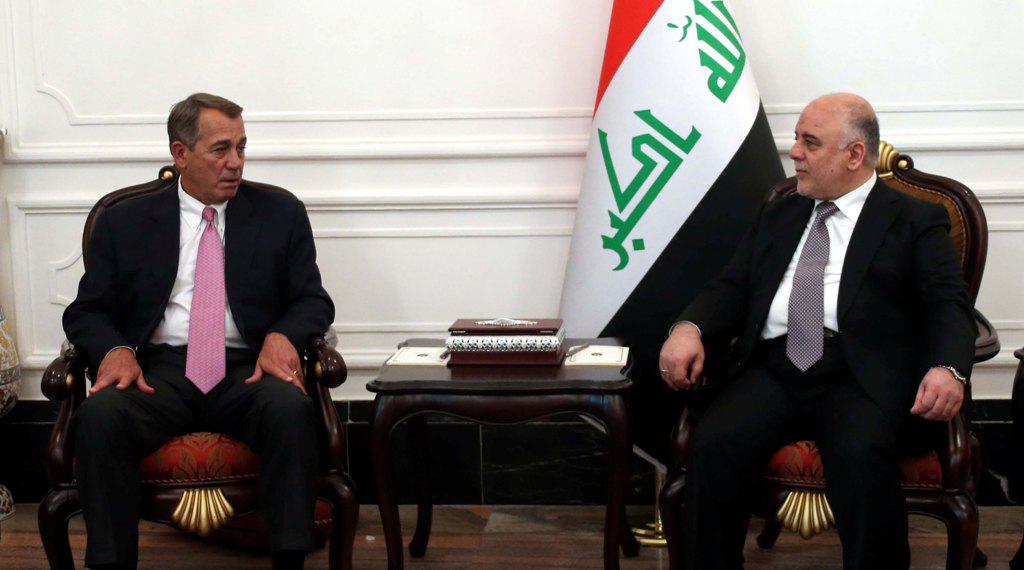
Hopefully, in these visits, the need for a political solution is being conveyed.
And the need for it to come quickly.
The Iraqis suffered under Nouri al-Maliki's empty words and promises.
Haider should be getting results.
If he doesn't, then US support needs to diminish.
Margaret Griffis (Antiwar.com) counts 252 violent deaths today.
They didn't live to see a political solution in Iraq.
Will anyone?
iraq
reuters
the washington post
loveday morris
bloomberg news
caroline alexander
iraqi spring mc
mcclatchy newspapers
mitchell prothero


