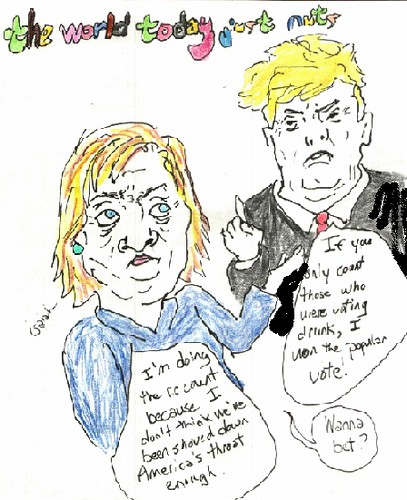
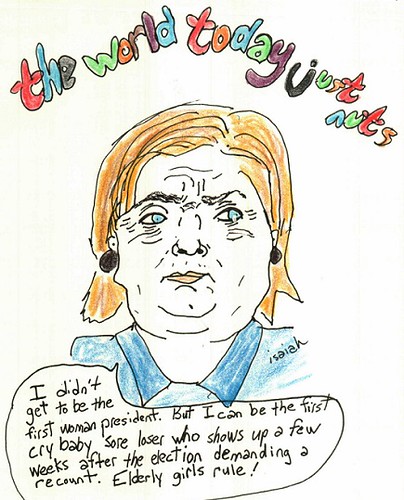
Isaiah's THE WORLD TODAY JUST NUTS "Recount" went up a few hours ago.
I found it and Michael Tracey's Tweets interesting:
- I look forward to hearing why it's somehow bad that Carrier will be keeping jobs in Indiana... because something something something Trump
- Carrier says it has reached a deal with Donald Trump that will keep nearly 1,000 factory jobs in Indiana. http://cnnmon.ie/2gGZfd5
 Michael Tracey
  CNN Breaking News
Sorry, that's really all I got.
I was on the phone with a cousin tonight.
Oh, I had that show on in the background.
The Real O'Neals.
Martha Plimpton's playing the same role she did in Raising Hope but her character's smarter and that just makes her even less likable.
I can offer that.
And that the actor playing her husband isn't just sexy, he's too sexy for Martha's character to have ever landed.
This is C.I.'s "Iraq snapshot:"
Tuesday, November 29, 2016. Chaos and violence continue, Human Rights Watch self-soils in public, AP lets Hayder al-Abadi get away with lying, and much more.
Human Rights Watch has self-disgraced yet again.
No, we're not referring to their war on Fidel Castro in the last days.
My opinion -- agree or disagree, I don't care: Cuba did not experience a revolution, it experienced a rebellion. You cannot have one person in charge for decades and call it a revolution. This apt description, grounded in political theory, led to a poli sci professor trying to bar me from his grad class because he worshiped Fidel.
I've called out abuses in Cuba for years and also noted the ways in which Fidel improved education and health for the people of Cuba. His record is a complex one and he will remain a fascinating character in history who will be the subject of many competing biographies.
I'm not a Fidel devotee and never have been.
So when I say Kenneth Roth's Twitter feed has been appalling on Fidel, I'm not saying that as someone who wants to defend Fidel or pretend that he didn't have serious human rights issues.
But if Kenneth wants to get into US healthcare -- as his idiotic Tweets suggest -- then he needs to acknowledge the good Fidel did with healthcare.
Instead, it's been one attack after another and people should be asking themselves, "Golly, I guess Cuba was one of the main focuses of Human Rights Watch, right?"
Wrong.
Maybe that's what has HRW's executive-director in such a tizzy?
Maybe he realizes HRW has blood on its hands with regards to the Cuban people?
If so, HRW has blood on the whole body
Human Rights Watch is soaked in blood.
Read this Tweet from HRW's Belkis Willie from earlier today.
Belkis is insane.
It doesn't matter what ISIS does, international law is clear that health facilities are not to be targets.
If that's too complex for the increasingly cartoon-like Human Rights Watch, let's go to the International Committee of the Red Cross for a speech that ICRC president Peter Maurer gave last may:
In a war, people are injured, malnourished and sick. Yet the greater the need for medical treatment, the more difficult it is to obtain such treatment, because the few places and people that can help, come under attack.
The ICRC found that within three years, 2,400 attacks against patients, health personnel, facilities and transports occurred in 11 conflict-affected countries. That's more than two attacks per day, every day, for three years. And it is only 11 countries we were looking at.
Last year, the World Health Organization announced that 60% of health-care facilities in Syria had been damaged or destroyed, while 25,000 people were wounded every month.
In Yemen, the ERC Stephen O'Brien said, that after a year of fighting, one quarter of the country's health services had been destroyed or shut down.
In Afghanistan, in 2015, the ICRC recorded a 50% increase in incidents against health staff and facilities, compared to the previous year. That means one incident every three days, without considering how many incidents go unreported.
Not always, but far too often, these incidents, attacks and destruction, constitute outright violations of international humanitarian law.
It is no coincidence that the very first Geneva Convention of 1864 pertained to the amelioration of the condition of the wounded and sick. To be precise, the wounded and sick in armed forces in the field.
As wars and armed conflicts have evolved from open battlefields to urban areas, and from pistols to mass shelling and bombardment by air forces, the wounded and sick are no longer just those in uniform.
The wounded and sick now include Ramish, who was nine years old when he stepped on a mine in Afghanistan. They include Mathilde, who was raped by fighters while she was harvesting her fields together with her husband in the Democratic Republic of the Congo. They included the wife of Khaled, in Syria, who died during childbirth because there was no midwife or doctor to tend to her. And they include all the nameless patients in the hospital I mentioned at the beginning.
These are just a few examples of the human beings, and their stories, that the staff and volunteers of the International Red Cross and Red Crescent Movement are confronted with in the field, every day, around the world.
They show the impact of war on people, but more importantly, they show that medical treatment and health care at large are crucial in times of war.
International humanitarian law therefore specifically protects medical personnel, facilities and transports, precisely because they are indispensable in times of war. Not doing so risks multiplying the impact on health systems, which in turn risk unravelling with an impact far beyond the region concerned, a burden on future generations.
Get it?
Because Human Rights Watch does not.
HRW begins distorting in the first two paragraphs of the alert that Belkis links to:
An airstrike targeting Islamic State, also known as ISIS, fighters hit a clinic south of Mosul on October 18, 2016, Human Rights Watch said today. The attack destroyed half the clinic, killed eight civilians, and wounded at least two more.
Two ISIS fighters and the ISIS transport minister were also killed, a witness told Human Rights Watch. A healthcare worker said ISIS fighters had forcibly taken over an office at the clinic and were holding meetings there regularly, putting civilians at risk of attack.
Who put civilians at risk?
The people who decided to bomb a clinic.
The Islamic State is a terrorist group.
They're not bound to any laws -- their actions are illegal.
The US-led coalition is bound by laws.
And their decision to bomb a clinic led to the deaths of 8 civilians.
That's the story that Human Rights Watch tries to ignore.
Since George Soros injected his blood money into HRW, it's become more and more of a joke but today it is even worse.
(Sidebar, I don't know if we'll go back to the backup sites. I can explain, at another time, publicly why we had to stop using them. But one great thing is knowing that if Soros and his flunkies want to monitor what we say, they have to come here each day -- as opposed to signing up for the alerts they did on the original back up site. George Soros made his money from people's misfortune. He's no different than any other robber baron.)
Repeating: The crime that took place was that western governments violated international law by bombing a health clinic.
If that's confusing to you, you shouldn't be at an organization that calls itself Human Rights Watch.
Maybe Ken can change the name to Western Government Protectors?
And let's stress, this is not my opinion, this is not some abstract desire that the multitudes want, this is international law.
It has been violated.
It could be prosecuted -- and in 20 years from now, it may be.
Human Rights Watch didn't make themselves useless this morning, they turned the organization into a joke.
Another joke is Iraq's prime minister Hayder al-Abadi. In a lengthy interview with the ASSOCIATED PRESS, Hayder insists, " If you look carefully at the Mosul operation, I have not received a single claim or complaint against the PMF."
November 20th, Human Rights Watch noted:
Iraqi government-backed Hashad al-Asha’ri militias detained and beat at least 22 men from two villages near Mosul. The militias also recruited at least 10 children in a camp for displaced people as fighters against the Islamic State, also known as ISIS.
And Hayder is aware of that.
It's why he went on his rage against the press and human rights organizations culminating in his
Dropping back to the November 21st snapshot:
ALSUMARIA reports that Iraq's prime minister Haider al-Abadi took to state media today in order to attack the media.
He's not talking about the WHO report that was falsely reported.
He's saying the media -- and human rights organizations -- are undermining his war effort by reporting on the various War Crimes taking place in the operation to liberate or 'liberate' Mosul.
It's a shame AP didn't bring that up in their interview with him.
But they don't appear to know much about Iraq these days.
Despite these War Crimes, the Parliament gave them legal coverage last week.
Though we've covered it repeatedly here, it's barely made a ripple in the US press.
That's not the case in the Arab world.
Mshari Al Thaydi (AL ARABIYA) notes today:
AL JAZEERA reports this morning:
Iraq is at risk of partition and the worst sectarian bloodletting since the 2003 US-led invasion, if Shia paramilitary units get involved in the fight against ISIL for Mosul, a senior Iraqi politician warned.
Iran-backed Popular Mobilisation forces, or Hashid al-Shaabi in Arabic, are supported by the Shia-led Baghdad government and want to play a bigger role in the offensive to regain ISIL's last major stronghold in Iraq.
But Khamis Khanjar, a Sunni politician and businessman who financed the 3,000 strong Turkish-trained force known as the Nineveh Guards Force, said it should lead the offensive, alongside the Iraqi army, and take control of the city after ISIL is driven out.
Mohammed Tawfeeq and Salma Abdelaziz (CNN) add:
The issue was raised at yesterday's US State Dept press briefing causing spokesperson John Kirby to dance around multiple issues.
QUESTION: Over the weekend, the Iraqi parliament passed a law making the Hashd al-Shaabi part of the official Iraqi Armed Forces. What’s your view on this? Are you concerned it will influence – it will increase Iranian influence in Baghdad?
MR KIRBY: Well, look, let me just talk about a couple of things in here. We think that the passage of this law, like all internal legislation, is an internal Iraqi matter. So I’m going to refer you to the Government of Iraq for details on that. That said, the United States continues to support a sovereign, inclusive, unified, and democratic Iraq that serves the aspirations of all Iraqis, and we continue to support Prime Minister Abadi as he controls, commands, and organizes the campaign to go after [the Islamic State] inside the country.
QUESTION: Well, there’s concern that’s been expressed by both Kurdish and Sunni Arab politicians that the Hashd al-Shaabi will be used as a military force outside of Iraq. Do you have any concerns about that?
MR KIRBY: Well, I think, as I said, we’ve been clear that we want all forces fighting [the Islamic State] in Iraq, all indigenous forces to be under the command and control of the Iraqi Government and Prime Minister Abadi, and we support his efforts to do that. This proposed legislation is certainly in keeping with what Prime Minister Abadi has said is important to him, which is having command and control over all the forces that are fighting [the Islamic State] inside the country. So I think – again, I’m not going to speculate about hypothetical outcomes here except to say that we continue to support a sovereign Iraq that has the resources, the organizational capabilities, and the support of the international community to do so in a sovereign way.
Now, I didn’t answer your question about Iran. And what I would tell you, though, is that we agree with Prime Minister Abadi’s statements on the importance of ensuring that all participants in the fight against [the Islamic State] in Iraq are regulated under the control of the Iraqi Government and held to the same accountability standards. We’re concerned, for our part, with helping Iraq rid the country of [the Islamic State], and who, as you know, just last week murdered scores of innocent civilians at a rest stop.
So the only other thing I’d say is – and we’ve said this before – that to the degree anybody is going to assist in the efforts to go after [the Islamic State] inside Iraq – now I’m talking about outside Iraqis – we want that to be done in a way that doesn’t further inflame sectarian tensions. Okay?
QUESTION: Are you – would you be satisfied that bringing al-Hashd al-Shaabi under the Government of Iraq and under the authority of the Government of Iraq is a safety valve or enough safety valve against interference and the influence of Iran?
MR KIRBY: I don’t know if I could possibly answer that question, Said.
QUESTION: Right, but I mean, from past efforts – I mean, if we look at Tikrit where they – basically, they have played a big role in liberating Tikrit and they had – they were a part, let’s say, to some excesses or even – maybe even massacres, some say, against the Sunni population, so they were not exactly, at the time – at the time of the liberation of Tikrit, a quite – quite disciplined.
MR KIRBY: So, look, a couple of points on that. I mean, we obviously take any allegations or reports of human rights violations very, very seriously, as does Prime Minister Abadi. And he has said – and he has started investigations on various such reports. And we think that’s important to let those investigations go through. And it doesn’t matter to us who is reported to have done it. It – those kinds of reports need to be taken seriously and need to be investigated. And if found that individuals or units are guilty of that, then they need to be held accountable for it. But again, I don’t want to get too far down the road on this legislation. It’s internal Iraqi legislation that they should speak to. But in general, we continue to support all forces in the – of the Iraqi Government that are arrayed against Daesh to be under Iraqi command and control. Okay?
QUESTION: Do you not have concerns that including groups accused of human rights abuses under the control of the Iraqi Government would alienate the Sunni population and sort of leads of the same --
MR KIRBY: No, of course we do. Like I said, we don’t want anything – we don’t want anybody participating in this fight in a manner that would inflame sectarian tensions any more than they already are a problem. So yes, of course we have concerns about that.
QUESTION: If – and if this law were to be finalized and passed, would – or when it goes into effect, if it goes into effect, does this then affect the kind of assistance that the U.S. can give the Iraqi military?
MR KIRBY: Well, I don’t want to speculate here about an outcome we don’t know is going to be the case. But we have very strict regulations, very strict laws that we have to obey when it comes to aid and assistance to foreign units – the Leahy law, which I think you’re familiar with – and we follow that law scrupulously. And U.S. aid and assistance cannot and will not go to units that have been proven to have participated in human rights violations. We take that very, very seriously. So if you’re asking me could that be the case – could units in the future, if they’re found to be guilty of human rights violations – Iraqi units, could they be – could be held – aid and assistance suspended due to the Leahy law – the answer is yes, of course. But I’m in no position right now to speculate that this law would lead to that outcome, okay?
John Kirby knows damn well that the Leahy law has been ignored repeatedly by the White House.
It's day 43 of the Mosul slog and no end in sight.
But the government slog continues as well.
In 2014, Hayder was installed as prime minister of Iraq by the US White House. At the time US President Barack Obama was noting the need for a political solution.
There has been no solution.
There has been no reconciliation.
In his interview with AP, Hayder pushed the issue off on others (and AP let him):
Hayder lives in a fantasy world.
The protests will be returning in Iraq shortly.
The following community sites updated:


Iraq
Human Rights Watch has self-disgraced yet again.
No, we're not referring to their war on Fidel Castro in the last days.
My opinion -- agree or disagree, I don't care: Cuba did not experience a revolution, it experienced a rebellion. You cannot have one person in charge for decades and call it a revolution. This apt description, grounded in political theory, led to a poli sci professor trying to bar me from his grad class because he worshiped Fidel.
I've called out abuses in Cuba for years and also noted the ways in which Fidel improved education and health for the people of Cuba. His record is a complex one and he will remain a fascinating character in history who will be the subject of many competing biographies.
I'm not a Fidel devotee and never have been.
So when I say Kenneth Roth's Twitter feed has been appalling on Fidel, I'm not saying that as someone who wants to defend Fidel or pretend that he didn't have serious human rights issues.
But if Kenneth wants to get into US healthcare -- as his idiotic Tweets suggest -- then he needs to acknowledge the good Fidel did with healthcare.
Instead, it's been one attack after another and people should be asking themselves, "Golly, I guess Cuba was one of the main focuses of Human Rights Watch, right?"
Wrong.
Maybe that's what has HRW's executive-director in such a tizzy?
Maybe he realizes HRW has blood on its hands with regards to the Cuban people?
If so, HRW has blood on the whole body
Human Rights Watch is soaked in blood.
Read this Tweet from HRW's Belkis Willie from earlier today.
 Belkis Wille
#ISIS is setting up offices in hospitals under its control #Iraq, putting patients at risk of attack #NotATarget
Belkis is insane.
It doesn't matter what ISIS does, international law is clear that health facilities are not to be targets.
If that's too complex for the increasingly cartoon-like Human Rights Watch, let's go to the International Committee of the Red Cross for a speech that ICRC president Peter Maurer gave last may:
In a war, people are injured, malnourished and sick. Yet the greater the need for medical treatment, the more difficult it is to obtain such treatment, because the few places and people that can help, come under attack.
The ICRC found that within three years, 2,400 attacks against patients, health personnel, facilities and transports occurred in 11 conflict-affected countries. That's more than two attacks per day, every day, for three years. And it is only 11 countries we were looking at.
Last year, the World Health Organization announced that 60% of health-care facilities in Syria had been damaged or destroyed, while 25,000 people were wounded every month.
In Yemen, the ERC Stephen O'Brien said, that after a year of fighting, one quarter of the country's health services had been destroyed or shut down.
In Afghanistan, in 2015, the ICRC recorded a 50% increase in incidents against health staff and facilities, compared to the previous year. That means one incident every three days, without considering how many incidents go unreported.
Not always, but far too often, these incidents, attacks and destruction, constitute outright violations of international humanitarian law.
It is no coincidence that the very first Geneva Convention of 1864 pertained to the amelioration of the condition of the wounded and sick. To be precise, the wounded and sick in armed forces in the field.
As wars and armed conflicts have evolved from open battlefields to urban areas, and from pistols to mass shelling and bombardment by air forces, the wounded and sick are no longer just those in uniform.
The wounded and sick now include Ramish, who was nine years old when he stepped on a mine in Afghanistan. They include Mathilde, who was raped by fighters while she was harvesting her fields together with her husband in the Democratic Republic of the Congo. They included the wife of Khaled, in Syria, who died during childbirth because there was no midwife or doctor to tend to her. And they include all the nameless patients in the hospital I mentioned at the beginning.
These are just a few examples of the human beings, and their stories, that the staff and volunteers of the International Red Cross and Red Crescent Movement are confronted with in the field, every day, around the world.
They show the impact of war on people, but more importantly, they show that medical treatment and health care at large are crucial in times of war.
International humanitarian law therefore specifically protects medical personnel, facilities and transports, precisely because they are indispensable in times of war. Not doing so risks multiplying the impact on health systems, which in turn risk unravelling with an impact far beyond the region concerned, a burden on future generations.
Get it?
Because Human Rights Watch does not.
HRW begins distorting in the first two paragraphs of the alert that Belkis links to:
An airstrike targeting Islamic State, also known as ISIS, fighters hit a clinic south of Mosul on October 18, 2016, Human Rights Watch said today. The attack destroyed half the clinic, killed eight civilians, and wounded at least two more.
Two ISIS fighters and the ISIS transport minister were also killed, a witness told Human Rights Watch. A healthcare worker said ISIS fighters had forcibly taken over an office at the clinic and were holding meetings there regularly, putting civilians at risk of attack.
Who put civilians at risk?
The people who decided to bomb a clinic.
The Islamic State is a terrorist group.
They're not bound to any laws -- their actions are illegal.
The US-led coalition is bound by laws.
And their decision to bomb a clinic led to the deaths of 8 civilians.
That's the story that Human Rights Watch tries to ignore.
Since George Soros injected his blood money into HRW, it's become more and more of a joke but today it is even worse.
(Sidebar, I don't know if we'll go back to the backup sites. I can explain, at another time, publicly why we had to stop using them. But one great thing is knowing that if Soros and his flunkies want to monitor what we say, they have to come here each day -- as opposed to signing up for the alerts they did on the original back up site. George Soros made his money from people's misfortune. He's no different than any other robber baron.)
Repeating: The crime that took place was that western governments violated international law by bombing a health clinic.
If that's confusing to you, you shouldn't be at an organization that calls itself Human Rights Watch.
Maybe Ken can change the name to Western Government Protectors?
And let's stress, this is not my opinion, this is not some abstract desire that the multitudes want, this is international law.
It has been violated.
It could be prosecuted -- and in 20 years from now, it may be.
Human Rights Watch didn't make themselves useless this morning, they turned the organization into a joke.
Another joke is Iraq's prime minister Hayder al-Abadi. In a lengthy interview with the ASSOCIATED PRESS, Hayder insists, " If you look carefully at the Mosul operation, I have not received a single claim or complaint against the PMF."
November 20th, Human Rights Watch noted:
Iraqi government-backed Hashad al-Asha’ri militias detained and beat at least 22 men from two villages near Mosul. The militias also recruited at least 10 children in a camp for displaced people as fighters against the Islamic State, also known as ISIS.
And Hayder is aware of that.
It's why he went on his rage against the press and human rights organizations culminating in his
Dropping back to the November 21st snapshot:
ALSUMARIA reports that Iraq's prime minister Haider al-Abadi took to state media today in order to attack the media.
He's not talking about the WHO report that was falsely reported.
He's saying the media -- and human rights organizations -- are undermining his war effort by reporting on the various War Crimes taking place in the operation to liberate or 'liberate' Mosul.
It's a shame AP didn't bring that up in their interview with him.
But they don't appear to know much about Iraq these days.
Despite these War Crimes, the Parliament gave them legal coverage last week.
Though we've covered it repeatedly here, it's barely made a ripple in the US press.
That's not the case in the Arab world.
Mshari Al Thaydi (AL ARABIYA) notes today:
AL JAZEERA reports this morning:
Iraq is at risk of partition and the worst sectarian bloodletting since the 2003 US-led invasion, if Shia paramilitary units get involved in the fight against ISIL for Mosul, a senior Iraqi politician warned.
Iran-backed Popular Mobilisation forces, or Hashid al-Shaabi in Arabic, are supported by the Shia-led Baghdad government and want to play a bigger role in the offensive to regain ISIL's last major stronghold in Iraq.
But Khamis Khanjar, a Sunni politician and businessman who financed the 3,000 strong Turkish-trained force known as the Nineveh Guards Force, said it should lead the offensive, alongside the Iraqi army, and take control of the city after ISIL is driven out.
Mohammed Tawfeeq and Salma Abdelaziz (CNN) add:
Critics argue this effectively legitimizes a militia, which does not maintain the same standards of training or battlefield conduct as the national military. Of the 328-seat Parliament, 208 voted in favor of the law. A majority of the Sunni members boycotted and left the chamber.
"I believe this committee has been politically motivated and it will have similar impact as Iran's Revolutionary Guards, and aims to weaken the Iraqi army," Raad al Dahlaki, a Sunni member of Parliament, said Monday.
The issue was raised at yesterday's US State Dept press briefing causing spokesperson John Kirby to dance around multiple issues.
QUESTION: Over the weekend, the Iraqi parliament passed a law making the Hashd al-Shaabi part of the official Iraqi Armed Forces. What’s your view on this? Are you concerned it will influence – it will increase Iranian influence in Baghdad?
MR KIRBY: Well, look, let me just talk about a couple of things in here. We think that the passage of this law, like all internal legislation, is an internal Iraqi matter. So I’m going to refer you to the Government of Iraq for details on that. That said, the United States continues to support a sovereign, inclusive, unified, and democratic Iraq that serves the aspirations of all Iraqis, and we continue to support Prime Minister Abadi as he controls, commands, and organizes the campaign to go after [the Islamic State] inside the country.
QUESTION: Well, there’s concern that’s been expressed by both Kurdish and Sunni Arab politicians that the Hashd al-Shaabi will be used as a military force outside of Iraq. Do you have any concerns about that?
MR KIRBY: Well, I think, as I said, we’ve been clear that we want all forces fighting [the Islamic State] in Iraq, all indigenous forces to be under the command and control of the Iraqi Government and Prime Minister Abadi, and we support his efforts to do that. This proposed legislation is certainly in keeping with what Prime Minister Abadi has said is important to him, which is having command and control over all the forces that are fighting [the Islamic State] inside the country. So I think – again, I’m not going to speculate about hypothetical outcomes here except to say that we continue to support a sovereign Iraq that has the resources, the organizational capabilities, and the support of the international community to do so in a sovereign way.
Now, I didn’t answer your question about Iran. And what I would tell you, though, is that we agree with Prime Minister Abadi’s statements on the importance of ensuring that all participants in the fight against [the Islamic State] in Iraq are regulated under the control of the Iraqi Government and held to the same accountability standards. We’re concerned, for our part, with helping Iraq rid the country of [the Islamic State], and who, as you know, just last week murdered scores of innocent civilians at a rest stop.
So the only other thing I’d say is – and we’ve said this before – that to the degree anybody is going to assist in the efforts to go after [the Islamic State] inside Iraq – now I’m talking about outside Iraqis – we want that to be done in a way that doesn’t further inflame sectarian tensions. Okay?
QUESTION: Are you – would you be satisfied that bringing al-Hashd al-Shaabi under the Government of Iraq and under the authority of the Government of Iraq is a safety valve or enough safety valve against interference and the influence of Iran?
MR KIRBY: I don’t know if I could possibly answer that question, Said.
QUESTION: Right, but I mean, from past efforts – I mean, if we look at Tikrit where they – basically, they have played a big role in liberating Tikrit and they had – they were a part, let’s say, to some excesses or even – maybe even massacres, some say, against the Sunni population, so they were not exactly, at the time – at the time of the liberation of Tikrit, a quite – quite disciplined.
MR KIRBY: So, look, a couple of points on that. I mean, we obviously take any allegations or reports of human rights violations very, very seriously, as does Prime Minister Abadi. And he has said – and he has started investigations on various such reports. And we think that’s important to let those investigations go through. And it doesn’t matter to us who is reported to have done it. It – those kinds of reports need to be taken seriously and need to be investigated. And if found that individuals or units are guilty of that, then they need to be held accountable for it. But again, I don’t want to get too far down the road on this legislation. It’s internal Iraqi legislation that they should speak to. But in general, we continue to support all forces in the – of the Iraqi Government that are arrayed against Daesh to be under Iraqi command and control. Okay?
QUESTION: Do you not have concerns that including groups accused of human rights abuses under the control of the Iraqi Government would alienate the Sunni population and sort of leads of the same --
MR KIRBY: No, of course we do. Like I said, we don’t want anything – we don’t want anybody participating in this fight in a manner that would inflame sectarian tensions any more than they already are a problem. So yes, of course we have concerns about that.
QUESTION: If – and if this law were to be finalized and passed, would – or when it goes into effect, if it goes into effect, does this then affect the kind of assistance that the U.S. can give the Iraqi military?
MR KIRBY: Well, I don’t want to speculate here about an outcome we don’t know is going to be the case. But we have very strict regulations, very strict laws that we have to obey when it comes to aid and assistance to foreign units – the Leahy law, which I think you’re familiar with – and we follow that law scrupulously. And U.S. aid and assistance cannot and will not go to units that have been proven to have participated in human rights violations. We take that very, very seriously. So if you’re asking me could that be the case – could units in the future, if they’re found to be guilty of human rights violations – Iraqi units, could they be – could be held – aid and assistance suspended due to the Leahy law – the answer is yes, of course. But I’m in no position right now to speculate that this law would lead to that outcome, okay?
John Kirby knows damn well that the Leahy law has been ignored repeatedly by the White House.
It's day 43 of the Mosul slog and no end in sight.
But the government slog continues as well.
In 2014, Hayder was installed as prime minister of Iraq by the US White House. At the time US President Barack Obama was noting the need for a political solution.
There has been no solution.
There has been no reconciliation.
In his interview with AP, Hayder pushed the issue off on others (and AP let him):
Q -You came to office over two years ago promising to unite Iraq. You have won a string of military victories, but have passed very little legislation to make Iraq a more inclusive country. Do you feel like you have lived up to the promises you made when you first became Prime Minister?
A - Well, legislations, we have sent legislation to parliament but parliament staled some of them. It is not a matter of legislation, it's a matter of practice. What you do on the ground. The main message to the Iraqi population, is this government working for the whole of Iraq, is it working toward providing services and security to the whole population regardless of their sect, their religion, their ethnic origin? This is the main question. I think in this sense, we are successful. We are much more successful than before. It is a huge departure from before, where now many Sunnis in these areas are welcoming the Iraqi government. They want to be with the Iraqi government, they want to support Iraqi security forces. They now consider the Iraqi army as a national hero. They want the Iraqi army to be in their areas. They want the Iraqi federal forces to be in their areas.
Hayder lives in a fantasy world.
The protests will be returning in Iraq shortly.
The following community sites updated:
WHY HIM?
7 hours ago
About those recounts . . .
7 hours ago
All so sad and disgusting
7 hours ago

Fake News, Hillary, Tulsi Gabbard
12 hours ago
Iraq


 #IRAQ شمرية العراق